



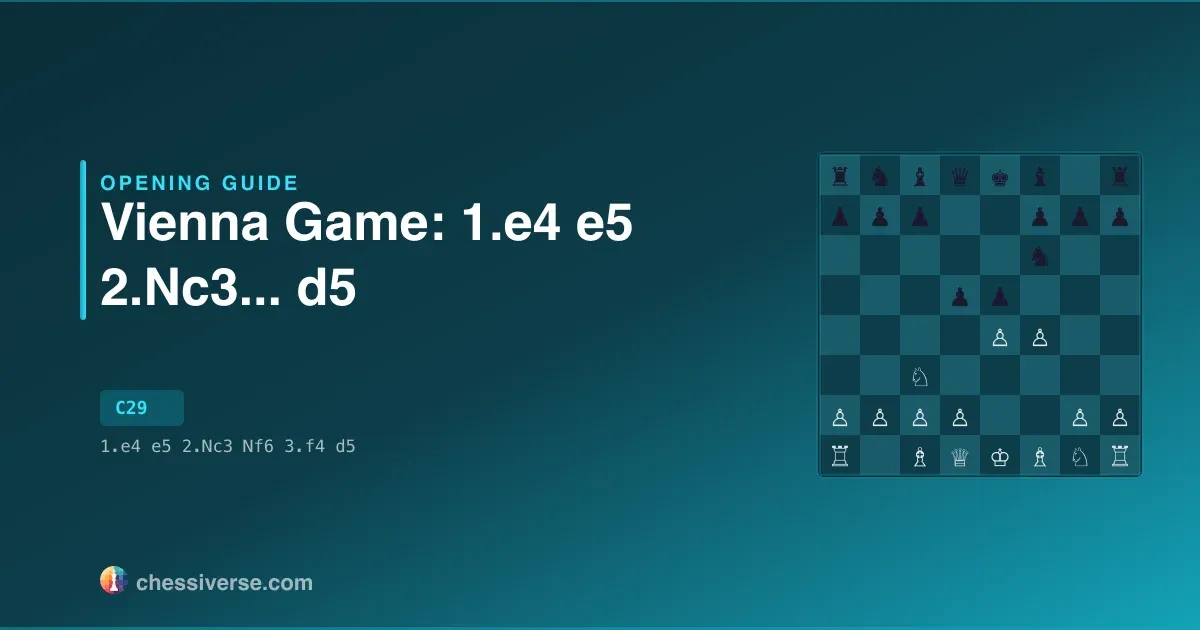
Starting from 1.e4 e5 2.Nc3 Nf6 3.f4 d5, players enter the Vienna Game: Vienna Gambit, Main Line — ECO C29. Black answers an attack with an attack, throwing the d-pawn into the centre and forcing White to choose between capturing on e5, on d5, or just losing the e-pawn.
Strategic Overview
3...d5 is the modern and correct way to handle the Vienna Gambit. Once White commits to f4, the centre becomes a war zone, and Black's best response is to add a second target rather than defend the first. White really has only one good move: 4.fxe5. The alternatives all collapse. Defending the e-pawn with 4.d3 fails because the resulting tactics on d1 and the loose f-pawn add up faster than White can develop; Black often gets a strong initiative with ...Qxd1+ ideas or central pawn breaks that flush out the f-pawn. Taking with 4.exd5 leaves White with a doubled d-pawn under fire on a half-open file, and Black does not even need to recapture immediately because plans like 4...e4 or 4...exf4 exploit the structural mess. After the principled 4.fxe5, the position becomes a typical Vienna structure with an e-pawn for Black to attack and central tension to resolve. The game tends to be tactical for the first ten moves and gradually settles into structural play once the pawn skeleton is fixed. This is one of the cleanest, most reliable replies for Black against a Vienna player who insists on f4. It punishes anything other than the precise main move and gives Black a comfortable, theoretically respected position.
Key Ideas
A few ideas come up again and again in this opening:
- Counter-strike beats passive defence — Pushing ...d5 attacks back instead of defending e5. With two central pawns in motion, White cannot keep both intact, and Black gets active pieces in return.
- 4.fxe5 is the only good move — The principled capture keeps the structural balance close to even and leads to standard Vienna middlegames. Anything else hands Black either an initiative or a structural target.
- 4.d3 collapses to tactics — Trying to hold the centre with the d-pawn fails because the f-pawn is no longer protected by the e5 trap. Black has multiple ways to break the position open favourably.
- 4.exd5 trashes the structure — Capturing on d5 leaves White with a weak doubled pawn on a half-open file. Black should not rush to recapture and instead exploit the structural damage with central breaks.
History and Notable Players
It arises from the Vienna Game: Falkbeer Variation. Among the most prolific White practitioners are Rudolf Spielmann (31 games), Jonny Hector (21 games), Amir Mallahi (20 games). Black-side regulars include Joseph Henry Blackburne (9 games), David W L Howell (8 games), Amos Burn (7 games).
Performance Across Rating Levels
How well the Vienna Game: Vienna Gambit, Main Line works depends on what level you're playing at. Among 1200-rated players, it appears in 0.02% of games — 102,252 of them on record — with White winning 47.8% and Black 49.2%. At 1800 the opening surfaces in 0.04% of games; White wins 48.2%, Black 47.4%, draws 4.4%. Among 2500-rated players the line appears in 0.09% of games and draws spike to 9.6%, indicating tight preparation. Positions also become less sharp as level rises (sharpness 0.97 → 0.90).
Time Control Patterns
Look at the same opening across time controls and blitz stands out. In bullet, it appears in 0.02% of games (644,628); White wins 50.5%. Blitz shows 0.03% adoption across 1,113,860 games, White scoring 48.7%. In rapid, the share rises to 0.03% — 307,237 games, White 46.3%. White's score swings 4.2pp across formats, so time control isn't just a stylistic choice here — it shifts the actual results.
Move Diversity and Theory Depth
Move choice is far from uniform in the Vienna Game: Vienna Gambit, Main Line. At 1200 Elo (102,252 games), the top reply is fxe5, played 77.9% of the time. One other move takes at least 5% of games, and the top three moves account for 92.2% of games. Entropy: 1.28. By 2500 (12,578 games), fxe5 dominates at 88.6% of replies; one other move reaches 5% and the top three moves account for 97.2% of games. Entropy drops to 0.73. That entropy collapse is the signature of a line where preparation pays off: at the top, players know the best move and play it.
Historical Trends
Long-term, the trajectory of this opening is informative. Adoption peaked in 2025 at 0.04% (285,340 games). 2025 marks the high — the opening is rising, currently at 0.04%.
Common Mistakes
- Drifting away from main theory — At 400 Elo, the three most-played moves cover 85.6% of games, against 97.5% at 2000. The most popular deviation is d3 (played 5.7% of the time at 400, much less so up top). It looks fine but quietly hands the better-prepared side an edge.
- Neglecting development — It can feel productive to make extra pawn moves early, but falling behind in piece development is what loses most amateur games — especially in open positions where active pieces find squares fast.
- Playing without a plan — Each Vienna Game: Vienna Gambit, Main Line middlegame demands a specific approach. Decide whether the position calls for attack, manoeuvre, or simplification before reaching for a move.
Practice on Chessiverse
Ready to try the Vienna Game: Vienna Gambit, Main Line against a bot? Pick an opponent at your level and play a game.