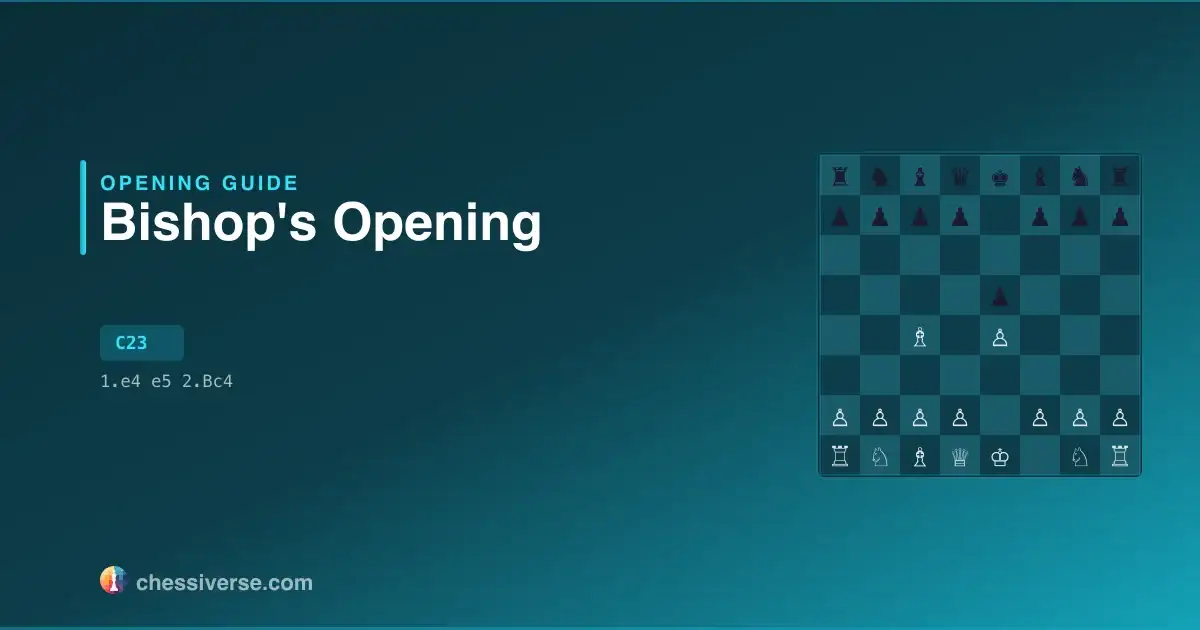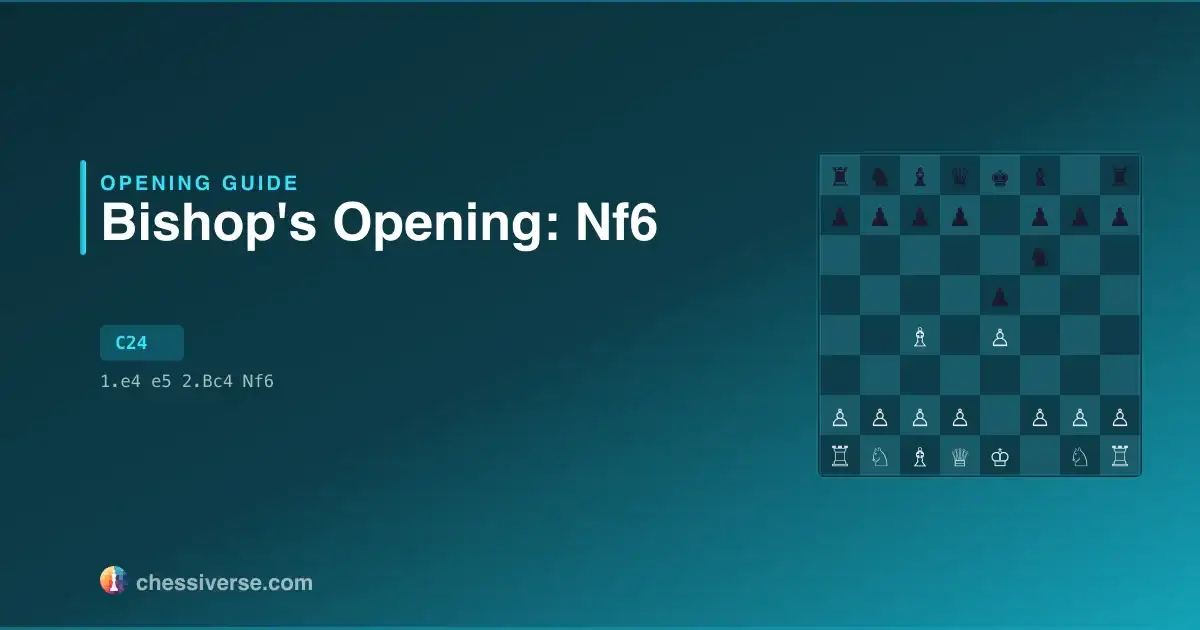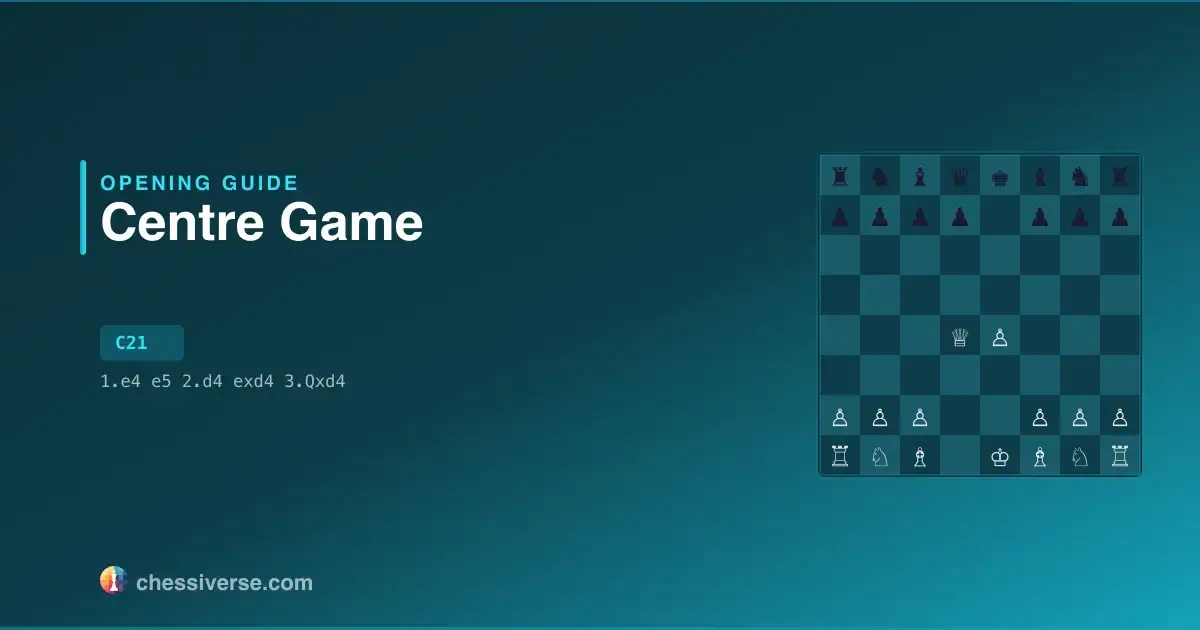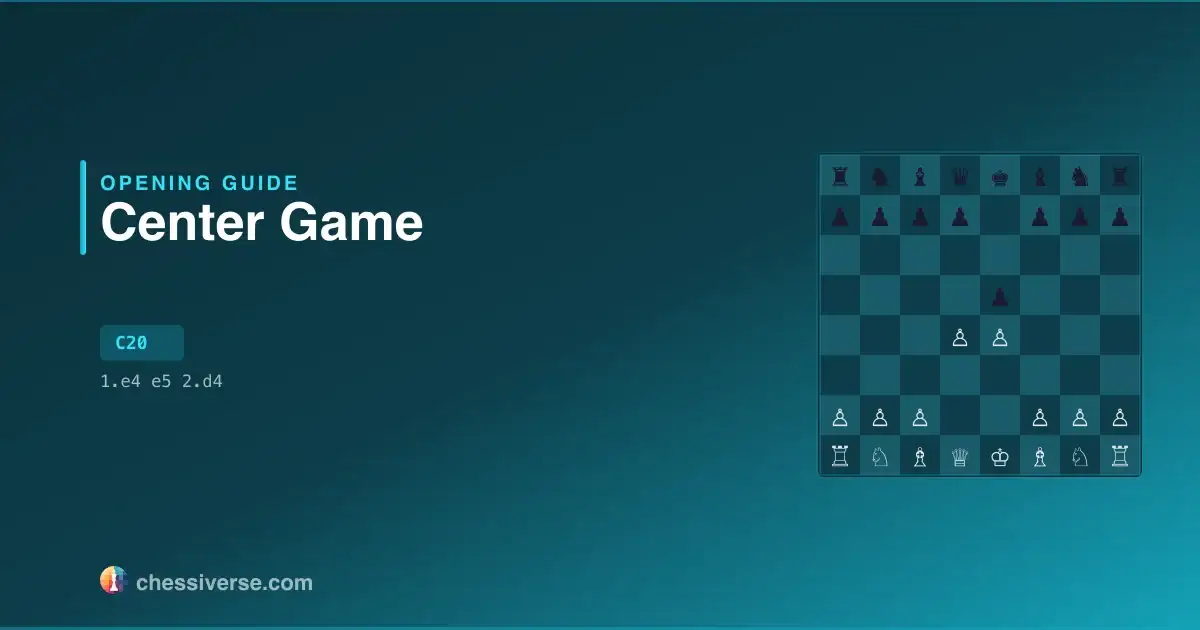




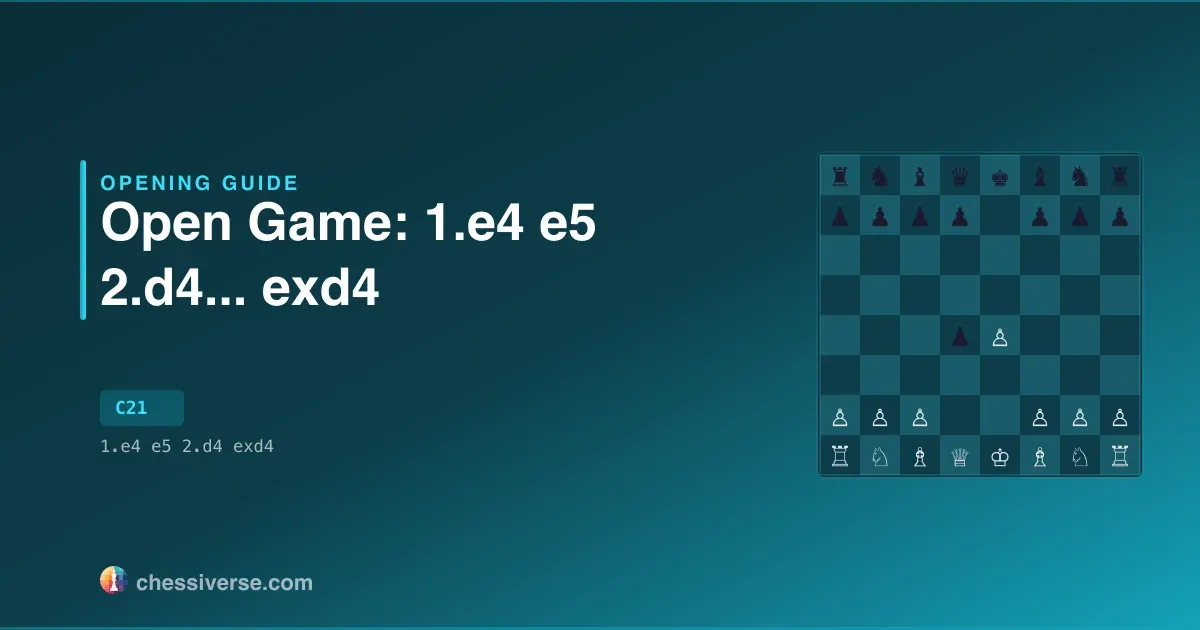
The Center Game Accepted arises after 1.e4 e5 2.d4 exd4 and falls under ECO code C21. By capturing on d4, Black steers toward Centre Game territory. After 3. Nf3, the Kieseritzky Variation, the position is rich in transposition possibilities: 3...Nc6 or 3...Bb4+ can reach the Scotch, 3...d6 leads to the Philidor, 3...Nf6 enters Petrov's Steinitz Variation, and 3...Bc5 followed by 4. Bc4 Nf6 transposes into the Lewis Gambit of the Bishop's Opening. One self-contained line is 3...Bc5 4. Nxd4 Nf6. With 51.7 million Lichess games across all rating levels, it is a specialized opening choice.
History and Notable Players
It arises from the Open Games (1...e5). Among the most prolific practitioners on the White side are Jacques Mieses (57 games), Frank James Marshall (31 games), Miguel Munoz Pantoja (23 games). On the Black side, notable exponents include Siegbert Tarrasch (9 games), Mikhail Chigorin (7 games), Joseph Henry Blackburne (7 games).
Statistics
Based on 51.7 million Lichess games across all rating levels:
- White wins: 50.3%
- Black wins: 45.9%
- Draws: 3.8%
The statistics show a roughly balanced opening where both sides have equal chances.
Main Lines and Variations
After 1.e4 e5 2.d4 exd4, the main continuations include:
Each of these lines leads to distinct types of positions and requires its own understanding of the resulting pawn structures and piece placements.
Practice on Chessiverse
The best way to learn the Center Game Accepted is through practice. On Chessiverse, you can play chess against computer opponents that specialize in this opening. Our AI bots range from beginner to grandmaster level, each with unique playing styles — from aggressive attackers to solid defenders. Choose a bot that matches your rating and work your way up as you master the opening's key ideas.
Performance Across Rating Levels
How well the Center Game Accepted works depends on what level you're playing at. At 1200 Elo, the opening shows up in 1.39% of games (9,344,667 samples). White scores 48.1%, Black 48.3%, draws 3.6%. Move up to 1800 Elo and the share shifts to 0.95%, with White winning 53.6% versus Black's 42.6%. At 2500, 0.21% of games go into this opening; draws sit at 9% — the line is well-mapped at this level.
Time Control Patterns
Time control matters here: rapid players reach for this opening more than others. In bullet, it appears in 0.66% of games (17,575,521); White wins 52.7%. Blitz shows 1.07% adoption across 38,554,548 games, White scoring 50.9%. In rapid, the share rises to 1.19% — 13,118,423 games, White 48.5%. White's score swings 4.2pp across formats, so time control isn't just a stylistic choice here — it shifts the actual results.
Move Diversity and Theory Depth
Looking at move selection shows how forcing — or not — the position really is. At 1200 Elo (9,344,667 games), the top reply is Qxd4, played 60% of the time. Two other moves each take at least 5% of games, and the top three moves account for 95.1% of games. Entropy: 1.60. By 2500 (28,941 games), Qxd4 is still the top reply, at 41.7%; two other moves reach 5% and the top three moves account for 96% of games. Entropy rises to 1.75. Even elite players don't fully agree on the best continuation here, which keeps the position dynamic.
Historical Trends
Year-over-year data tells you whether this opening is a contemporary fixture or a fading one. Adoption peaked in 2013 at 1.35% (38,883 games). By 2025 it sits at 1.13%, down 17% from that high, leaving the line in decline.