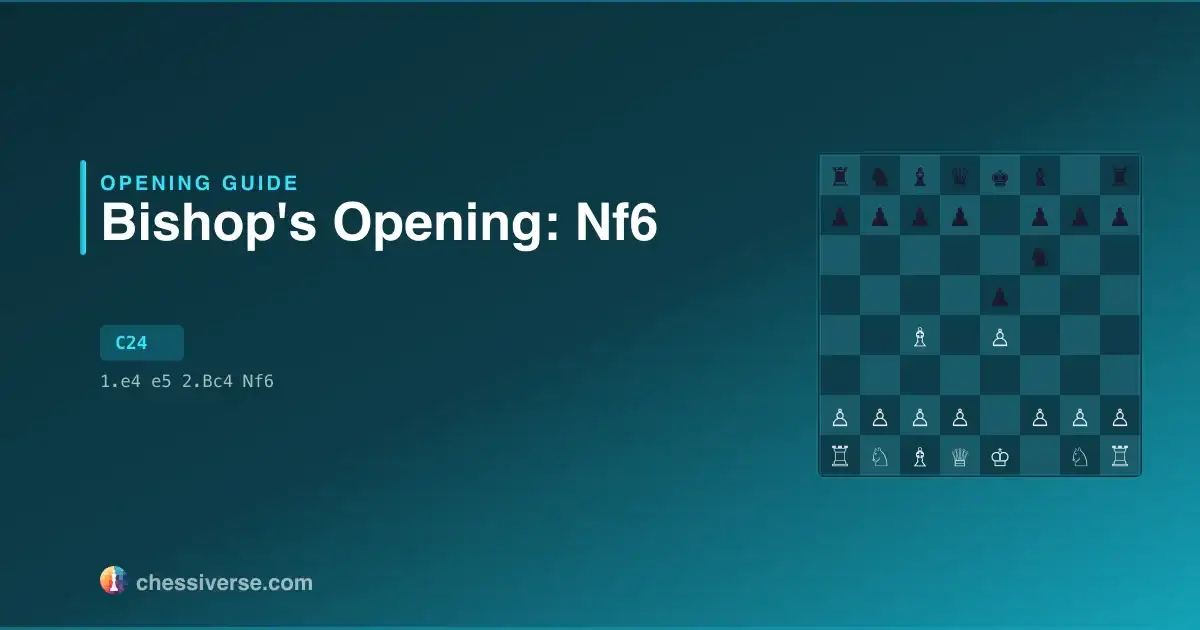





The King's Knight Opening arises after 1.e4 e5 2.Nf3 and falls under ECO code C40. This is the single most common opening move sequence in chess. White places a piece on an active square, strengthens control of the center and d4 in particular, and puts immediate pressure on Black's e5-pawn. Black must decide whether to defend the pawn or launch a counter-attack. The overwhelming favorite is 2...Nc6, which develops a piece while simultaneously protecting e5 and contesting d4, making it roughly five times more popular than all alternatives combined. From here, the game branches into many of chess's most celebrated openings: 3. Bb5 enters the Spanish (Ruy Lopez), 3. Bc4 the Italian, and 3. d4 the Scotch. With 816 million Lichess games across all rating levels, it is one of the most popular openings.
- 2.Nf3 attacks the undefended e5 pawn, and Black most often defends it with 2...Nc6
- The knight move prepares quick kingside castling and supports a later d4 push in the centre
- It is the gateway to famous openings: 3.Bb5 gives the Ruy Lopez, 3.Bc4 the Italian Game and 3.d4 the Scotch Game
History and Notable Players
It arises from the Open Games (1...e5). Among the most prolific practitioners on the White side are Viswanathan Anand (617 games), Sergey Karjakin (428 games), Alexei Shirov (416 games). On the Black side, notable exponents include Ivan Sokolov (487 games), Levon Aronian (483 games), Oleg M Romanishin (456 games).
Named after: Named for the move that defines it: White develops the king's knight to f3 on the second move of an Open Game.
2.Nf3 is White's most popular second move after 1.e4 e5, and from it the Ruy Lopez remains the most frequent continuation at the top level.
Statistics
Based on 816 million Lichess games across all rating levels:
- White wins: 51.1%
- Black wins: 44.6%
- Draws: 4.3%
White holds a moderate edge statistically, though Black has good practical chances.
Main Lines and Variations
After 1.e4 e5 2.Nf3, the main continuations include:
Each of these lines leads to distinct types of positions and requires its own understanding of the resulting pawn structures and piece placements.
Practice on Chessiverse
The best way to learn the King's Knight Opening is through practice. On Chessiverse, you can play chess against computer opponents that specialize in this opening. Our AI bots range from beginner to grandmaster level, each with unique playing styles — from aggressive attackers to solid defenders. Choose a bot that matches your rating and work your way up as you master the opening's key ideas.
Performance Across Rating Levels
The picture changes a lot as you climb the rating ladder. At 1200 Elo, the opening shows up in 23.36% of games (157,600,220 samples). White scores 51.4%, Black 44.7%, draws 3.9%. Move up to 1800 Elo and the share shifts to 12.47%, with White winning 50.8% versus Black's 44.6%. At the top end (2500+ Elo), popularity is 7.18% with 10.6% draws — a clear sign of how much theory rules the line at master level. White's edge erodes by 4.7pp from 1200 to 2500 Elo, suggesting Black's counterplay is easier to find with experience.
Time Control Patterns
Time control matters here: rapid players reach for this opening more than others. In bullet, it appears in 9.13% of games (242,824,295); White wins 50.8%. Blitz shows 15.74% adoption across 565,951,009 games, White scoring 50.9%. In rapid, the share rises to 22.60% — 250,098,442 games, White 51.5%.
Move Diversity and Theory Depth
What players actually play after the opening moves depends heavily on rating. At 1200 Elo (157,600,220 games), the top reply is Nc6, played 63% of the time. Two other moves each take at least 5% of games, and the top three moves account for 89% of games. Entropy: 1.82. By 2500 (979,625 games), Nc6 dominates at 81.5% of replies; only one other move still reaches 5% and the top three moves account for 97.2% of games. Entropy drops to 0.97. That entropy collapse is the signature of a line where preparation pays off: at the top, players know the best move and play it.
Historical Trends
Long-term, the trajectory of this opening is informative. Adoption peaked in 2021 at 17.95% (137,054,073 games). By 2025 it sits at 16.72%, 7% below the peak and roughly back to its 2013 level, leaving the line flat over the full period.