



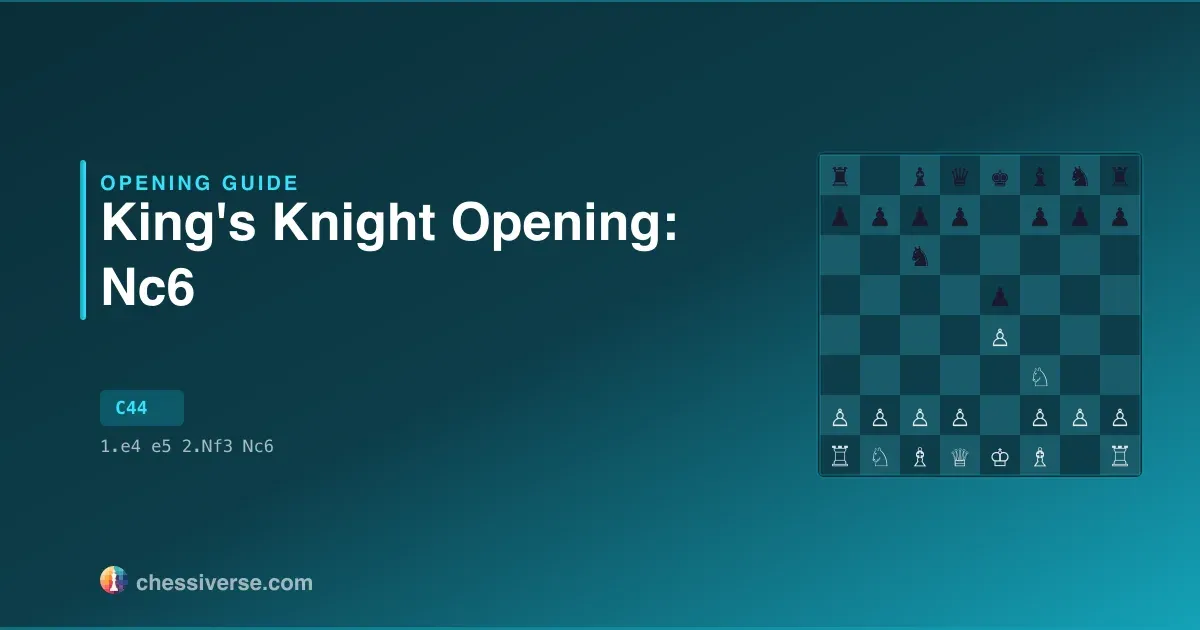
The King's Knight Opening: Normal Variation (2...Nc6) arises after 1.e4 e5 2.Nf3 Nc6 and falls under ECO code C44. This natural developing move is by far Black's most popular response, defending the e5-pawn while simultaneously contesting d4, and it produces the most common position in chess after just two moves per side. Black keeps pawn commitments to a minimum for now. White's next move is typically a bishop development, and by delaying Nc3, White preserves the possibility of occupying the center with c3 and d4. The most popular and theoretically rich continuation is 3. Bb5, the Spanish or Ruy Lopez, which indirectly pressures the e5-pawn by targeting its defender on c6. This tends to produce deep, positional battles. The main line continues 3...a6, though numerous other well-studied responses exist. With 523.1 million Lichess games across all rating levels, it is one of the most popular openings.
History and Notable Players
It arises from the King's Knight Opening. Among the most prolific practitioners on the White side are Viswanathan Anand (521 games), Sergey Karjakin (363 games), Maxime Vachier Lagrave (362 games). On the Black side, notable exponents include Levon Aronian (480 games), Ivan Sokolov (477 games), Oleg M Romanishin (456 games).
Statistics
Based on 523.1 million Lichess games across all rating levels:
- White wins: 50.8%
- Black wins: 44.9%
- Draws: 4.3%
White holds a moderate edge statistically, though Black has good practical chances.
Main Lines and Variations
After 1.e4 e5 2.Nf3 Nc6, the main continuations include:
Each of these lines leads to distinct types of positions and requires its own understanding of the resulting pawn structures and piece placements.
Practice on Chessiverse
The best way to learn the King's Knight Opening: Normal Variation (2...Nc6) is through practice. On Chessiverse, you can play chess against computer opponents that specialize in this opening. Our AI bots range from beginner to grandmaster level, each with unique playing styles — from aggressive attackers to solid defenders. Choose a bot that matches your rating and work your way up as you master the opening's key ideas.
Performance Across Rating Levels
Popularity and results vary sharply by rating level. The 1200 bracket has 100,261,700 games (14.86% of all games at that level); White wins 50.9%, Black 45.1%, 4% are drawn. At 1800 the opening surfaces in 8.41% of games; White wins 50.8%, Black 44.5%, draws 4.7%. At 2500, 5.92% of games go into this opening; draws sit at 10.5% — the line is well-mapped at this level. White's edge erodes by 4.1pp from 1200 to 2500 Elo, suggesting Black's counterplay is easier to find with experience.
Time Control Patterns
Time control matters here: rapid players reach for this opening more than others. In bullet, it appears in 5.63% of games (149,640,850); White wins 51%. Blitz shows 10.05% adoption across 361,411,754 games, White scoring 50.8%. In rapid, the share rises to 14.61% — 161,689,078 games, White 50.8%.
Move Diversity and Theory Depth
Looking at move selection shows how forcing — or not — the position really is. At 1200 Elo (100,261,700 games), the top reply is Bc4, played 42.1% of the time. Three other moves each take at least 5% of games, and the top three moves account for 78.9% of games. Entropy: 2.25. By 2500 (807,186 games), Bb5 takes over as the top reply at 46.1%; three other moves reach 5% and the top three moves account for 87.5% of games. Entropy drops to 1.89.
Historical Trends
Tracking the King's Knight Opening: Normal Variation (2...Nc6) year over year shows a clear story. Adoption peaked in 2023 at 11.60% (92,046,702 games). By 2025 it sits at 10.98%, 5% below the peak and roughly back to its 2013 level, leaving the line flat over the full period.