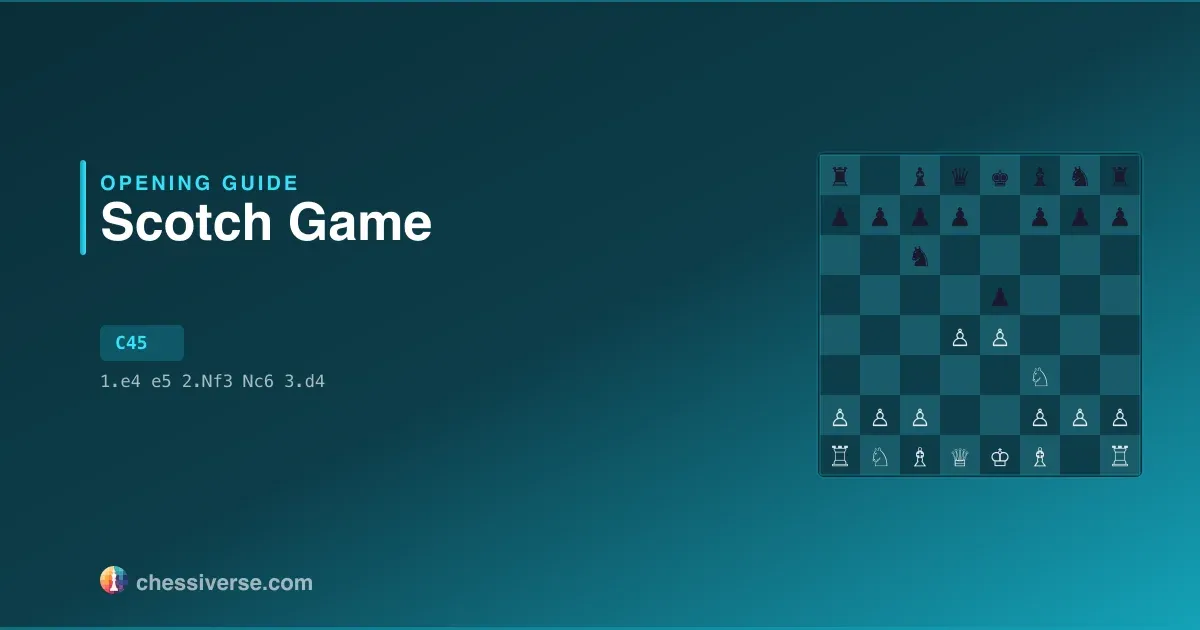
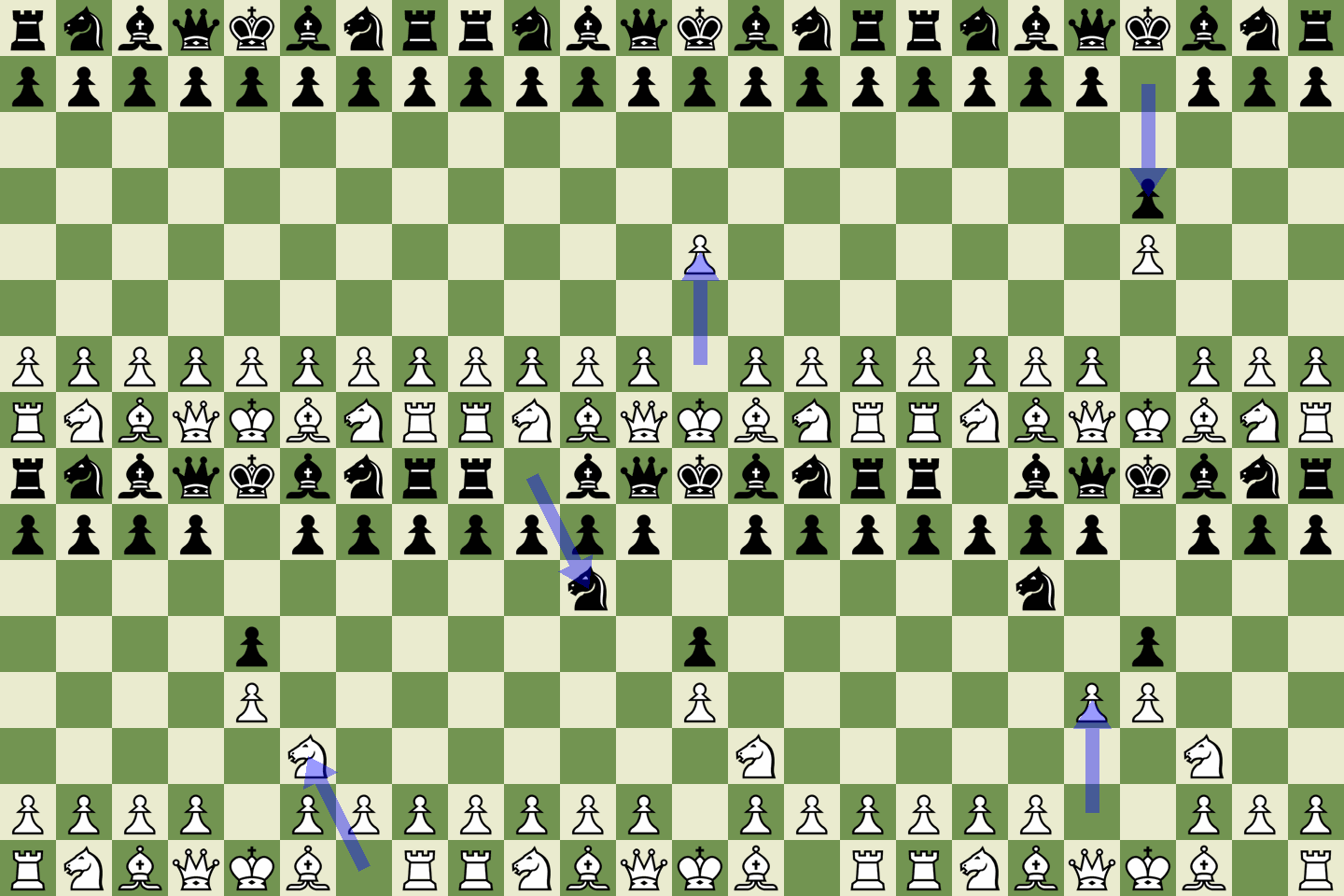
The Scotch Game arises after 1.e4 e5 2.Nf3 Nc6 3.d4 and falls under ECO code C44. White pushes aggressively in the centre, looking to open the position early. Nearly all games continue with 3...exd4, resolving the central tension and creating an open game with ample room for both sides to manoeuvre. The Lolli Variation, 3...Nxd4, is a viable alternative: White can exchange on d4 with 4. Nxd4 exd4 5. Qxd4, using the centralised queen to exploit the fact that Black traded a knight, or play 4. Nxe5, creating a threat against d4. The rare 3...d6 transposes into a Philidor Defense structure, giving White several promising choices, the most direct being 4. d5, pushing the knight away and expanding in the centre, while 4. Bb5 transposes into an Old Steinitz Spanish. With 91.1 million Lichess games across all rating levels, it is a well-established opening choice.
- White trades the d-pawn for Black's e-pawn to open the centre early and fight for control of the centre.
- The capture Nxc6 met by bxc6 is a recurring idea, saddling Black with doubled pawns.
- Instead of the main line 4.Nxd4, White can gambit a pawn with 4.Bc4 (Scotch Gambit) or 4.c3 (Goring Gambit) for fast development.
History and Notable Players
The earliest known analysis of this opening dates back to 1750. The opening is named after Scotland. It arises from the Open Games (1...e5). Among the most prolific practitioners on the White side are Sergei Rublevsky (102 games), Dusko Pavasovic (95 games), Robert Zelcic (77 games). On the Black side, notable exponents include Vladimir P Malaniuk (56 games), Oleg M Romanishin (54 games), Aleksej Aleksandrov (49 games).
Ercole del Rio mentioned the opening in his 1750 treatise, and it was common throughout the 19th century before falling from favour by 1900, when analysts felt it released the central tension too early and let Black equalise. Garry Kasparov led a major revival in the late 20th century, arguing it posed Black lasting strategic problems.
Named after: An 1824 correspondence match between Edinburgh and London, which gave the opening its Scottish name.
Notable players: Garry Kasparov, Jan Timman, Sergei Rublevsky
After being written off around 1900 and spending most of a century out of fashion, the Scotch roared back when Garry Kasparov adopted it as a way to sidestep the mountains of theory in the Ruy Lopez.
Statistics
Based on 91.1 million Lichess games across all rating levels:
- White wins: 52.9%
- Black wins: 42.6%
- Draws: 4.5%
White has a significant statistical advantage in this line, reflecting the initiative that comes with the first move.
Practice on Chessiverse
The best way to learn the Scotch Game is through practice. On Chessiverse, you can play chess against computer opponents that specialize in this opening. Our AI bots range from beginner to grandmaster level, each with unique playing styles — from aggressive attackers to solid defenders. Choose a bot that matches your rating and work your way up as you master the opening's key ideas.
Performance Across Rating Levels
The picture changes a lot as you climb the rating ladder. The 1200 bracket has 15,899,994 games (2.36% of all games at that level); White wins 53.5%, Black 42.5%, 4% are drawn. By 1800, popularity is 1.65% and White's score is 52.3% to Black's 42.8%. At the top end (2500+ Elo), popularity is 0.74% with 10.8% draws — a clear sign of how much theory rules the line at master level. White's edge erodes by 6.7pp from 1200 to 2500 Elo, suggesting Black's counterplay is easier to find with experience.
Time Control Patterns
The Scotch Game skews toward rapid chess. In bullet, it appears in 1.21% of games (32,230,202); White wins 52.3%. Blitz shows 1.82% adoption across 65,473,452 games, White scoring 52.7%. In rapid, the share rises to 2.32% — 25,616,049 games, White 53.4%.
Move Diversity and Theory Depth
Move choice is far from uniform in the Scotch Game. At 1200 Elo (15,899,994 games), the top reply is exd4, played 64.5% of the time. Two other moves each take at least 5% of games, and the top three moves account for 82.3% of games. Entropy: 1.95. By 2500 (100,685 games), exd4 dominates at 98.1% of replies; no other move reaches 5% and the top three moves account for 99.4% of games. Entropy drops to 0.18. That entropy collapse is the signature of a line where preparation pays off: at the top, players know the best move and play it.
Historical Trends
Tracking the Scotch Game year over year shows a clear story. Adoption peaked in 2025 at 2.12% (15,705,267 games). 2025 marks the high — the opening is rising, currently at 2.12%.