



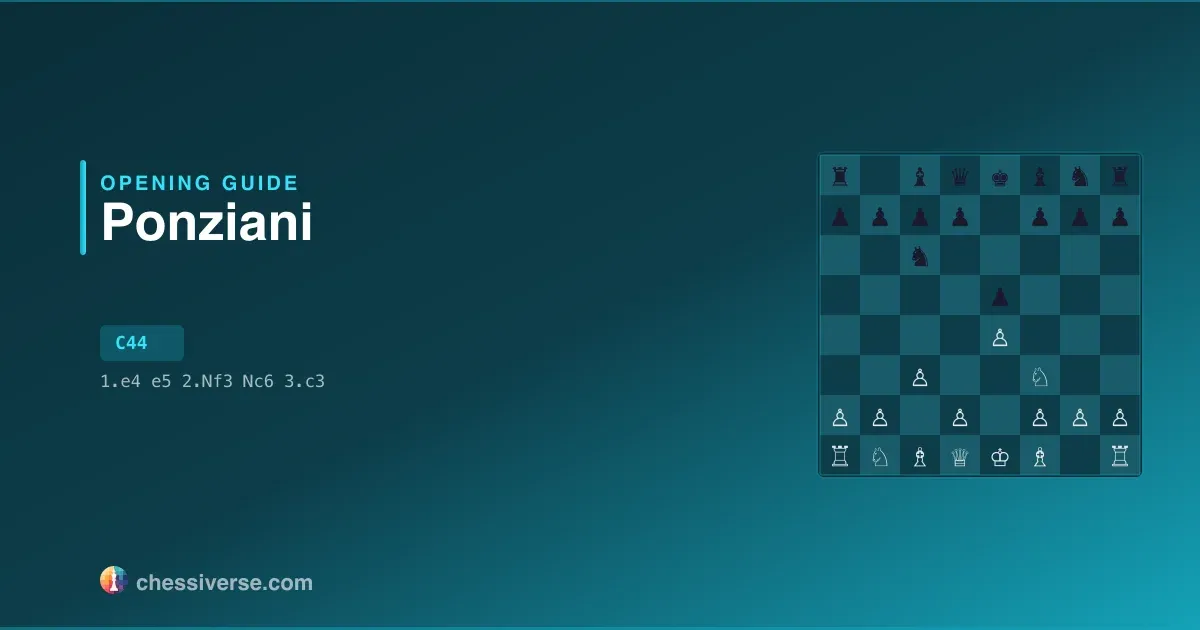
The Ponziani Opening arises after 1.e4 e5 2.Nf3 Nc6 3.c3 and falls under ECO code C44. With 3. c3, White signals a clear intent to push d4 on the next move, while also opening the a4 diagonal for the queen. The price of supporting d4 this way is that the c3 square becomes unavailable for the knight, which in turn leaves the e4 pawn without piece protection. Black's strongest responses therefore zero in on e4: both 3...Nf6 and 3...d5 exploit this vulnerability directly. By contrast, passive moves like 3...d6 or the common amateur error 3...Bc5? simply allow White to play 4. d4 and consolidate a comfortable two-pawn center. After 3...Nf6, the Jaenisch Counterattack, White generally pushes 4. d4 regardless, and Black typically captures one of the central pawns. The character of the resulting positions varies enormously, ranging from quiet, slightly better endgames for White to the razor-sharp Vukovic Gambit, which can descend into tactical chaos almost immediately. With 19.2 million Lichess games across all rating levels, it is one of the most popular openings.
- 3.c3 prepares d4 to build a big pawn center, while also opening a second diagonal for White's queen.
- The cost is that c3 takes the natural square from White's queen knight and leaves White a step behind in development.
- Black's usual replies are 3...Nf6, considered the safest course, and 3...d5, an aggressive counter-strike in the centre.
History and Notable Players
It arises from the Open Games (1...e5). Among the most prolific practitioners on the White side are Viswanathan Anand (521 games), Sergey Karjakin (363 games), Maxime Vachier Lagrave (362 games). On the Black side, notable exponents include Levon Aronian (480 games), Ivan Sokolov (477 games), Oleg M Romanishin (456 games).
One of the oldest recorded openings, it appears in the earliest chess treatises, including Lucena's work and the Gottingen manuscript. Howard Staunton championed it in his 1847 book, and for a time it was even known as Staunton's Opening. Today it is rare at the top, mostly appearing as a surprise weapon.
Named after: Domenico Lorenzo Ponziani, an 18th-century Italian theorist whose key contribution was introducing the countergambit 3...f5 in 1769.
Notable players: Howard Staunton, Magnus Carlsen
The opening predates its namesake by centuries, showing up in chess literature around 1497, and it still scores at the highest level: Magnus Carlsen won a game with it in 2013.
Statistics
Based on 19.2 million Lichess games across all rating levels:
- White wins: 49.9%
- Black wins: 46.1%
- Draws: 4%
The statistics show a roughly balanced opening where both sides have equal chances.
Practice on Chessiverse
The best way to learn the Ponziani Opening is through practice. On Chessiverse, you can play chess against computer opponents that specialize in this opening. Our AI bots range from beginner to grandmaster level, each with unique playing styles — from aggressive attackers to solid defenders. Choose a bot that matches your rating and work your way up as you master the opening's key ideas.
Performance Across Rating Levels
The picture changes a lot as you climb the rating ladder. The 1200 bracket has 3,625,768 games (0.54% of all games at that level); White wins 50.1%, Black 46.2%, 3.7% are drawn. Move up to 1800 Elo and the share shifts to 0.31%, with White winning 49.6% versus Black's 46.1%. Among 2500-rated players the line appears in 0.06% of games and draws spike to 9.4%, indicating tight preparation.
Time Control Patterns
Look at the same opening across time controls and rapid stands out. In bullet, it appears in 0.20% of games (5,292,759); White wins 51.4%. Blitz shows 0.37% adoption across 13,246,704 games, White scoring 50.1%. In rapid, the share rises to 0.54% — 5,924,258 games, White 49.5%.
Move Diversity and Theory Depth
What players actually play after the opening moves depends heavily on rating. At 1200 Elo (3,625,768 games), the top reply is Nf6, played 48.2% of the time. Three other moves each take at least 5% of games, and the top three moves account for 84.4% of games. Entropy: 2.18. By 2500 (8,592 games), Nf6 dominates at 55.4% of replies; only one other move still reaches 5% and the top three moves account for 94% of games. Entropy drops to 1.53. The narrowing is significant — strong players consolidate around a small set of best moves, while amateurs scatter across many plausible-looking options.
Historical Trends
Year-over-year data tells you whether this opening is a contemporary fixture or a fading one. Adoption peaked in 2023 at 0.47% (3,765,358 games). By 2025 it sits at 0.45%, 5% below the peak but still 33% above its 2013 level, so the line is up over the full period despite easing from the high.