

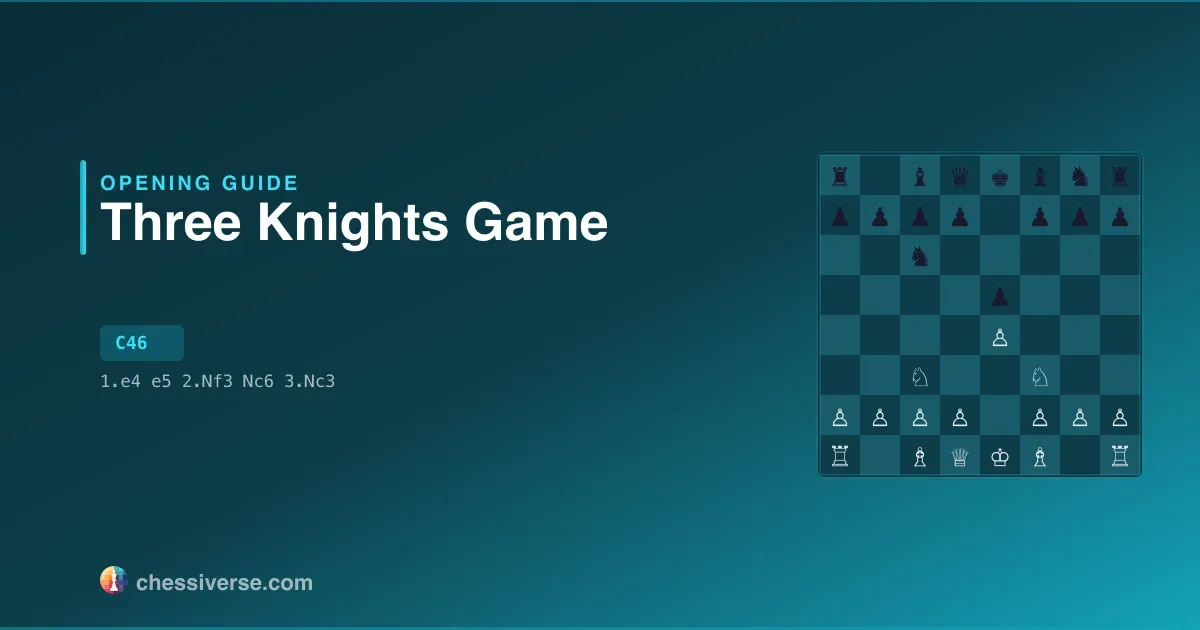
The Three Knights Game arises after 1.e4 e5 2.Nf3 Nc6 3.Nc3 and falls under ECO code C46. White follows the classic principle of developing knights before bishops, reasoning that both knights belong on f3 and c3 regardless of what follows. Although 3. Nc3 does not create any direct threats, it is surprisingly difficult for Black to deviate from symmetry, as there are no attractive ways to break the pattern. The natural and overwhelmingly popular reply is 3...Nf6, which transitions into the quiet but solid Four Knights Game. Bishop development is less appealing for Black at this point since no ideal square presents itself. One ambitious alternative is 3...f5?, the Winawer Defense, where Black gambits a pawn. The main response is 4. d4, though even the simple 4. exf5 should favor White objectively, despite Black retaining some practical chances at the amateur level. With 70.6 million Lichess games across all rating levels, it is a well-established opening choice.
- Black's third move decides everything: 3...Nf6 heads straight into the Four Knights Game, so independent play means avoiding it
- Sidesteps like 3...g6 or 3...Bb4 dodge the drawish Four Knights, though White can strike back in the centre with d4 or the jump Nd5
- Passive replies such as 3...d6 or 3...Be7 leave Black cramped in a Philidor-like position
History and Notable Players
It arises from the King's Knight Opening: Normal Variation (2...Nc6). Among the most prolific practitioners on the White side are Igor Glek (97 games), Geza Maroczy (58 games), Daniel H Campora (47 games). On the Black side, notable exponents include Oleg Korneev (45 games), Vladimir P Malaniuk (42 games), Michele Godena (42 games).
The earliest recorded game is Staunton vs. Cochrane, London 1841. Wilhelm Steinitz later defended it with 3...g6 against Rosenthal in 1873. Today it is a rare guest at master level, since Black usually prefers livelier setups.
Notable players: Staunton, Cochrane, Wilhelm Steinitz
The opening really only exists when Black declines the symmetry: play 3...Nf6 and it stops being a Three Knights Game and becomes a Four Knights Game.
Statistics
Based on 70.6 million Lichess games across all rating levels:
- White wins: 48.3%
- Black wins: 47%
- Draws: 4.7%
The statistics show a roughly balanced opening where both sides have equal chances.
Main Lines and Variations
After 1.e4 e5 2.Nf3 Nc6 3.Nc3, the main continuations include:
Each of these lines leads to distinct types of positions and requires its own understanding of the resulting pawn structures and piece placements.
Practice on Chessiverse
The best way to learn the Three Knights Game is through practice. On Chessiverse, you can play chess against computer opponents that specialize in this opening. Our AI bots range from beginner to grandmaster level, each with unique playing styles — from aggressive attackers to solid defenders. Choose a bot that matches your rating and work your way up as you master the opening's key ideas.
Performance Across Rating Levels
Popularity and results vary sharply by rating level. Among 1200-rated players, it appears in 2.38% of games — 16,069,071 of them on record — with White winning 47.9% and Black 47.6%. At 1800 the opening surfaces in 0.71% of games; White wins 49.7%, Black 45.3%, draws 5%. At 2500, 0.68% of games go into this opening; draws sit at 12.3% — the line is well-mapped at this level.
Time Control Patterns
The Three Knights Game skews toward rapid chess. In bullet, it appears in 1.06% of games (28,301,300); White wins 50.1%. Blitz shows 1.31% adoption across 47,126,007 games, White scoring 48.8%. In rapid, the share rises to 2.12% — 23,497,407 games, White 47.3%. White's score swings 2.8pp across formats, so time control isn't just a stylistic choice here — it shifts the actual results.
Move Diversity and Theory Depth
What players actually play after the opening moves depends heavily on rating. At 1200 Elo (16,069,071 games), the top reply is Nf6, played 50.9% of the time. Three other moves each take at least 5% of games, and the top three moves account for 83.2% of games. Entropy: 2.13. By 2500 (92,648 games), Nf6 dominates at 89.6% of replies; no other move reaches 5% and the top three moves account for 95.1% of games. Entropy drops to 0.76. The narrowing is significant — strong players consolidate around a small set of best moves, while amateurs scatter across many plausible-looking options.
Historical Trends
Long-term, the trajectory of this opening is informative. Adoption peaked in 2023 at 1.62% (12,843,190 games). By 2025 it sits at 1.57%, 3% below the peak but still 38% above its 2013 level, so the line is up over the full period despite easing from the high.