



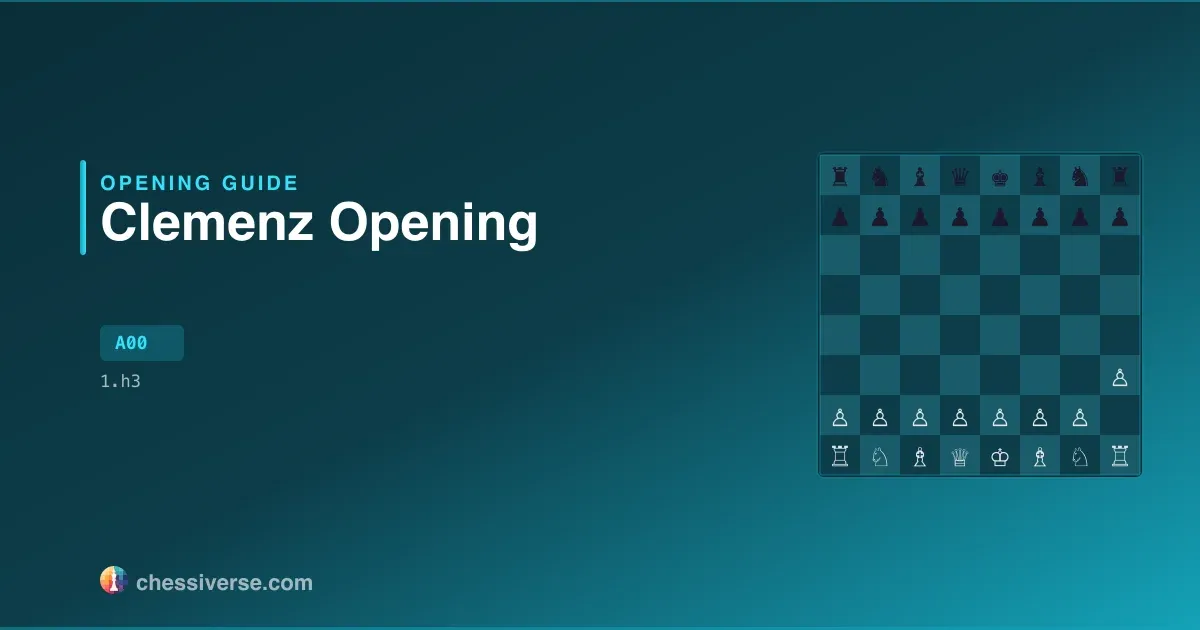
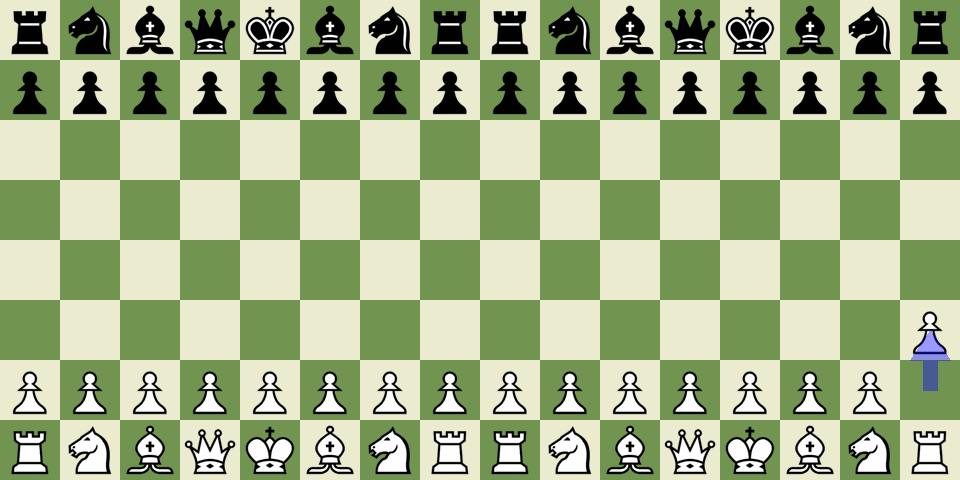
1.h3 opens the Clemenz Opening, ECO A00. 1.h3 is the chess equivalent of clearing your throat. It doesn't develop, doesn't fight for the centre, and rarely appears at any level — but it's not actually losing.
Strategic Overview
1.h3 makes no immediate concession and no real progress either. The move prevents a future ...Bg4 by Black, which can be slightly useful against certain setups, and serves as a waiting move that keeps options open. The cost is a wasted tempo on a flank pawn move that contributes nothing to development or central control. Most players would happily prefer 1.Nf3 in the same spirit but with a piece developing. The opening is playable in the loose sense that it doesn't immediately lose anything. Transpositions are possible — for example, 1.h3 e5 2.c4 transposes into a King's English position with the small loss of a tempo, and 1.h3 d5 2.d4 produces a standard Queen's Pawn structure where h3 is a minor luxury. Black has a wide variety of natural responses. 1...e5 stakes a central claim, 1...d5 does the same on the other diagonal, and 1...Nf6 develops cleanly. Against ...f5, White can try the Korchnoi Attack idea with 2.d4 and a later g4 to exploit the kingside weaknesses, though Black has resources. The Clemenz is a curiosity rather than a serious opening — useful for surprise value or as a way to step out of book against a known opponent. Otherwise, there are no good reasons to play it.
Key Ideas
When players succeed in this line, they usually do so by leaning on the following themes:
- Pure waiting move — The move achieves nothing concrete in terms of development or central control. It's a tempo-spending move that keeps options open without committing.
- Prevents ...Bg4 — The one small justification is that ...Bg4 from Black no longer pins or harasses the f3 knight (when it eventually arrives). It's a minor prophylactic benefit.
- Mostly transpositional — Most games drift back into standard openings — King's English, Queen's Pawn, or Sicilian-flavoured positions — with h3 played one move earlier than usual. The independent value of the opening is essentially zero.
Performance Across Rating Levels
How well the Clemenz Opening works depends on what level you're playing at. Among 1200-rated players, it appears in 0.10% of games — 688,776 of them on record — with White winning 41.7% and Black 51.8%. By 1800, popularity is 0.03% and White's score is 44.4% to Black's 51.3%. Among 2500-rated players the line appears in 0.04% of games and draws spike to 7.9%, indicating tight preparation. White's score improves by 3.9pp from the 1200 bracket to the 2500 bracket — the line rewards preparation.
Time Control Patterns
Time control matters here: bullet players reach for this opening more than others. In bullet, it appears in 0.08% of games (2,168,934); White wins 45.9%. Blitz shows 0.07% adoption across 2,398,396 games, White scoring 42.4%. In rapid, the share rises to 0.08% — 843,641 games, White 40.7%. White's score swings 5.2pp across formats, so time control isn't just a stylistic choice here — it shifts the actual results.
Move Diversity and Theory Depth
Looking at move selection shows how forcing — or not — the position really is. At 1200 Elo (688,776 games), the top reply is e5, played 48.6% of the time. Two other moves each take at least 5% of games, and the top three moves account for 78% of games. Entropy: 2.40. By 2500 (4,989 games), d5 takes over as the top reply at 42.5%; four other moves reach 5% and the top three moves account for 72.7% of games. Entropy rises to 2.63. Even elite players don't fully agree on the best continuation here, which keeps the position dynamic.
Historical Trends
Tracking the Clemenz Opening year over year shows a clear story. Adoption peaked in 2014 at 0.11% (9,533 games). By 2025 it sits at 0.07%, 36% below the peak and roughly back to its 2013 level, leaving the line flat over the full period.
Named after: Named after the Estonian player Hermann Clemenz (1846-1908).
Notable players: Michael Basman
1.h3 is among the rarest of the twenty possible first moves in chess - yet it at least weakens White's kingside less than fellow oddballs 1.g4 and 1.f3.
Main Lines and Variations
The main branches off 1.h3 include:
Each branch leads to a different middlegame character — the resulting pawn structure decides what kind of game you get.
Common Mistakes
- Neglecting development — It can feel productive to make extra pawn moves early, but falling behind in piece development is what loses most amateur games — especially in open positions where active pieces find squares fast.
- Playing without a plan — Each Clemenz Opening middlegame demands a specific approach. Decide whether the position calls for attack, manoeuvre, or simplification before reaching for a move.
Practice on Chessiverse
Ready to try the Clemenz Opening against a bot? Pick an opponent at your level and play a game.