



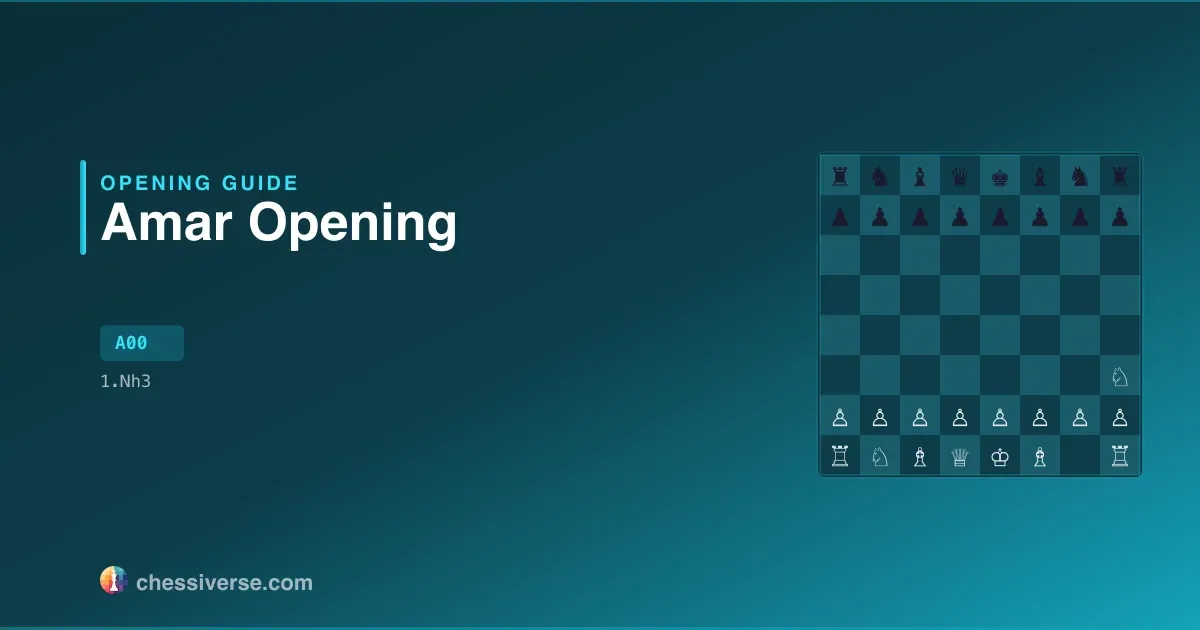
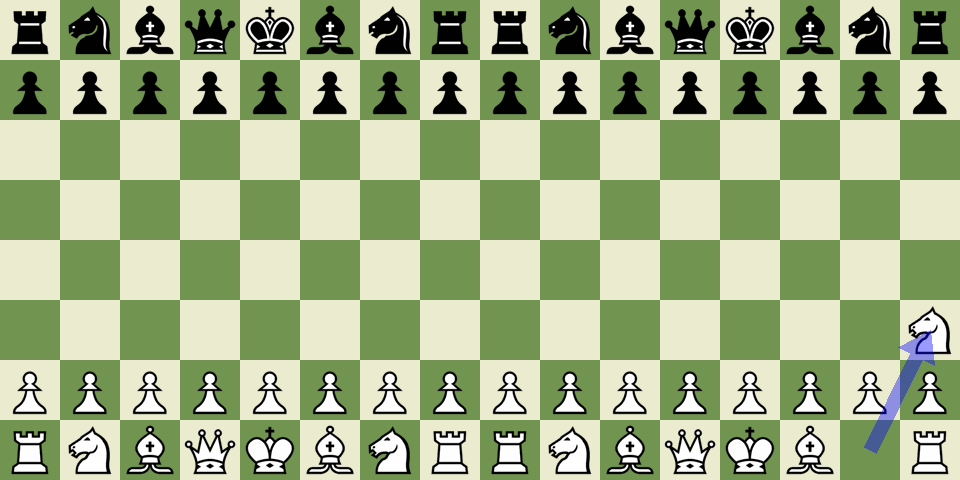
1.Nh3 opens the Amar Opening, ECO A00. Also known as the Paris Opening or the Drunken Knight Opening, 1.Nh3 sends the king's knight to the edge of the board on the very first move — and chess pedagogy hates the edge of the board.
Strategic Overview
1.Nh3 is one of the genuinely strange first moves. The knight develops, which technically counts as progress, but it goes to a square where it controls very few central squares and exerts almost no influence on the position. The standard chess maxim "knights on the rim are dim" exists for a reason: from h3 the knight has just three squares to move to, none of them particularly inspiring. White hasn't lost material and hasn't created any structural weaknesses, but the move surrenders the first-move advantage in practical terms. Black can essentially play any decent opening move and reach a comfortable position. The only thing Black should avoid is 1...g5??, which both weakens the king and drops a pawn after a future Nxg5. Otherwise Black has free choice. Most lines see Black grabbing the centre with ...d5 or ...e5 and developing naturally, with White scrambling to do something useful with the misplaced knight. At master level the opening is a joke; at any level it's hard to find a serious justification beyond surprise value.
Key Ideas
When players succeed in this line, they usually do so by leaning on the following themes:
- Knight on the rim is functionally bad — Developing the knight to h3 puts it on a square with minimal central influence and few good follow-up squares. It's the textbook example of where a knight does not belong.
- Effectively surrenders the first-move edge — Because the move achieves nothing concrete, Black can play almost any reasonable response and reach a position where White has no advantage. The first-move tempo is essentially wasted.
- Avoid only the trap 1...g5?? — Black should not weaken the kingside by playing ...g5, since the knight on h3 can simply capture the pawn. Any other normal developing move is acceptable.
Performance Across Rating Levels
The picture changes a lot as you climb the rating ladder. Among 1200-rated players, it appears in 0.02% of games — 167,681 of them on record — with White winning 33.7% and Black 58.6%. At 1800 the opening surfaces in 0.01% of games; White wins 48.9%, Black 46.9%, draws 4.2%. At 2500, 0.03% of games go into this opening; draws sit at 7.6% — the line is well-mapped at this level. White's score improves by 14.4pp from the 1200 bracket to the 2500 bracket — the line rewards preparation.
Time Control Patterns
The Amar Opening skews toward bullet chess. In bullet, it appears in 0.03% of games (793,917); White wins 47%. Blitz shows 0.02% adoption across 836,032 games, White scoring 41.2%. In rapid, the share rises to 0.03% — 306,176 games, White 34.1%. White's score swings 12.9pp across formats, so time control isn't just a stylistic choice here — it shifts the actual results.
Move Diversity and Theory Depth
Move choice is far from uniform in the Amar Opening. At 1200 Elo (167,681 games), the top reply is e5, played 42.1% of the time. Two other moves each take at least 5% of games, and the top three moves account for 75% of games. Entropy: 2.55. By 2500 (3,526 games), d5 takes over as the top reply at 53.5%; three other moves reach 5% and the top three moves account for 77.7% of games. Entropy drops to 2.34.
Historical Trends
Long-term, the trajectory of this opening is informative. Adoption peaked in 2021 at 0.03% (254,278 games). By 2025 it sits at 0.02%, 42% below the peak but still 14% above its 2013 level, so the line is up over the full period despite easing from the high.
The move was played in 1930s Paris by the amateur Charles Amar, and Tartakower used both the Amar and Paris Opening names for it. Tartakower's 1933 Paris game against Lilienthal produced the Gent Gambit line, and Carlsen won with the opening in a 2018 rapid PRO Chess League game against Dreev.
Named after: Charles Amar, a Parisian amateur who played 1.Nh3 in the 1930s; Savielly Tartakower probably coined the name.
Notable players: Charles Amar, Savielly Tartakower, Magnus Carlsen
Because the notation 1.Nh3 resembles NH3, the chemical formula for ammonia, it could be called the Ammonia Opening, and author Tim Harding joked that Amar stands for 'Absolutely mad and ridiculous'.
Main Lines and Variations
The main branches off 1.Nh3 include:
Each branch leads to a different middlegame character — the resulting pawn structure decides what kind of game you get.
Common Mistakes
- Neglecting development — Extra pawn moves in the opening are tempting, especially when you "know the moves". Developing a piece each turn is the simple correction.
- Playing without a plan — Each Amar Opening middlegame demands a specific approach. Decide whether the position calls for attack, manoeuvre, or simplification before reaching for a move.
Practice on Chessiverse
Ready to try the Amar Opening against a bot? Pick an opponent at your level and play a game.