

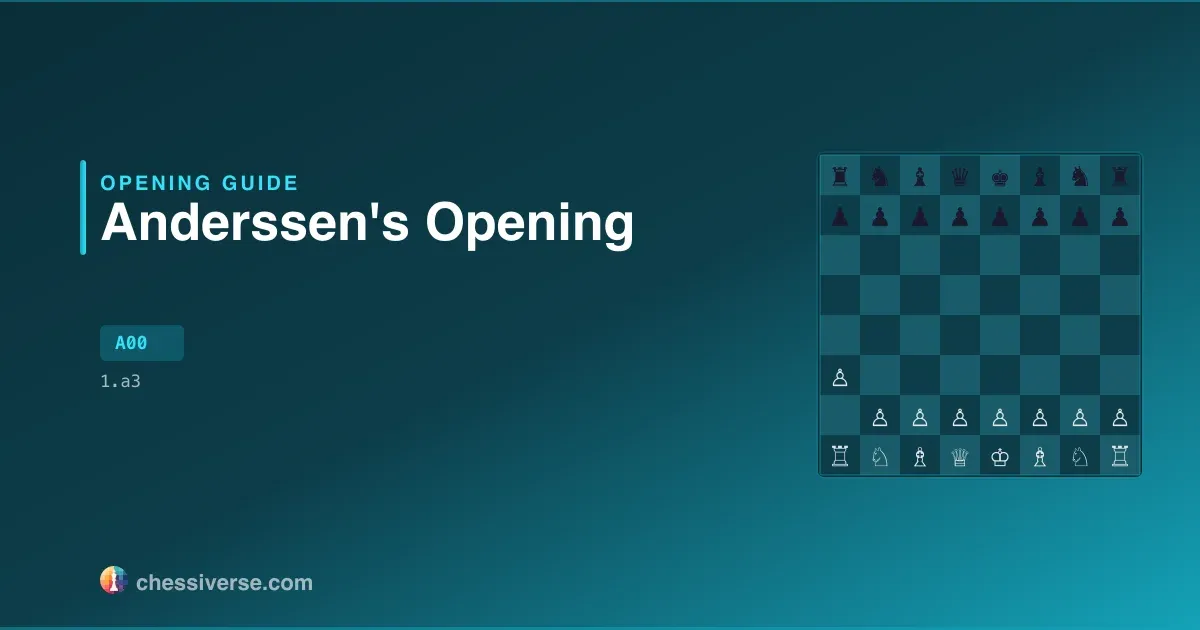
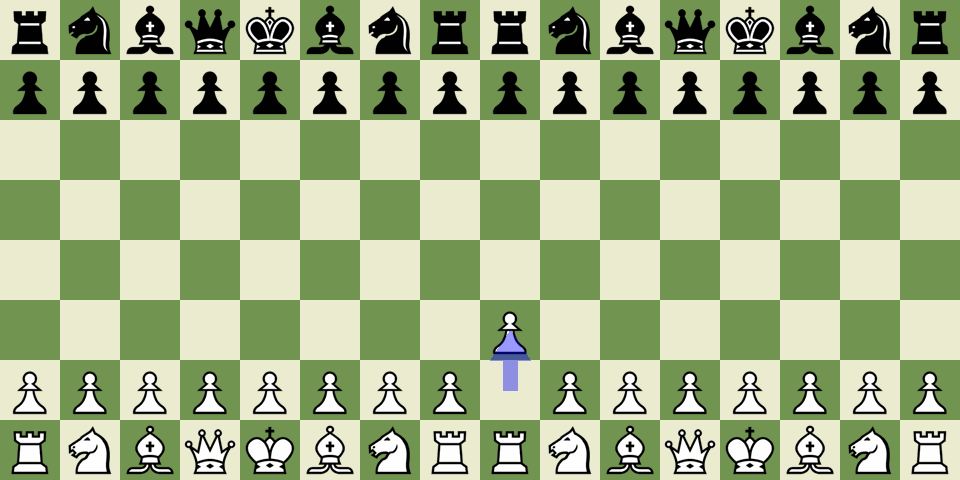
The Anderssen's Opening begins with 1.a3 (ECO A00). A waiting move dressed up as strategy. White hands the initiative to Black and hopes that a3 turns out to be a useful tempo somewhere down the line.
Strategic Overview
1.a3 is a pure pass. It doesn't develop a piece, doesn't claim the center, and doesn't pressure anything. The honest pitch is psychological: White invites Black to commit first, then tries to steer into a known structure where the a3 pawn happens to be useful, such as a reversed Najdorf or an English with b4 in the air. Against 1...e5, White can play 2.c4 and treat the game as an English where a3 prepares b4. Against 1...d5, the b4 push is still on the menu, leaning toward a Polish-style setup. Against 1...c5, a3 is a familiar anti-Sicilian wrinkle. The catch is obvious: Black moves first now, picks the structure, and gets to use the extra tempo wherever it suits. Adolf Anderssen tried it against Morphy, which is the most generous thing anyone can say about the line.
Key Ideas
A few ideas come up again and again in this opening:
- Wait and let Black commit first — The whole point of 1.a3 is to defer the structural decision. White watches what Black plays in the center and only then chooses between English, Polish, or anti-Sicilian formations where a3 is genuinely useful.
- Prepare a queenside expansion with b4 — a3 supports a future b4, which can grab queenside space, fianchetto the bishop to b2, or create a Najdorf-like structure with reversed colors. Without that follow-up, the move has no purpose.
- Accept a tempo down for a fresh game — 1.a3 is essentially playing Black with an extra waiting move. Practically, you trade theoretical depth for an unfamiliar position your opponent has never studied. Sound players equalize easily; unprepared ones drift.
Performance Across Rating Levels
The picture changes a lot as you climb the rating ladder. At 1200 Elo, the opening shows up in 0.09% of games (604,446 samples). White scores 46%, Black 48.6%, draws 5.3%. By 1800, popularity is 0.06% and White's score is 48.5% to Black's 46.8%. Among 2500-rated players the line appears in 0.12% of games and draws spike to 9.1%, indicating tight preparation.
Time Control Patterns
Look at the same opening across time controls and bullet stands out. In bullet, it appears in 0.12% of games (3,134,026); White wins 48.7%. Blitz shows 0.08% adoption across 2,933,578 games, White scoring 47%. In rapid, the share rises to 0.08% — 888,267 games, White 44.9%. White's score swings 3.8pp across formats, so time control isn't just a stylistic choice here — it shifts the actual results.
Move Diversity and Theory Depth
Move choice is far from uniform in the Anderssen's Opening. At 1200 Elo (604,446 games), the top reply is e5, played 48.4% of the time. Two other moves each take at least 5% of games, and the top three moves account for 78.2% of games. Entropy: 2.38. By 2500 (16,051 games), d5 takes over as the top reply at 25.9%; three other moves reach 5% and the top three moves account for 65.6% of games. Entropy rises to 2.87. Even elite players don't fully agree on the best continuation here, which keeps the position dynamic.
Historical Trends
Tracking the Anderssen's Opening year over year shows a clear story. Adoption peaked in 2013 at 0.25% (7,090 games). By 2025 it sits at 0.08%, down 68% from that high, leaving the line in decline.
Anderssen debuted 1.a3 in games 6, 8 and 10 of his December 1858 Paris match with Paul Morphy, scoring a win, a draw and a loss, though Morphy still won the match. Anderssen revived it in 1877-78 to beat Paulsen, Mackenzie and Mason, and other 19th-century players such as Steinitz and Blackburne also experimented with it.
Named after: Adolf Anderssen, who played 1.a3 three times against Paul Morphy in their 1858 Paris match.
Notable players: Adolf Anderssen, Zvonko Krecak, Magnus Carlsen, Hikaru Nakamura
In a January 2023 Titled Tuesday online game, Hikaru Nakamura beat Magnus Carlsen with 1.a3 - the same offbeat move Carlsen himself had tried in a 2010 blindfold game against Ivanchuk and lost.
Common Mistakes
- Neglecting development — It can feel productive to make extra pawn moves early, but falling behind in piece development is what loses most amateur games — especially in open positions where active pieces find squares fast.
- Playing without a plan — Each Anderssen's Opening middlegame demands a specific approach. Decide whether the position calls for attack, manoeuvre, or simplification before reaching for a move.
Practice on Chessiverse
Ready to try the Anderssen's Opening against a bot? Pick an opponent at your level and play a game.