

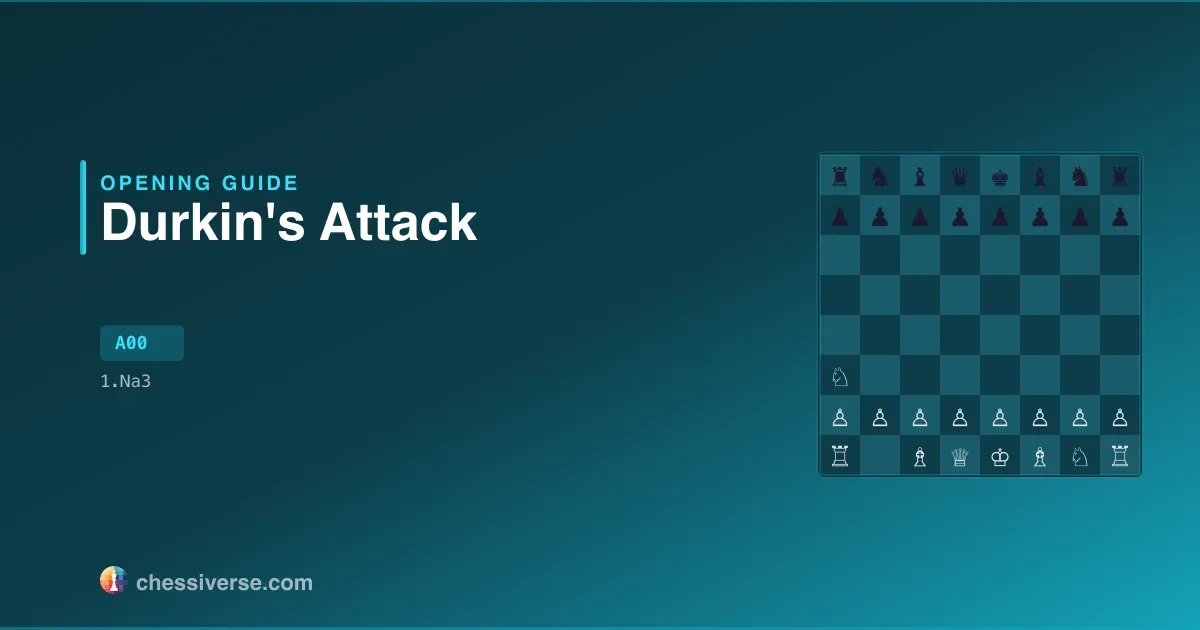
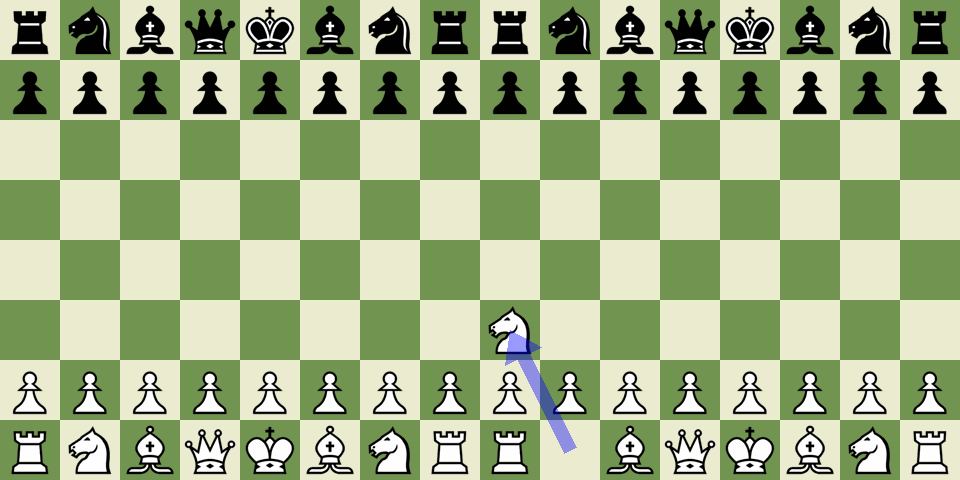
The Durkin's Attack begins with 1.Na3 (ECO A00). A knight to the edge of the board on move one. It controls almost nothing, blocks the a-pawn, and exists mainly because one player from New Jersey kept playing it.
Strategic Overview
1.Na3 sends a knight to the rim, where its scope is roughly half what it would be on c3. The knight covers b5 and c4 and not much else, and it blocks the a-pawn from supporting any future queenside expansion. Functionally it's a pass: White hands the move to Black and waits to see what they do. Black has no reason to be polite back. 1...e5 and 1...d5 are both strong, claiming the center directly. After 1...e5, White's one semi-coherent idea is 2.Nc4, eyeing the e5-pawn, but Black defends easily with ...Nc6 or ...d6 and continues normal development. The opening is associated almost entirely with Robert Durkin of New Jersey, who played it in over-the-board and correspondence games. Eric Schiller nicknamed it the Sodium Attack as a nod to the chemical symbol Na. The naming is the most interesting thing about it.
Key Ideas
A few ideas come up again and again in this opening:
- Black takes the center immediately — 1.Na3 doesn't pressure anything central, so Black can play 1...e5 or 1...d5 without concern. The knight on a3 doesn't cover d5 or e5, so nothing prevents a direct central claim.
- White's only follow-up is 2.Nc4 — After 1...e5, the knight wants to reroute via c4 to attack the e5-pawn. Black handles this with simple development like ...Nc6 and ...d6. There's no tactical sting waiting in this line.
- A knight on the rim blocks queenside expansion — With the knight on a3, the a-pawn can't easily advance, and any later b4 push needs the knight to move first. White's queenside is structurally hampered by its own opening move.
Performance Across Rating Levels
Popularity and results vary sharply by rating level. The 1200 bracket has 70,117 games (0.01% of all games at that level); White wins 34.2%, Black 58.9%, 6.9% are drawn. At 1800 the opening surfaces in 0.01% of games; White wins 53.9%, Black 42.4%, draws 3.7%. At 2500, 0.01% of games go into this opening; draws sit at 10.2% — the line is well-mapped at this level. White's score improves by 10.7pp from the 1200 bracket to the 2500 bracket — the line rewards preparation.
Time Control Patterns
Look at the same opening across time controls and rapid stands out. In bullet, it appears in 0.01% of games (268,342); White wins 45.3%. Blitz shows 0.01% adoption across 330,931 games, White scoring 42.6%. In rapid, the share rises to 0.01% — 131,437 games, White 35.8%. White's score swings 9.5pp across formats, so time control isn't just a stylistic choice here — it shifts the actual results.
Move Diversity and Theory Depth
What players actually play after the opening moves depends heavily on rating. At 1200 Elo (70,117 games), the top reply is e5, played 49% of the time. Two other moves each take at least 5% of games, and the top three moves account for 76% of games. Entropy: 2.49. By 2500 (1,566 games), d5 takes over as the top reply at 30%; three other moves reach 5% and the top three moves account for 68.5% of games. Entropy rises to 2.79. Even elite players don't fully agree on the best continuation here, which keeps the position dynamic.
Historical Trends
Long-term, the trajectory of this opening is informative. Adoption peaked in 2014 at 0.014% (1,289 games). By 2025 it sits at 0.009%, 35% below the peak and roughly back to its 2013 level, leaving the line flat over the full period.
Robert Durkin of New Jersey championed 1.Na3 in over-the-board and correspondence play, but hardly anyone else has taken it up. Chess author Eric Schiller gave it the nickname Sodium Attack.
Named after: The opening carries the name of Robert T. Durkin (1923-2014), a New Jersey player who used 1.Na3 both over the board and by correspondence.
Notable players: Robert T. Durkin
The nickname Sodium Attack is a chemistry pun: Na, the notation for the knight move, is the chemical symbol for sodium; similarly, 1.Nh3 is sometimes called the Ammonia Opening.
Common Mistakes
- Neglecting development — It can feel productive to make extra pawn moves early, but falling behind in piece development is what loses most amateur games — especially in open positions where active pieces find squares fast.
- Playing without a plan — Each Durkin's Attack middlegame demands a specific approach. Decide whether the position calls for attack, manoeuvre, or simplification before reaching for a move.
Practice on Chessiverse
Ready to try the Durkin's Attack against a bot? Pick an opponent at your level and play a game.