



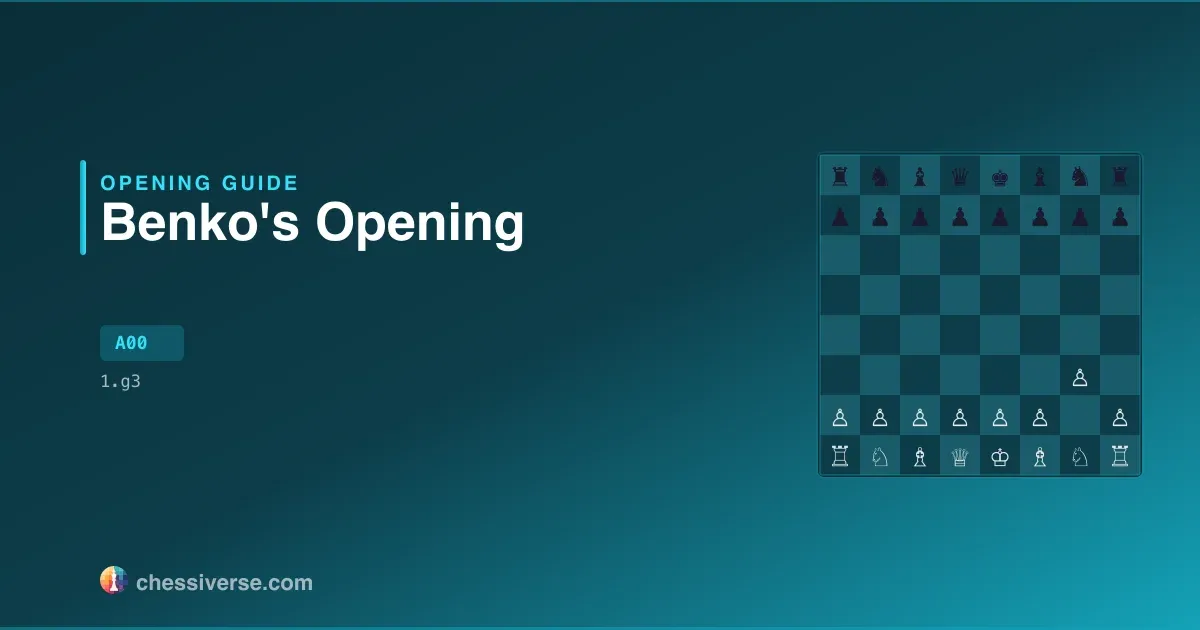
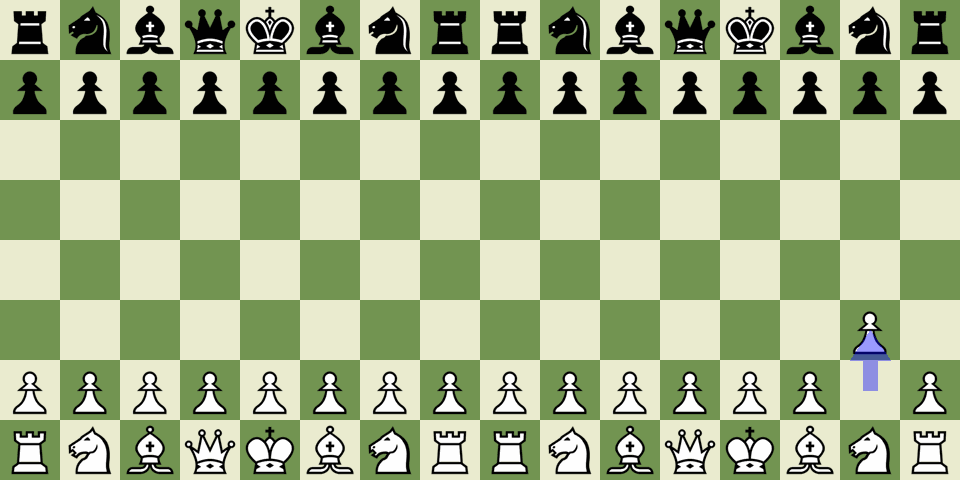
1.g3 opens the Benko's Opening, ECO A00. Also known as the Hungarian Opening or King's Fianchetto, 1.g3 is the calm hypermodern alternative that delays the central fight and signals a long-term plan built around the g2 bishop.
Strategic Overview
1.g3 doesn't touch the centre directly. Instead, White prepares to fianchetto the king's bishop on g2, where it will exert long-diagonal pressure on Black's queenside and centre. The hypermodern logic is straightforward: central pawns can be powerful but they can also be targets, so White will pressure the centre from afar rather than occupy it outright. The move is highly transpositional. With a King's Indian Attack setup (Bg2, Nf3, kingside castling), play can drift into Réti, English, Catalan or KIA structures depending on how Black responds. The most common Black reactions place pawns in the centre directly — 1...d5 or 1...e5 — and accept a fight for the central squares. Other replies, including the somewhat off-beat 1...g6 (mirroring White) or unusual moves like ...h5, are all playable. Analysis generally gives White a small edge or full equality across the various continuations, but the practical character of the opening matters: White's plans are clear, the king is safe early, and the position has long-term potential without immediate tactical hazards. It's a sensible choice for players who want to avoid heavy theory while keeping flexible plans.
Key Ideas
A few ideas come up again and again in this opening:
- Hypermodern central control from the flank — Rather than occupying the centre with pawns, White prepares to pressure it with a long-diagonal bishop. The plan is patient, system-based, and avoids early commitment to a specific pawn structure.
- The g2 bishop is the main piece — Fianchettoing the king's bishop gives White a permanent asset on the a8-h1 diagonal. Aimed at Black's queenside and centre, it shapes the entire middlegame plan.
- Highly transpositional — The move 1.g3 can lead into Réti, English, Catalan, or King's Indian Attack structures depending on how both sides develop. Players using this move need to be comfortable with multiple opening systems.
- Black's natural reply is to claim the centre — Pushing 1...d5 or 1...e5 directly puts a pawn in the middle and challenges White's hypermodern plan. White must then decide whether to continue with the King's Indian Attack or transpose into a more conventional setup.
Performance Across Rating Levels
How well the Benko's Opening works depends on what level you're playing at. The 1200 bracket has 7,969,041 games (1.18% of all games at that level); White wins 48.7%, Black 47%, 4.3% are drawn. At 1800 the opening surfaces in 1.06% of games; White wins 48.3%, Black 46.7%, draws 4.9%. Among 2500-rated players the line appears in 1.02% of games and draws spike to 10%, indicating tight preparation. Positions also become less sharp as level rises (sharpness 0.96 → 0.90).
Time Control Patterns
Time control matters here: bullet players reach for this opening more than others. In bullet, it appears in 2.60% of games (69,001,864); White wins 50.8%. Blitz shows 1.22% adoption across 43,737,465 games, White scoring 48.9%. In rapid, the share rises to 0.89% — 9,853,219 games, White 47.6%. White's score swings 3.2pp across formats, so time control isn't just a stylistic choice here — it shifts the actual results.
Move Diversity and Theory Depth
Looking at move selection shows how forcing — or not — the position really is. At 1200 Elo (7,969,041 games), the top reply is e5, played 42.6% of the time. Two other moves each take at least 5% of games, and the top three moves account for 75.5% of games. Entropy: 2.50. By 2500 (138,558 games), d5 takes over as the top reply at 39.8%; five other moves reach 5% and the top three moves account for 70.7% of games. Entropy rises to 2.67. Even elite players don't fully agree on the best continuation here, which keeps the position dynamic.
Historical Trends
Long-term, the trajectory of this opening is informative. Adoption peaked in 2014 at 1.29% (116,450 games). By 2025 it sits at 1.15%, 11% below the peak and roughly back to its 2013 level, leaving the line flat over the full period.
Annotations to an 1828 Madras-Hyderabad correspondence match show Indian players using 1.g3 long before hypermodern pioneer Richard Reti tried it at Baden-Baden 1925. Pal Benko made it famous at the 1962 Candidates in Curacao, opening with it in his first eleven White games, and Korchnoi later played it against Karpov in their 1978 world title match.
Named after: Pal Benko, who brought 1.g3 to international prominence at the 1962 Candidates Tournament in Curacao, beating Bobby Fischer and Mikhail Tal with it.
Notable players: Pal Benko, Richard Reti, Viktor Korchnoi
At the 1962 Candidates in Curacao, Benko trusted 1.g3 in his first eleven games with White - and scored wins over both Bobby Fischer and Mikhail Tal.
Main Lines and Variations
The main branches off 1.g3 include:
Each branch leads to a different middlegame character — the resulting pawn structure decides what kind of game you get.
Common Mistakes
- Neglecting development — It can feel productive to make extra pawn moves early, but falling behind in piece development is what loses most amateur games — especially in open positions where active pieces find squares fast.
- Playing without a plan — Each Benko's Opening middlegame demands a specific approach. Decide whether the position calls for attack, manoeuvre, or simplification before reaching for a move.
Practice on Chessiverse
Ready to try the Benko's Opening against a bot? Pick an opponent at your level and play a game.