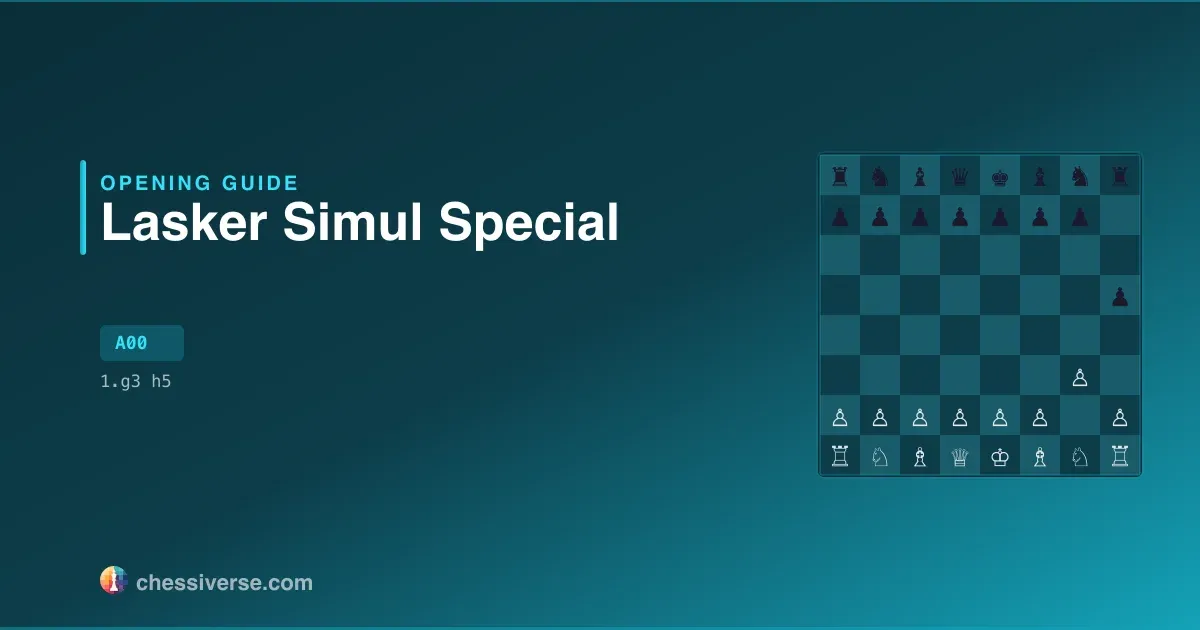
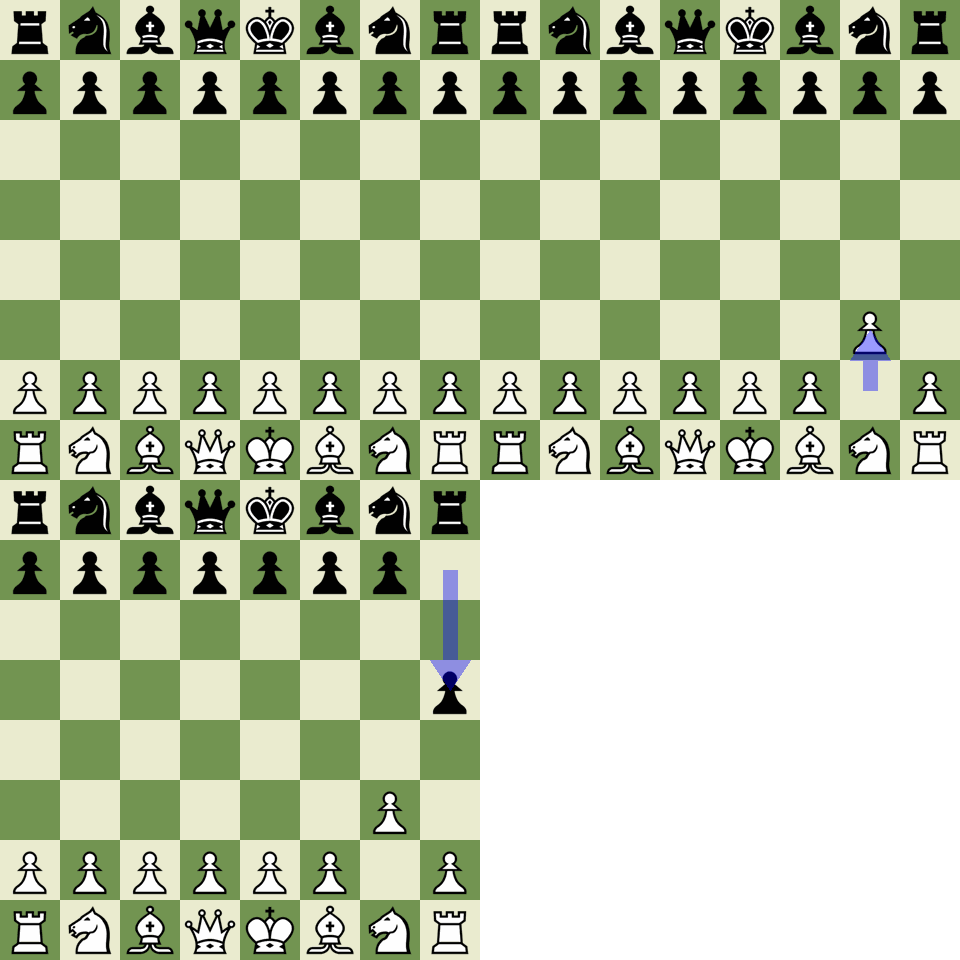
1.g3 h5 opens the Lasker Simul Special, ECO A00. A genuinely bizarre answer to 1.g3. Black throws the h-pawn forward, hoping to advance further and pry open the h-file before any normal development occurs.
Strategic Overview
1...h5 is the kind of move that earns a name not because it's good but because it's memorable. The idea is concrete: push the h-pawn another square to h4, hit the g3 pawn, and try to crack open the h-file for attacking purposes. Against the King's Indian Attack setup, this can be more annoying than it first appears, because White's plan involves castling kingside, which means an open h-file might point straight at the king. That said, the move costs Black a tempo on routine development and weakens the queenside in advance. White can respond by simply ignoring the h-pawn and developing normally — the centre is still up for grabs, and any flank attack without a developed army tends to fizzle. The Lasker Simul Special is exactly what it sounds like: an unorthodox try suitable for simultaneous exhibitions or for surprise value in club games. It is not a serious main-line answer to 1.g3.
History and Notable Players
It arises from the Benko's Opening.
Performance Across Rating Levels
How well the Lasker Simul Special works depends on what level you're playing at. At 1200 Elo, the opening shows up in 0.00% of games (31,985 samples). White scores 49.7%, Black 45.1%, draws 5.2%. At 1800 the opening surfaces in 0.01% of games; White wins 43.8%, Black 52.3%, draws 3.9%. At the top end (2500+ Elo), popularity is 0.06% with 7.2% draws — a clear sign of how much theory rules the line at master level. White's edge erodes by 5.4pp from 1200 to 2500 Elo, suggesting Black's counterplay is easier to find with experience.
Time Control Patterns
Look at the same opening across time controls and bullet stands out. In bullet, it appears in 0.03% of games (879,096); White wins 45.9%. Blitz shows 0.01% adoption across 362,320 games, White scoring 45.8%. In rapid, the share rises to 0.00% — 46,899 games, White 47.7%.
Move Diversity and Theory Depth
Move choice is far from uniform in the Lasker Simul Special. At 1200 Elo (31,985 games), the top reply is Bg2, played 77.1% of the time. No other move reaches 5% of games, and the top three moves account for 85.6% of games. Entropy: 1.51. By 2500 (8,628 games), Bg2 is still the top reply, at 47.4%; four other moves reach 5% and the top three moves account for 81.7% of games. Entropy rises to 2.17. Even elite players don't fully agree on the best continuation here, which keeps the position dynamic.
Common Mistakes
- Drifting away from main theory — At 400 Elo, the three most-played moves cover 74.4% of games, against 91% at 2000. The most popular deviation is b3 (played 6.1% of the time at 400, much less so up top). It looks fine but quietly hands the better-prepared side an edge.
- Neglecting development — It can feel productive to make extra pawn moves early, but falling behind in piece development is what loses most amateur games — especially in open positions where active pieces find squares fast.
- Playing without a plan — Each Lasker Simul Special middlegame demands a specific approach. Decide whether the position calls for attack, manoeuvre, or simplification before reaching for a move.
Practice on Chessiverse
Ready to try the Lasker Simul Special against a bot? Pick an opponent at your level and play a game.