

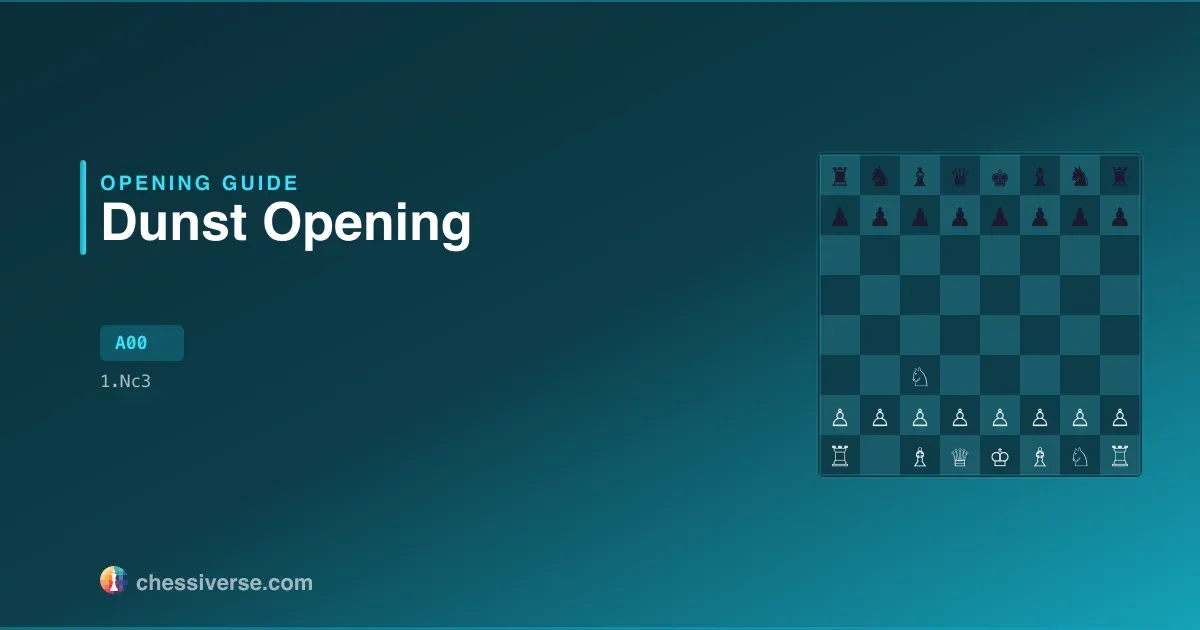
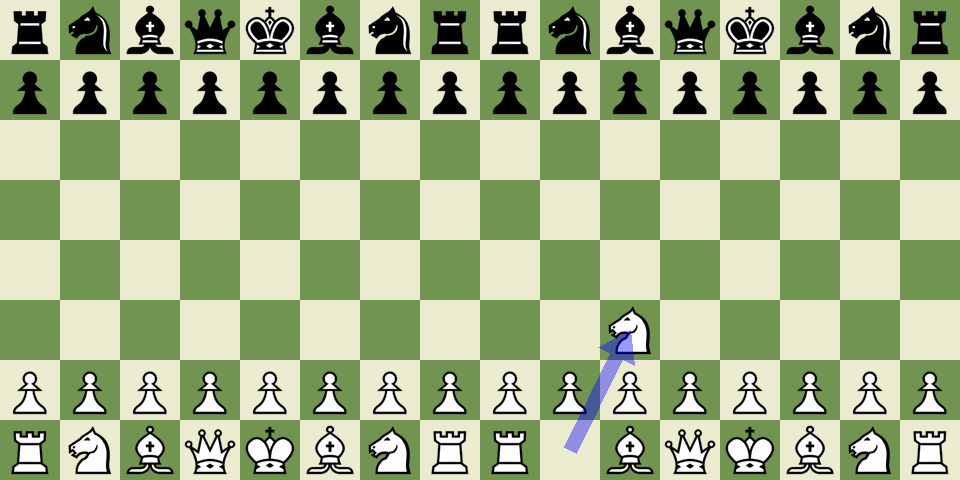
1.Nc3 opens the Dunst Opening, ECO A00. Sometimes called the Van Geet, Heinrichsen, or simply 1.Nc3, this opening develops a knight to a sensible central square and then surrenders the typical c4 thrust in exchange for transpositional flexibility.
Strategic Overview
1.Nc3 is a real opening, not a joke — it develops a piece toward the centre, controls e4 and d5, and prepares for a wide variety of continuations. Two practical reasons keep it out of fashion. First, the knight on c3 blocks the c-pawn, which means typical Queen's Pawn structures requiring c4 are no longer available without further reorganisation. Second, unlike 1.Nf3 (which prevents 1...e5), 1.Nc3 doesn't prevent 1...d5 because the pawn would already be defended by the queen. The main response is precisely 1...d5, threatening 2...d4 to take space and chase the knight again. White can prevent or allow that threat through different strategies. 2.d4 transposes into closed-game structures; 2.Nf3 enters a reversed Mexican Defense; 2.e3 supports the centre passively. The most direct try is 2.e4, allowing 2...d4 3.Nce2 e5 4.Ng3 and accepting a strange but playable position. Many other White moves on move two simply transpose into more conventional king-pawn openings. The Dunst is a sound sideline with real strategic content. It avoids mainstream theory while keeping the option to enter the same middlegames through different doors.
Key Ideas
When players succeed in this line, they usually do so by leaning on the following themes:
- Knight develops to a real central square — Unlike most A00 sidelines, 1.Nc3 actually puts a piece on a square that influences the centre. It controls e4 and d5 and is a legitimate developing move.
- Loses the option of c4 — The knight on c3 blocks the natural c-pawn advance, which means standard Queen's Gambit and English structures are unavailable. White trades opening breadth for the surprise factor of the move order.
- 1...d5 is the main response — Black usually plays 1...d5, threatening to kick the knight with ...d4. The response is principled because the d-pawn is defended by the queen, unlike with 1.Nf3.
- Highly transpositional — Most White second moves transpose into more conventional openings — closed games, reversed Mexican, or king-pawn structures. The Dunst is more a move-order trick than an independent system.
Performance Across Rating Levels
The picture changes a lot as you climb the rating ladder. The 1200 bracket has 3,109,534 games (0.46% of all games at that level); White wins 46.7%, Black 49%, 4.4% are drawn. Move up to 1800 Elo and the share shifts to 0.35%, with White winning 50.1% versus Black's 45.4%. Among 2500-rated players the line appears in 0.48% of games and draws spike to 9.8%, indicating tight preparation. Positions also become less sharp as level rises (sharpness 0.96 → 0.90).
Time Control Patterns
The Dunst Opening skews toward bullet chess. In bullet, it appears in 0.81% of games (21,600,863); White wins 50.2%. Blitz shows 0.45% adoption across 16,147,205 games, White scoring 48.3%. In rapid, the share rises to 0.43% — 4,744,833 games, White 46.2%. White's score swings 4.0pp across formats, so time control isn't just a stylistic choice here — it shifts the actual results.
Move Diversity and Theory Depth
What players actually play after the opening moves depends heavily on rating. At 1200 Elo (3,109,534 games), the top reply is e5, played 42.9% of the time. Three other moves each take at least 5% of games, and the top three moves account for 71.3% of games. Entropy: 2.63. By 2500 (65,489 games), d5 takes over as the top reply at 42%; four other moves reach 5% and the top three moves account for 73% of games. Entropy drops to 2.61. Move diversity stays high even at master level, suggesting the opening doesn't force one specific response.
Historical Trends
Tracking the Dunst Opening year over year shows a clear story. Adoption peaked in 2015 at 0.54% (120,224 games). By 2025 it sits at 0.43%, 20% below the peak and roughly back to its 2013 level, leaving the line flat over the full period.
The move 1.Nc3 appears as early as Blackburne versus Noa, London 1883. It collected different names around the world: for Lithuania's Arved Heinrichsen, for Dutch IM Dirk van Geet, who used it frequently, and in the United States for Ted Dunst. Despite that pedigree it has stayed a rarity, only the eighth most common first move.
Named after: Named for Ted A. Dunst (1907-1985), a New York master who analyzed and played 1.Nc3.
Notable players: Ted A. Dunst, Dirk van Geet
The name Sleipnir Opening for 1.Nc3 apparently comes from Germany: Sleipnir is Odin's eight-legged horse in Norse myth, and a knight can have up to eight possible moves.
Main Lines and Variations
The main branches off 1.Nc3 include:
Each branch leads to a different middlegame character — the resulting pawn structure decides what kind of game you get.
Common Mistakes
- Neglecting development — It can feel productive to make extra pawn moves early, but falling behind in piece development is what loses most amateur games — especially in open positions where active pieces find squares fast.
- Playing without a plan — Each Dunst Opening middlegame demands a specific approach. Decide whether the position calls for attack, manoeuvre, or simplification before reaching for a move.
Practice on Chessiverse
Ready to try the Dunst Opening against a bot? Pick an opponent at your level and play a game.