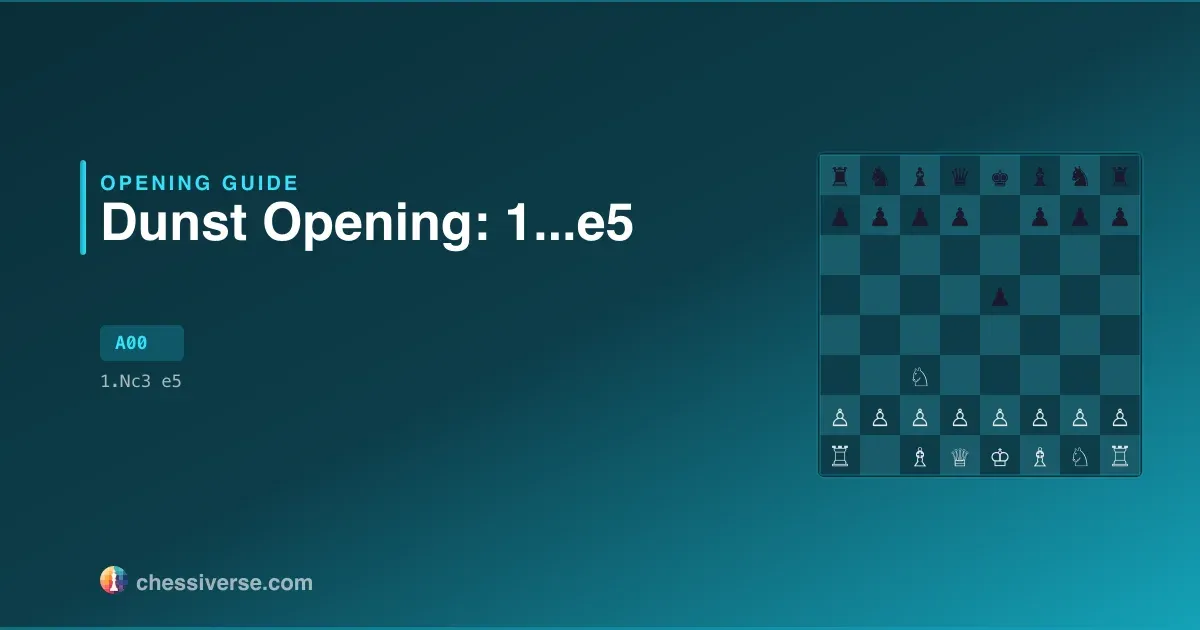
Dunst Opening: 1...e5

-20%
A001.Nc3 e5
Nov 5, 2028
TL;DR

1...e5 grabs the centre and dares White to do something. Effectively a mirrored Nimzowitsch Defence with White a tempo up — White can play 2.d4 with theoretical advantage, but most Dunst games stay in offbeat waters.

Reviewed by

IM John Bartholomew
IM John BartholomewCo-Founder & Chess Educator

International Master and chess educator. Co-founded Chessable and joined Chessiverse as co-founder. Best known for his "Climbing the Rating Ladder" YouTube series and structured opening courses.

Dunst Opening: 1...e5: A Complete Guide
Dunst Opening: 1...e5 - Opening Moves
Summary

Starting from 1.Nc3 e5, players enter the Dunst Opening: 1...e5 — ECO A00. Black answers 1.Nc3 with the symmetric central response, producing a position that resembles a Nimzowitsch Defence with colours reversed — and crucially, with an extra tempo for White.

Strategic Overview

1...e5 occupies the centre directly and dares White to do something useful with the knight on c3. The mirror image of 1.e4 Nc6 (the Nimzowitsch Defence) is on the board, except with White to move and a useful tempo in hand. White has a few principled tries to exploit the extra move. The most direct is 2.d4 exd4 3.Qxd4, mimicking the Nimzowitsch lines but with the bonus that Black hasn't yet played ...d5 — so the Black queen isn't already developed to challenge White's queen on d4. Black's natural reply 3...Nc6 reaches a position similar to Nimzowitsch theory but with White a tempo to the good. The alternative is 2.Nf3 Nc6 3.d4, transposing into Napoleon Attack territory and from there into Scotch-style positions where White's reversed setup gives clean development and central pressure. The position after 1.Nc3 e5 is playable for both sides but tends to slightly favour White because the extra tempo lets White realise plans that work poorly with reversed colours. As a sideline, it's solid and has real strategic content.

Key Ideas

A few ideas come up again and again in this opening:

  • Reversed Nimzowitsch with an extra tempo — The position resembles 1.e4 Nc6 with colours reversed. White's extra move means certain Nimzowitsch ideas that struggle for Black work cleanly for White here.
  • 2.d4 exd4 3.Qxd4 is the most direct try — Because Black hasn't yet played ...d5, the queen can recapture on d4 without immediately being attacked. The resulting positions resemble Nimzowitsch theory with White's tempo advantage intact.
  • 2.Nf3 reaches Napoleon Attack ideas — An alternative second move transposes into a Scotch-like structure after Nf3 and d4. White gets natural development and central pressure without dropping into mainstream theory.

History and Notable Players

It arises from the Dunst Opening.

Performance Across Rating Levels

The picture changes a lot as you climb the rating ladder. Among 1200-rated players, it appears in 0.20% of games — 1,316,963 of them on record — with White winning 47% and Black 48.8%. Move up to 1800 Elo and the share shifts to 0.07%, with White winning 52.2% versus Black's 43.4%. Among 2500-rated players the line appears in 0.03% of games and draws spike to 9.6%, indicating tight preparation. White's score improves by 4.0pp from the 1200 bracket to the 2500 bracket — the line rewards preparation.

Time Control Patterns

Look at the same opening across time controls and rapid stands out. In bullet, it appears in 0.14% of games (3,591,455); White wins 50.7%. Blitz shows 0.13% adoption across 4,641,720 games, White scoring 48.5%. In rapid, the share rises to 0.18% — 2,016,837 games, White 46.4%. White's score swings 4.3pp across formats, so time control isn't just a stylistic choice here — it shifts the actual results.

Move Diversity and Theory Depth

Looking at move selection shows how forcing — or not — the position really is. At 1200 Elo, the top reply is e4, played 36.5% of the time. There are 3 other moves seeing meaningful share, and 82.3% of games stick to established theory. Entropy: 2.42. By 2500, Nf3 dominates at 55.3% of replies; only 3 viable alternatives remain and 93.7% of moves are theory. Entropy drops to 1.75. The narrowing is significant — strong players consolidate around a small set of best moves, while amateurs scatter across many plausible-looking options.

Year-over-year data tells you whether this opening is a contemporary fixture or a fading one. Adoption peaked in 2016 at 0.17% (102,070 games). By 2025 it sits at 0.13% — a 20% shift overall, leaving the line in decline.

Main Lines and Variations

After 1.Nc3 e5, the established follow-ups are:

Each branch leads to a different middlegame character — the resulting pawn structure decides what kind of game you get.

Common Mistakes

  • Playing outside main lines — At 400 Elo, only 78.4% of moves follow established theory — at 2000 that climbs to 87.5%. Most of the gap is players who pick a reasonable-looking move over the best one, and the position quietly drifts.
  • Neglecting development — Extra pawn moves in the opening are tempting, especially when you "know the moves". Developing a piece each turn is the simple correction.
  • Playing without a plan — Each Dunst Opening: 1...e5 middlegame demands a specific approach. Decide whether the position calls for attack, manoeuvre, or simplification before reaching for a move.

Practice on Chessiverse

Ready to try the Dunst Opening: 1...e5 against a bot? Pick an opponent at your level and play a game.

Quick Facts

Main Line1.Nc3 e5
DifficultyBeginner
Parent OpeningDunst Opening
Style

Unorthodox openings deviate from classical principles to surprise opponents and lead the game into unfamiliar territory. They can be highly effective when the opponent is unprepared.

6,658,557games on Lichess
47.9%
4.6%
47.6%
White wins Draws Black wins

Data from Lichess opening explorer (blitz & rapid)

Most Popular At400
SharpnessSharp

Popularity by Rating

Percentage of all games at each rating bracket that feature this opening.

Data from Lichess opening explorer (blitz & rapid games)

Theory Adherence by Rating

How often players choose the single most popular move at this position. Higher = more predictable play.

White to move after the opening line

Popularity Over Time

Share of all Lichess blitz + rapid games featuring this opening, by year.

Top Moves by Rating

White to move after the opening line

RatingMost Popular2nd3rd
400Nf335.2%e432.9%d410.2%
1000e436.3%Nf330.2%d414.8%
1200e436.5%Nf329.3%d416.6%
1400e436.4%Nf327.8%d418%
1600e437.4%Nf329.7%d415%
1800e441.6%Nf328.5%d411.6%
2000e447.3%Nf328.9%d411.2%
2200e447.2%Nf336.1%d47.1%
2500Nf355.3%e428.6%d49.8%

Popularity by Time Control

Bullet
0.14%3.6M
Blitz
0.13%4.6M
Rapid
0.18%2.0M
2% more decisive in bullet
Raw data tables (Lichess blitz + rapid)
Dunst Opening: 1...e5: popularity and win rates by player rating
Rating (Elo)Share %GamesWhite win %Black win %Draw %Sharpness
4000.501,141,15645.549.15.50.945
10000.291,207,86346.249.24.70.953
12000.201,316,96347.048.84.30.957
14000.131,213,36447.948.14.00.960
16000.09888,90250.245.54.20.958
18000.07552,29752.243.44.40.956
20000.06258,48552.842.34.90.951
22000.0474,84551.142.56.40.936
25000.034,68251.039.49.60.904
Dunst Opening: 1...e5: move-choice theory adherence by rating
Rating (Elo)Top moveTop move %Viable movesTheory %Entropy
400Nf335.2378.42.488
1000e436.3381.32.440
1200e436.5382.32.415
1400e436.4482.22.413
1600e437.4482.12.376
1800e441.6481.72.323
2000e447.3387.52.081
2200e447.2390.51.893
2500Nf355.3393.71.754
Dunst Opening: 1...e5: popularity over time
YearShare %GamesWhite win %Black win %Draw %
20130.164,74347.149.83.1
20140.1614,68848.947.93.1
20150.1635,72946.749.73.6
20160.17102,07047.049.23.8
20170.15169,41748.247.74.0
20180.15275,39748.547.34.2
20190.15426,66548.347.54.2
20200.14828,86347.148.24.7
20210.151,141,47746.948.34.8
20220.141,063,19448.047.44.5
20230.141,117,04348.147.34.7
20240.13989,70748.546.94.6
20250.13975,12848.447.14.5
Dunst Opening: 1...e5: popularity by time control
FormatShare %GamesWhite win %Black win %Draw %Sharpness
bullet0.143,591,45550.746.62.70.973
blitz0.134,641,72048.547.14.40.956
rapid0.182,016,83746.448.74.90.951
Dunst Opening: 1...e5: top candidate moves by rating bracket
Rating (Elo)1st move1st %2nd move2nd %3rd move3rd %
400Nf335.2e432.9d410.2
1000e436.3Nf330.2d414.8
1200e436.5Nf329.3d416.6
1400e436.4Nf327.8d418.0
1600e437.4Nf329.7d415.0
1800e441.6Nf328.5d411.6
2000e447.3Nf328.9d411.2
2200e447.2Nf336.1d47.1
2500Nf355.3e428.6d49.8

Frequently Asked Questions

What is the Dunst Opening: 1...e5?

The Dunst Opening: 1...e5 begins with 1.Nc3 e5 and is classified under ECO code A00. This position resembles a Nimzowitsch defence, 1.

Is the Dunst Opening: 1...e5 good for beginners?

The Dunst Opening: 1...e5 can be played at any level. Beginners should focus on understanding the key strategic ideas rather than memorizing long theoretical lines. Our AI bots at various rating levels provide a great way to practice the opening concepts.

What are the main variations of the Dunst Opening: 1...e5?

The main continuations include: Battambang Opening. Each variation leads to distinct types of positions with their own strategic themes.

What are the win rates for the Dunst Opening: 1...e5?

In a database of 6,658,557 master games, White wins 47.9% of the time, Black wins 47.6%, and 4.6% are drawn.

Reviewed by

IM John Bartholomew
IM John BartholomewCo-Founder & Chess Educator

International Master and chess educator. Co-founded Chessable and joined Chessiverse as co-founder. Best known for his "Climbing the Rating Ladder" YouTube series and structured opening courses.

Practice This Opening on Chessiverse

Play against 1000+ AI bots with unique personalities and opening repertoires. From beginner-friendly to grandmaster-level opponents, find the perfect sparring partner for any opening.

Play Now

Not sure which opening fits you? Take the free chess personality test — your style determines which openings will work with you.

Back to Articles