

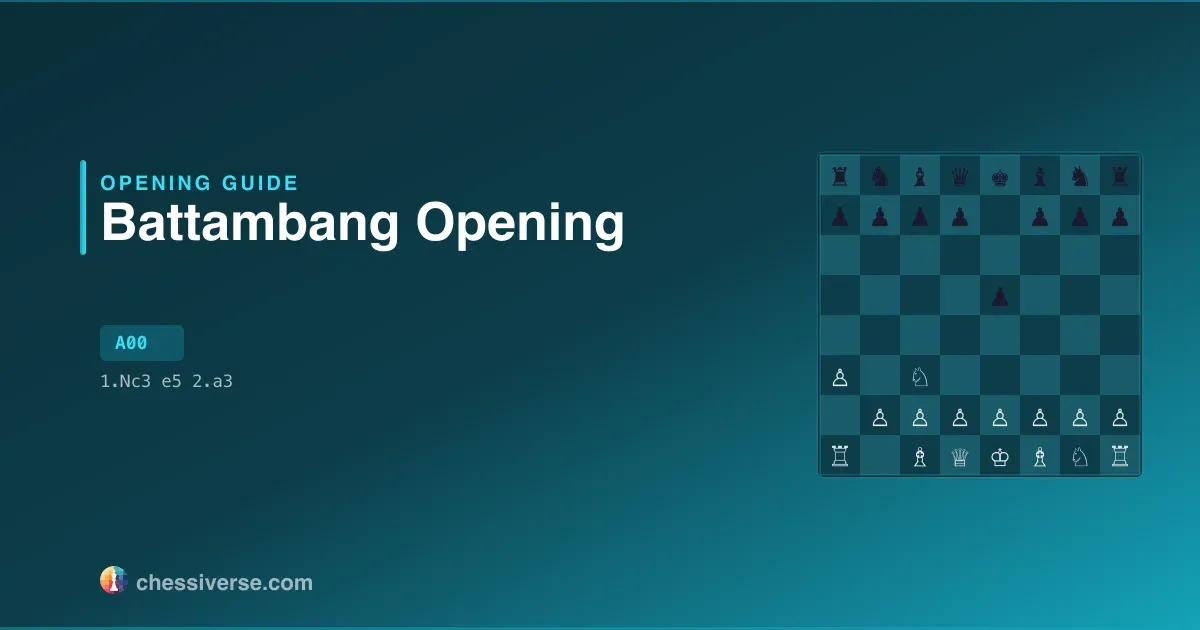

Starting from 1.Nc3 e5 2.a3, players enter the Battambang Opening — ECO A00. Lichess records 134,814 games in this line, which gives us a reliable view of how it actually performs in practice.
History and Notable Players
It arises from the Van Geet Opening: Reversed Nimzowitsch.
Move Diversity and Theory Depth
Looking at move selection shows how forcing — or not — the position really is. At 1200 Elo (26,716 games), the top reply is d5, played 29.3% of the time. Four other moves each take at least 5% of games, and the top three moves account for 73.1% of games. Entropy: 2.64. By 2500 (737 games), d5 dominates at 62% of replies; only two other moves still reach 5% and the top three moves account for 93.3% of games. Entropy drops to 1.69. The narrowing is significant — strong players consolidate around a small set of best moves, while amateurs scatter across many plausible-looking options.
Common Mistakes
- Drifting away from main theory — At 400 Elo, the three most-played moves cover 62.6% of games, against 83.4% at 2000. The most popular deviation is Nc6 (played 21.3% of the time at 400, much less so up top). It looks fine but quietly hands the better-prepared side an edge.
- Neglecting development — Extra pawn moves in the opening are tempting, especially when you "know the moves". Developing a piece each turn is the simple correction.
- Playing without a plan — Each Battambang Opening middlegame demands a specific approach. Decide whether the position calls for attack, manoeuvre, or simplification before reaching for a move.
Practice on Chessiverse
Ready to try the Battambang Opening against a bot? Pick an opponent at your level and play a game.