

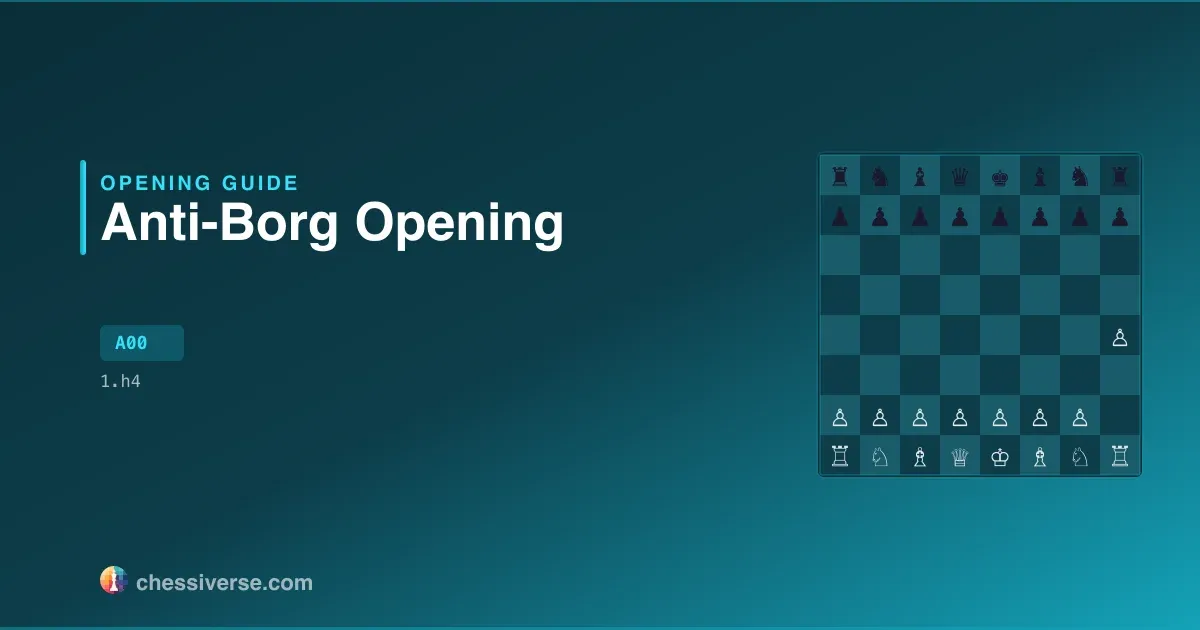
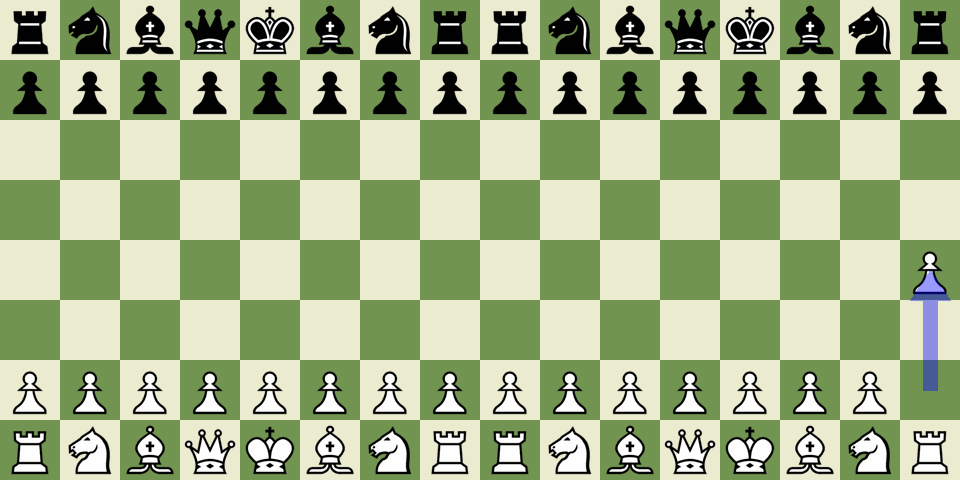
The Anti-Borg Opening begins with 1.h4 (ECO A00). A wing pawn shove that ignores the center, weakens the king, and gets nothing in return. White essentially passes the move while damaging the kingside.
Strategic Overview
1.h4 is a flank shove with no developmental purpose. It doesn't fight for the center, it weakens the squares around the white king, and the rook it nominally frees almost never finds a useful path through h3. Castling kingside is now uncomfortable, and there's no offsetting threat. Black's best replies are central: 1...d5 grabs space and rules out any silly 2.Rh3 idea, while 1...e5 also claims the center and frees Black's queen and dark-squared bishop. The one response to avoid is 1...g6?!, which justifies the h-pawn push by letting White answer 2.h5 with real pressure on Black's fianchetto. Nobody plays this in classical chess at a high level. Magnus Carlsen and Hikaru Nakamura have trotted it out in blitz, and Carlsen even won games with it in Titled Tuesday, but those wins are about preparation gaps and time pressure, not strategic merit. For serious play, treat 1.h4 as a curiosity, not a weapon.
Key Ideas
When players succeed in this line, they usually do so by leaning on the following themes:
- Black should hit the center, not the wing — 1...d5 or 1...e5 punishes 1.h4 by taking exactly what White ignored. Trying to match White on the wing with ...h5 just plays into the same problem from the other side.
- Avoid 1...g6, it justifies the h-pawn — Fianchettoing against 1.h4 invites 2.h5, which puts immediate pressure on Black's intended kingside structure. The g6-pawn becomes a target rather than a shield.
- White's king is now harder to shelter — The h4 pawn weakens g3 and g4 and removes the easy castled-king cover. Even if White recovers a few tempi, the long-term kingside weakness usually outlasts any short-term surprise value.
Performance Across Rating Levels
How well the Anti-Borg Opening works depends on what level you're playing at. The 1200 bracket has 1,013,074 games (0.15% of all games at that level); White wins 38.4%, Black 54.2%, 7.4% are drawn. At 1800 the opening surfaces in 0.05% of games; White wins 45.6%, Black 50.3%, draws 4.2%. At the top end (2500+ Elo), popularity is 0.08% with 7.4% draws — a clear sign of how much theory rules the line at master level. White's score improves by 10.6pp from the 1200 bracket to the 2500 bracket — the line rewards preparation.
Time Control Patterns
The Anti-Borg Opening skews toward rapid chess. In bullet, it appears in 0.12% of games (3,208,201); White wins 44.7%. Blitz shows 0.10% adoption across 3,647,958 games, White scoring 40.5%. In rapid, the share rises to 0.14% — 1,518,247 games, White 36.3%. White's score swings 8.4pp across formats, so time control isn't just a stylistic choice here — it shifts the actual results.
Move Diversity and Theory Depth
Move choice is far from uniform in the Anti-Borg Opening. At 1200 Elo (1,013,074 games), the top reply is e5, played 48% of the time. Two other moves each take at least 5% of games, and the top three moves account for 75.7% of games. Entropy: 2.48. By 2500 (11,159 games), d5 takes over as the top reply at 43.1%; three other moves reach 5% and the top three moves account for 75.6% of games. Entropy rises to 2.51. Even elite players don't fully agree on the best continuation here, which keeps the position dynamic.
Historical Trends
Long-term, the trajectory of this opening is informative. Adoption peaked in 2021 at 0.14% (1,031,547 games). By 2025 it sits at 0.10%, 23% below the peak and roughly back to its 2013 level, leaving the line flat over the full period.
1.h4 is among the rarest of White's twenty possible first moves. David Bronstein told of a Russian player who kept winning with it, and in modern online blitz both Magnus Carlsen and Hikaru Nakamura have wheeled it out - Carlsen even beat Alireza Firouzja with it in a November 2023 online event.
Named after: Anti-Borg is one of many nicknames for 1.h4, more commonly called the Desprez Opening after French player Marcel Després, or the Kadas Opening.
Notable players: Magnus Carlsen, Hikaru Nakamura
The same modest pawn push answers to a whole roster of names - Anti-Borg, Harry's Opening, the Samurai Opening, even Reagan's Attack - alongside its official Desprez and Kadas labels.
Common Mistakes
- Neglecting development — Extra pawn moves in the opening are tempting, especially when you "know the moves". Developing a piece each turn is the simple correction.
- Playing without a plan — Each Anti-Borg Opening middlegame demands a specific approach. Decide whether the position calls for attack, manoeuvre, or simplification before reaching for a move.
Practice on Chessiverse
Ready to try the Anti-Borg Opening against a bot? Pick an opponent at your level and play a game.