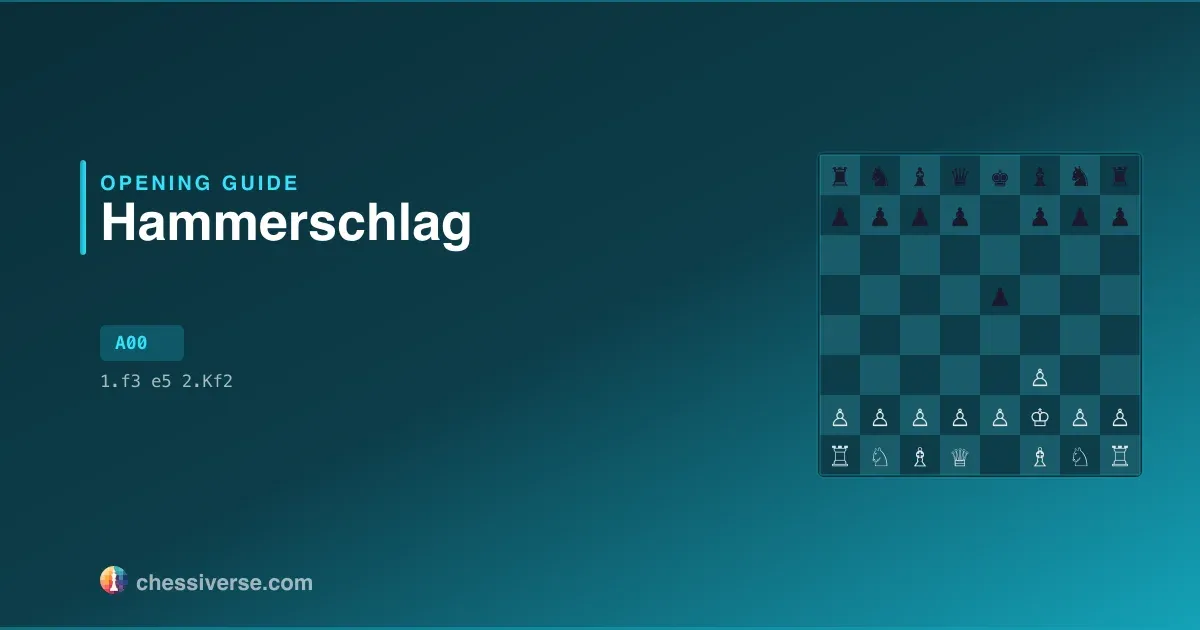
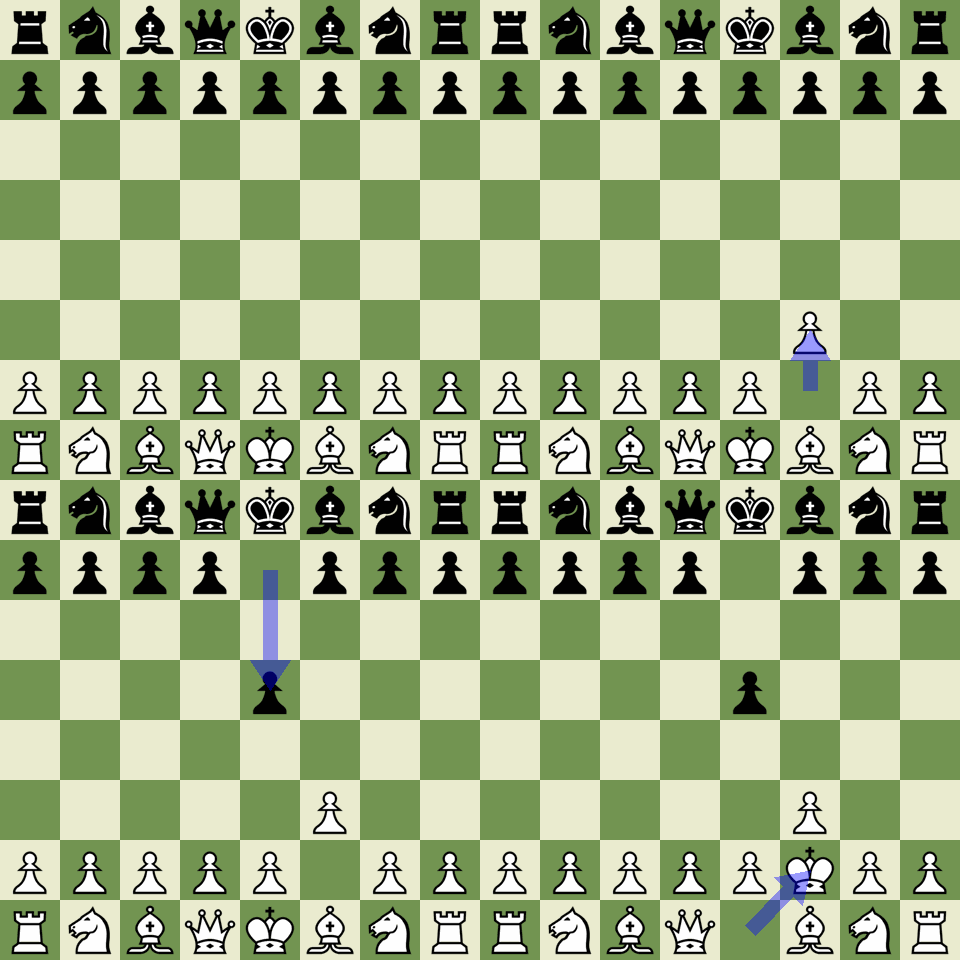
1.f3 e5 2.Kf2 opens the Hammerschlag, ECO A00. After the worst legal first move, White doubles down by walking the king out and giving up castling rights. This isn't an opening. It's a stunt.
Strategic Overview
1.f3 e5 2.Kf2 is a joke line dressed up with multiple names depending on which forum you're reading. It's been called the Hammerschlag, the Fried Fox, the Pork Chop, and a few other things. The strategic content is nearly zero: White has weakened the kingside on move one, then on move two has voluntarily surrendered castling and exposed the king to checks on a diagonal Black has just opened. Black is winning in any objective sense. The line earned brief fame when Magnus Carlsen used a related king-walk idea to defeat Wesley So in the Banter Series, and again through internet legends about a mystery ICC player in 2001 who rumor speculated might have been Bobby Fischer. The honest reason anyone plays it is for entertainment or to mock a much weaker opponent. If you face it as Black, play normal developing moves, target the king, and don't try to refute it with anything clever. Sound chess wins on its own.
Key Ideas
When players succeed in this line, they usually do so by leaning on the following themes:
- Castling is gone, target the king — After 2.Kf2, White's king cannot castle in either direction. Black should focus on opening the center with ...d5 and developing pieces with check-threats along the e and f files. The king has nowhere safe to hide.
- Don't try to refute it tactically — There's no single forcing line that wins material. The path is patient: complete development, control the center, and let White's structural damage compound into a winning middlegame. Forcing tries often blunder back into nothing.
History and Notable Players
It arises from the Gedult's Opening.
It grows out of the Barnes Opening, 1.f3, named for Englishman Thomas Wilson Barnes. Simon Williams used 2.Kf2 to beat Martin Simons in the last round of the 1999 British Championship when he had nothing at stake, and in 2020 Magnus Carlsen played it against Wesley So in blitz purely for the psychological effect.
Notable players: Simon Williams, Magnus Carlsen
The two moves answer to many names — Fried Fox, Pork Chop, Tumbleweed, Half Bird — and after Carlsen crushed Wesley So with them in 2020 blitz, So admitted that losing to f3 and Kf2 was humiliating and hard to forget.
Performance Across Rating Levels
The picture changes a lot as you climb the rating ladder. The 1200 bracket has 19,395 games (0.00% of all games at that level); White wins 44.8%, Black 51.5%, 3.6% are drawn. At 1800 the opening surfaces in 0.00% of games; White wins 45.7%, Black 50.5%, draws 3.8%. Among 2500-rated players the line appears in 0.01% of games and draws spike to 7.2%, indicating tight preparation. White's edge erodes by 3.9pp from 1200 to 2500 Elo, suggesting Black's counterplay is easier to find with experience.
Move Diversity and Theory Depth
Move choice is far from uniform in the Hammerschlag. At 1200 Elo (19,395 games), the top reply is Bc5+, played 33.1% of the time. Three other moves each take at least 5% of games, and the top three moves account for 75.5% of games. Entropy: 2.54. By 2500 (1,444 games), d5 takes over as the top reply at 71.9%; three other moves reach 5% and the top three moves account for 86% of games. Entropy drops to 1.60. The narrowing is significant — strong players consolidate around a small set of best moves, while amateurs scatter across many plausible-looking options.
Common Mistakes
- Drifting away from main theory — At 400 Elo, the three most-played moves cover 68.1% of games, against 77.9% at 2000. The most popular deviation is Nc6 (played 11% of the time at 400, less so up top). It looks fine but quietly hands the better-prepared side an edge.
- Neglecting development — Extra pawn moves in the opening are tempting, especially when you "know the moves". Developing a piece each turn is the simple correction.
- Playing without a plan — Each Hammerschlag middlegame demands a specific approach. Decide whether the position calls for attack, manoeuvre, or simplification before reaching for a move.
Practice on Chessiverse
Ready to try the Hammerschlag against a bot? Pick an opponent at your level and play a game.