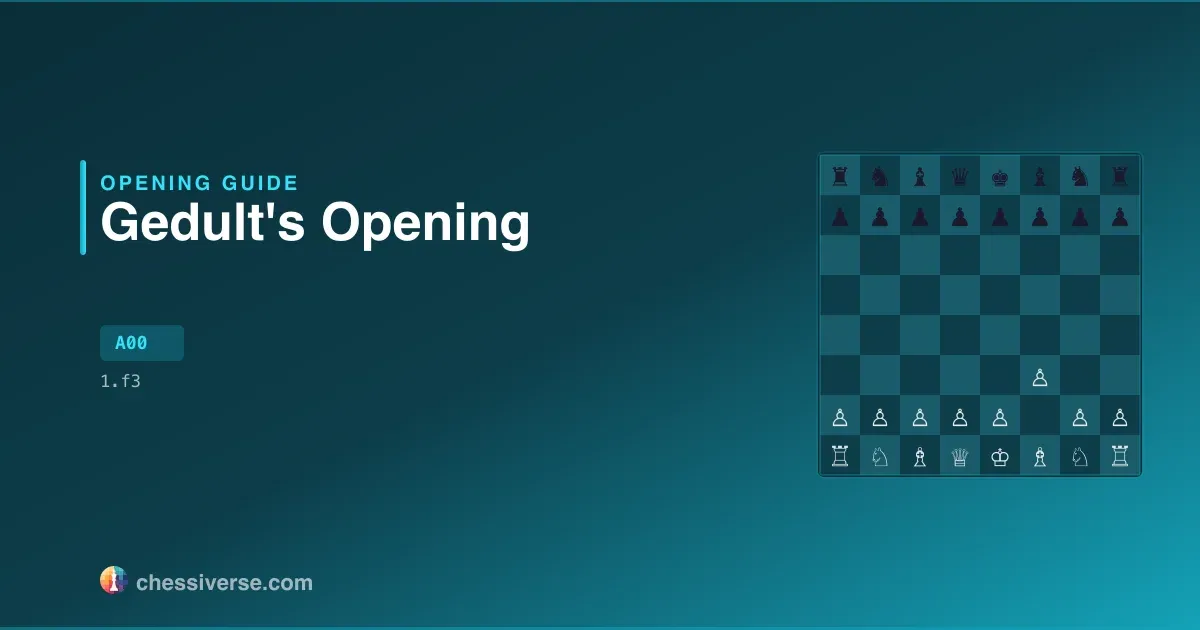
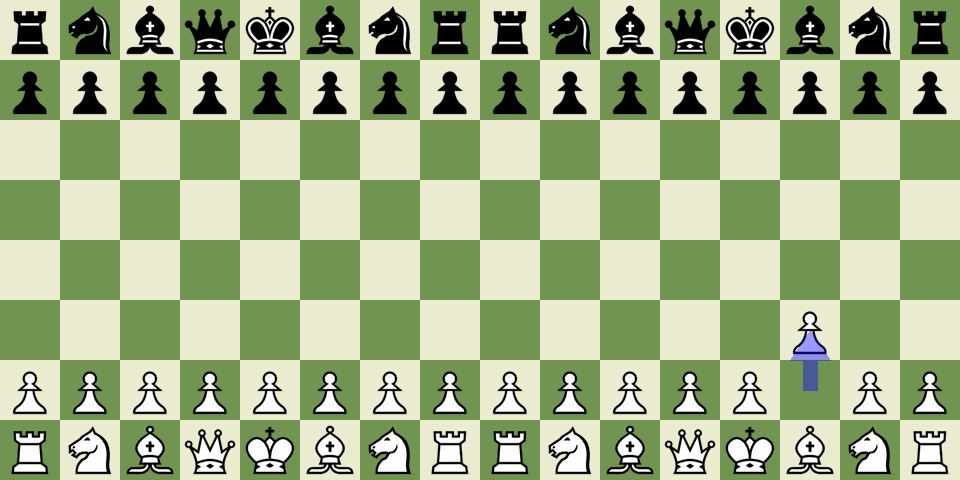
1.f3 opens the Gedult's Opening, ECO A00. There's a strong case that this is the worst legal first move on the board. It weakens the king, blocks the natural knight square, and contests the center less than 1.e4 would have anyway.
Strategic Overview
1.f3 is essentially anti-development. It takes away f3 from the king's knight, opens the e1-h4 diagonal straight at the white king, and the central control it offers is something 1.e4 does better while also putting a pawn on a real square. Black's best response is 1...e5, claiming the center and exploiting the newly weakened diagonal. From there Black has a clear edge and a target to play against. White's most famous follow-up, 2.g4??, allows the fool's mate after 2...Qh4#. More commonly, players who choose 1.f3 are either trolling a much lower-rated opponent for sport or steering into the Hammerschlag with 2.Kf2, surrendering castling rights to play a comedy game. There's no serious strategic plan here. If you face it, take the center, develop quickly, and aim at the king on e1.
Key Ideas
When players succeed in this line, they usually do so by leaning on the following themes:
- 1...e5 punishes the weakened diagonal — The opening of the e1-h4 diagonal is the immediate strategic flaw of 1.f3. By playing 1...e5, Black both occupies the center and lines up ...Qh4 ideas that White must spend tempo preventing.
- Avoid fool's mate after 2.g4 — If White doubles down with 2.g4??, Black wins instantly with 2...Qh4#. It is the fastest checkmate in chess, and it exists precisely because 1.f3 already weakened the king's diagonal.
- The king's knight has lost its home square — The knight that normally goes to f3 must now reroute through e2 or h3, both passive squares. White's development is permanently slower because of one pawn move.
Performance Across Rating Levels
Popularity and results vary sharply by rating level. The 1200 bracket has 589,459 games (0.09% of all games at that level); White wins 38.7%, Black 55.7%, 5.6% are drawn. Move up to 1800 Elo and the share shifts to 0.07%, with White winning 44.7% versus Black's 51.2%. Among 2500-rated players the line appears in 0.07% of games and draws spike to 7.5%, indicating tight preparation.
Time Control Patterns
The Gedult's Opening skews toward bullet chess. In bullet, it appears in 0.23% of games (6,019,464); White wins 46.7%. Blitz shows 0.08% adoption across 3,012,230 games, White scoring 41.7%. In rapid, the share rises to 0.06% — 679,257 games, White 35.8%. White's score swings 10.9pp across formats, so time control isn't just a stylistic choice here — it shifts the actual results.
Move Diversity and Theory Depth
Looking at move selection shows how forcing — or not — the position really is. At 1200 Elo (589,459 games), the top reply is e5, played 45.4% of the time. Three other moves each take at least 5% of games, and the top three moves account for 76.2% of games. Entropy: 2.49. By 2500 (9,778 games), d5 takes over as the top reply at 40.4%; four other moves reach 5% and the top three moves account for 77.2% of games. Entropy drops to 2.44. Move diversity stays high even at master level, suggesting the opening doesn't force one specific response.
Historical Trends
Long-term, the trajectory of this opening is informative. Adoption peaked in 2021 at 0.09% (677,468 games). By 2025 it sits at 0.08%, 14% below the peak but still 40% above its 2013 level, so the line is up over the full period despite easing from the high.
Namesake Thomas Wilson Barnes scored more wins in friendly play against Paul Morphy in 1858 than anyone else. The move itself has been panned ever since: Edmar Mednis rated 1.f3 the worst of White's twenty possible first moves, and Paul van der Sterren likened it to shooting yourself in the foot.
Named after: Gedult's Opening is an alternative name for 1.f3, more commonly called the Barnes Opening after English player Thomas Wilson Barnes (1825-1874).
Notable players: Simon Williams, Magnus Carlsen
1.f3 e5 2.g4 Qh4# is the fool's mate, yet Magnus Carlsen still met Wesley So with 1.f3 and 2.Kf2 in a 2020 blitz game, for the psychological effect.
Main Lines and Variations
After 1.f3, the established follow-ups are:
Each branch leads to a different middlegame character — the resulting pawn structure decides what kind of game you get.
Common Mistakes
- Neglecting development — It can feel productive to make extra pawn moves early, but falling behind in piece development is what loses most amateur games — especially in open positions where active pieces find squares fast.
- Playing without a plan — Each Gedult's Opening middlegame demands a specific approach. Decide whether the position calls for attack, manoeuvre, or simplification before reaching for a move.
Practice on Chessiverse
Ready to try the Gedult's Opening against a bot? Pick an opponent at your level and play a game.