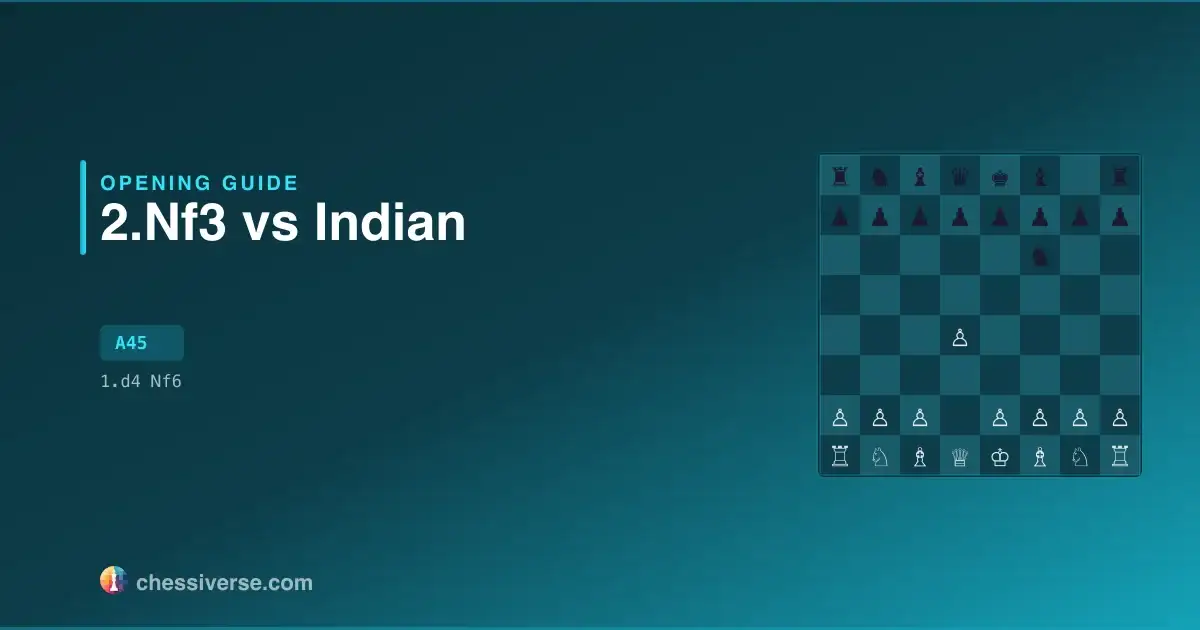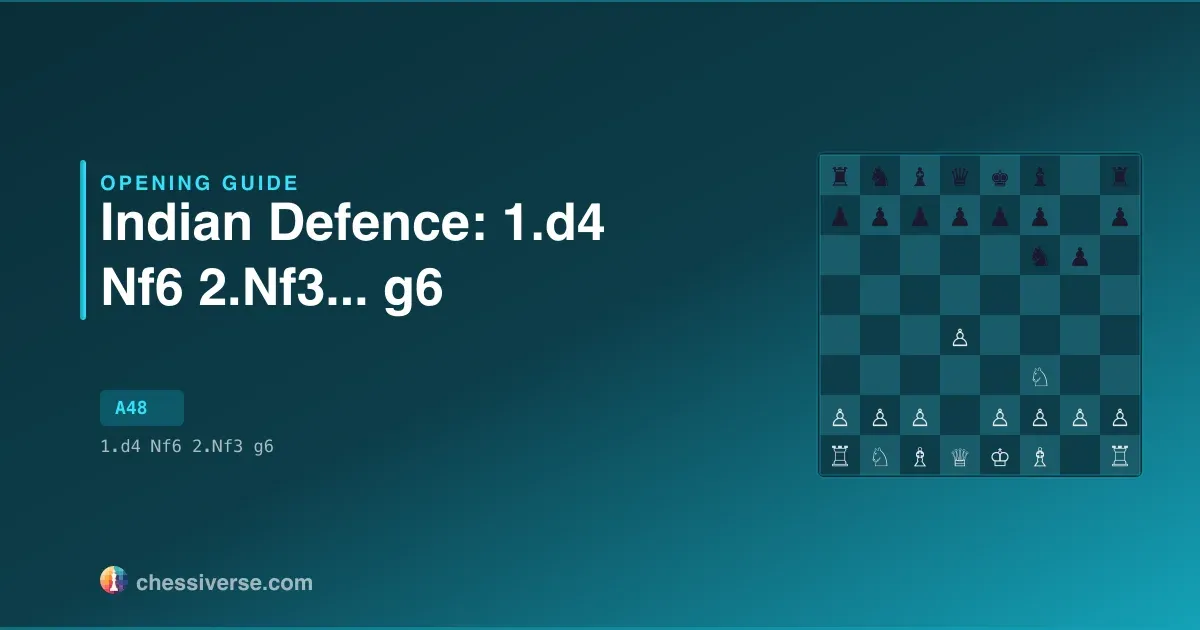
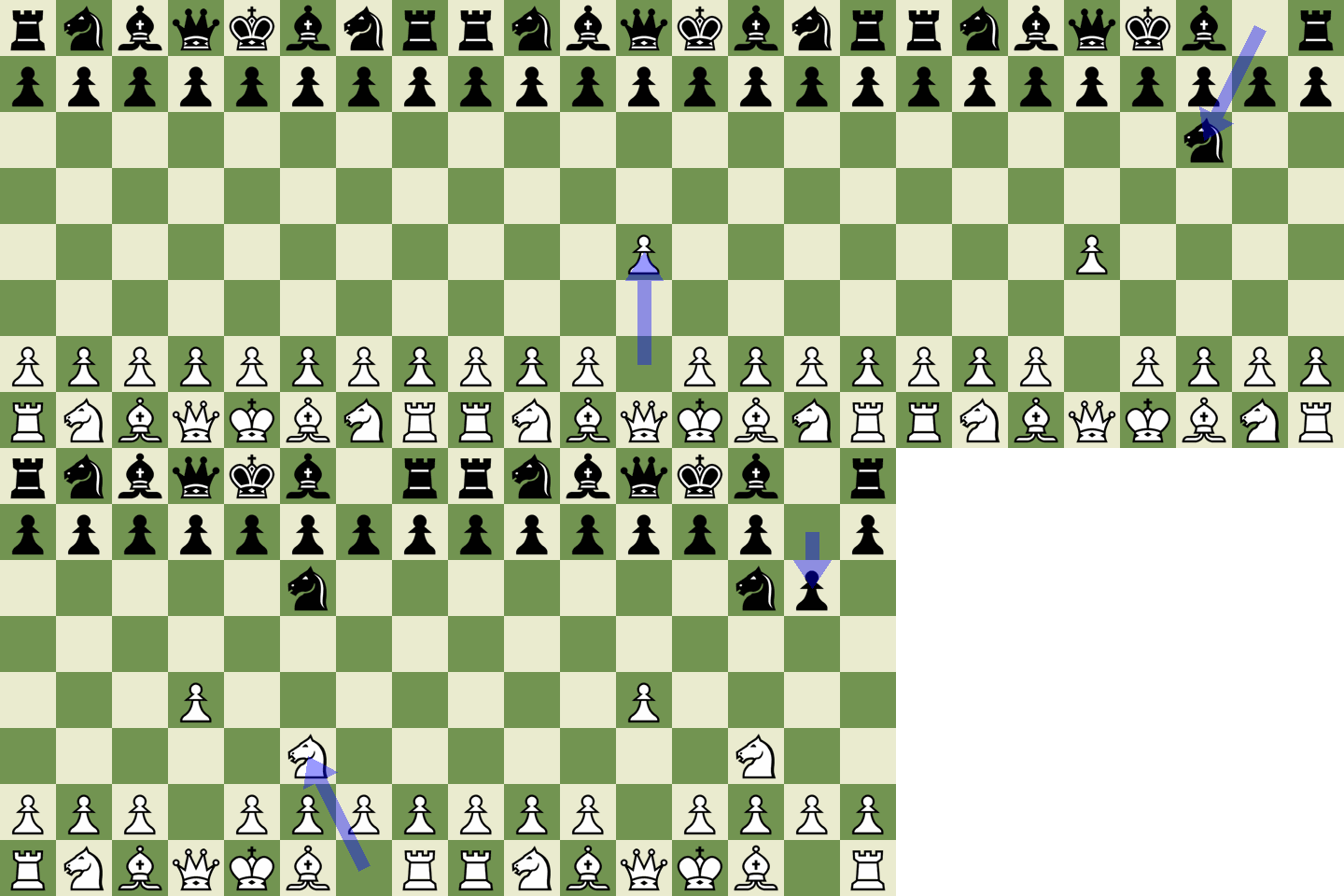
1.d4 Nf6 2.Nf3 g6 opens the East Indian Defense, ECO A48. White holds back the c-pawn and Black holds back the d-pawn — a mutual waiting game that keeps every major Indian Defense alive. The first side to commit a pawn dictates the structure.
Strategic Overview
This is a flexible position because both sides are deliberately uncommitted. White hasn't played c4, which means the King's Indian and Grünfeld are still latent rather than active. Black hasn't played ...d5 or ...d6, which means the choice between Grünfeld (active center) and King's Indian (fianchetto with delayed center) is still open. White's main options are 3.c4 (transposing into mainstream Indian Defense theory), 3.g3 (a quieter setup heading for a King's Indian Attack-style game), and 3.Bf4 or 3.Bg5 (Anti-Indian systems that try to disrupt Black's plans before they crystallize). The interesting feature of this position is that both sides can use it to dodge their opponent's preparation. A Black player who doesn't want to face the Bayonet Attack or Mar del Plata Variations of the King's Indian can use this move order to steer toward something else. A White player who doesn't want to memorize Grünfeld theory can play 3.g3 and head for a quieter game. The middlegame character depends entirely on which transposition both sides agree to. There's no single strategic theme — the opening is a launching pad for many different middlegame structures.
Key Ideas
The recurring motifs below distinguish a confident handler of this opening from a beginner:
- Mutual waiting game preserves all options — Neither side has committed to the structure that defines mainstream Indian Defense theory. Both sides are dodging preparation by keeping pawn moves flexible.
- 3.c4 returns to mainstream theory — If White plays c4, the game transposes into normal King's Indian, Grünfeld, or related Indian Defense lines. This is the principled but most theoretical path.
- 3.g3 heads for a quieter game — Fianchetto setups without c4 give White a flexible structure resembling a King's Indian Attack. The game becomes slower and more strategic than mainstream Indian theory.
- Anti-Indian setups with Bf4 or Bg5 — Developing the queen's bishop early lets White avoid Indian theory entirely. The resulting positions are more positional and less concrete than mainstream lines.
History and Notable Players
It arises from the Indian Game: 2.Nf3 Systems. Among the most prolific White practitioners are Oleg M Romanishin (197 games), Vladimir P Malaniuk (165 games), Mark L Hebden (153 games). Black-side regulars include Mark L Hebden (121 games), Zdenko Kozul (121 games), Lubomir Ftacnik (112 games).
Performance Across Rating Levels
How well the East Indian Defense works depends on what level you're playing at. The 1200 bracket has 901,108 games (0.13% of all games at that level); White wins 46.3%, Black 49.7%, 4% are drawn. At 1800 the opening surfaces in 0.45% of games; White wins 48.1%, Black 46.5%, draws 5.4%. At the top end (2500+ Elo), popularity is 1.79% with 10.7% draws — a clear sign of how much theory rules the line at master level. Positions also become less sharp as level rises (sharpness 0.96 → 0.89).
Time Control Patterns
Look at the same opening across time controls and bullet stands out. In bullet, it appears in 0.39% of games (10,263,606); White wins 48.8%. Blitz shows 0.38% adoption across 13,770,418 games, White scoring 47.9%. In rapid, the share rises to 0.22% — 2,417,471 games, White 45.9%. White's score swings 2.9pp across formats, so time control isn't just a stylistic choice here — it shifts the actual results.
Move Diversity and Theory Depth
Move choice is far from uniform in the East Indian Defense. At 1200 Elo (901,108 games), the top reply is e3, played 21.6% of the time. Five other moves each take at least 5% of games, and the top three moves account for 61.2% of games. Entropy: 2.93. By 2500 (244,053 games), c4 takes over as the top reply at 35.1%; only four other moves still reach 5% and the top three moves account for 66.1% of games. Entropy drops to 2.66.
Historical Trends
Tracking the East Indian Defense year over year shows a clear story. Adoption peaked in 2020 at 0.41% (2,380,763 games). By 2025 it sits at 0.32%, 24% below the peak but still 45% above its 2013 level, so the line is up over the full period despite easing from the high.
Main Lines and Variations
After 1.d4 Nf6 2.Nf3 g6, the established follow-ups are:
Each branch leads to a different middlegame character — the resulting pawn structure decides what kind of game you get.
Common Mistakes
- Neglecting development — It can feel productive to make extra pawn moves early, but falling behind in piece development is what loses most amateur games — especially in open positions where active pieces find squares fast.
- Letting White own the centre — Hypermodern openings concede central space on purpose, but only if you strike back in time. Delay the counter-blow and you end up squeezed.
Practice on Chessiverse
Ready to try the East Indian Defense against a bot? Pick an opponent at your level and play a game.