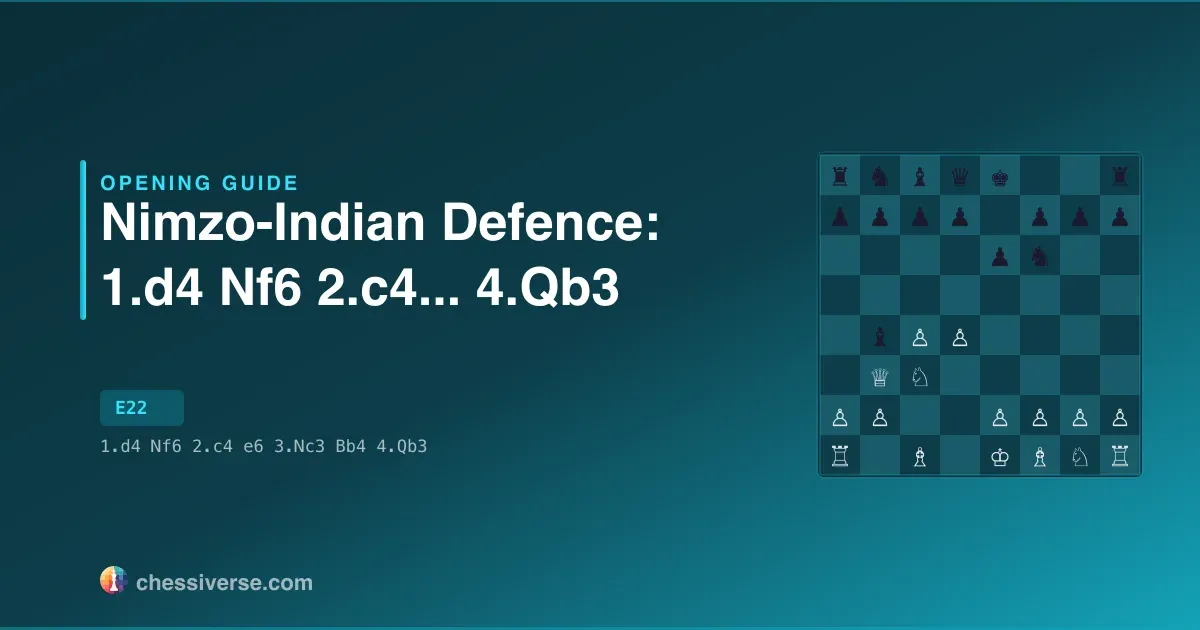
The Nimzo-Indian Defense: Spielmann Variation begins with 1.d4 Nf6 2.c4 e6 3.Nc3 Bb4 4.Qb3 (ECO E22). The Spielmann Variation. The queen comes out early to protect the pinned knight and harass the bishop — a direct, somewhat unfashionable reply that asks Black to commit early.
Strategic Overview
4.Qb3 has two simultaneous jobs. The queen defends the knight on c3, removing the threat of doubled pawns from ...Bxc3+, and it attacks the bishop on b4 at the same time. The trade-off is the classic objection to early queen sorties: she might become a target if Black gets in clean developing moves. The line was a Spielmann favourite and has been periodically revived, but it sits well outside the modern Nimzo main lines. Black's responses tend to revolve around piece development that simultaneously addresses the bishop's safety and the queen's exposure — ...a5 to defend the bishop, ...c5 to question the centre, or development with ...Nc6 to keep options open. White's plan is to use the queen actively without losing time and to convert the now-secured c3 knight into a central asset. The middlegame structures depend heavily on how Black resolves the bishop question, but if Black plays accurately, the queen on b3 can find herself overworked. Against an unprepared opponent the line carries some surprise value; against theory, it's a slightly committal way to play the Nimzo.
Key Ideas
The recurring motifs below distinguish a confident handler of this opening from a beginner:
- Defending the knight and attacking the bishop in one move — 4.Qb3 does two things at once: it removes the threat of ...Bxc3+ doubling White's c-pawns and it pressures the bishop on b4, forcing Black to respond.
- Early queen development cuts both ways — Bringing the queen out so early is the textbook "don't do this" move. White justifies it because Black can't easily harass the queen with developing moves, but if Black plays precisely the queen can become a target.
- Black usually defends the bishop with ...a5 or trades — The most common reaction is to support the bishop with ...a5, keeping the pin intact and gaining queenside space. Other options include trading on c3 anyway and accepting the structure, or shifting focus with ...c5.
History and Notable Players
It arises from the Nimzo-Indian Defense. Among the most prolific White practitioners are Gideon Stahlberg (17 games), Wolfgang Riedel (14 games), Guillermo Soppe (13 games). Black-side regulars include Aaron Nimzowitsch (8 games), Alexander Alekhine (7 games), Edgard Colle (6 games).
Performance Across Rating Levels
How well the Nimzo-Indian Defense: Spielmann Variation works depends on what level you're playing at. The 1200 bracket has 12,179 games (0.00% of all games at that level); White wins 49.5%, Black 47.4%, 3.1% are drawn. At 1800 the opening surfaces in 0.01% of games; White wins 48.3%, Black 46.8%, draws 4.9%. At the top end (2500+ Elo), popularity is 0.05% with 9.5% draws — a clear sign of how much theory rules the line at master level. Positions also become less sharp as level rises (sharpness 0.97 → 0.91).
Time Control Patterns
Look at the same opening across time controls and blitz stands out. In bullet, it appears in 0.01% of games (163,688); White wins 49.4%. Blitz shows 0.01% adoption across 371,102 games, White scoring 48.5%. In rapid, the share rises to 0.01% — 62,785 games, White 46%. White's score swings 3.4pp across formats, so time control isn't just a stylistic choice here — it shifts the actual results.
Move Diversity and Theory Depth
Looking at move selection shows how forcing — or not — the position really is. At 1200 Elo (12,151 games), the top reply is Bxc3+, played 43% of the time. Three other moves each take at least 5% of games, and the top three moves account for 77.3% of games. Entropy: 2.31. By 2500 (6,333 games), c5 takes over as the top reply at 70.5%; three other moves reach 5% and the top three moves account for 91% of games. Entropy drops to 1.47. That entropy collapse is the signature of a line where preparation pays off: at the top, players know the best move and play it.
Historical Trends
Tracking the Nimzo-Indian Defense: Spielmann Variation year over year shows a clear story. Adoption peaked in 2015 at 0.012% (2,644 games). By 2025 it sits at 0.009%, 27% below the peak but still 21% above its 2013 level, so the line is up over the full period despite easing from the high.
Main Lines and Variations
The main branches off 1.d4 Nf6 2.c4 e6 3.Nc3 Bb4 4.Qb3 include:
Each branch leads to a different middlegame character — the resulting pawn structure decides what kind of game you get.
Common Mistakes
- Drifting away from main theory — At 400 Elo, the three most-played moves cover 75.4% of games, against 86.2% at 2000. The most popular deviation is a5 (played 21.8% of the time at 400, much less so up top). It looks fine but quietly hands the better-prepared side an edge.
- Neglecting development — It can feel productive to make extra pawn moves early, but falling behind in piece development is what loses most amateur games — especially in open positions where active pieces find squares fast.
- Letting White own the centre — Hypermodern openings concede central space on purpose, but only if you strike back in time. Delay the counter-blow and you end up squeezed.
Practice on Chessiverse
Ready to try the Nimzo-Indian Defense: Spielmann Variation against a bot? Pick an opponent at your level and play a game.