



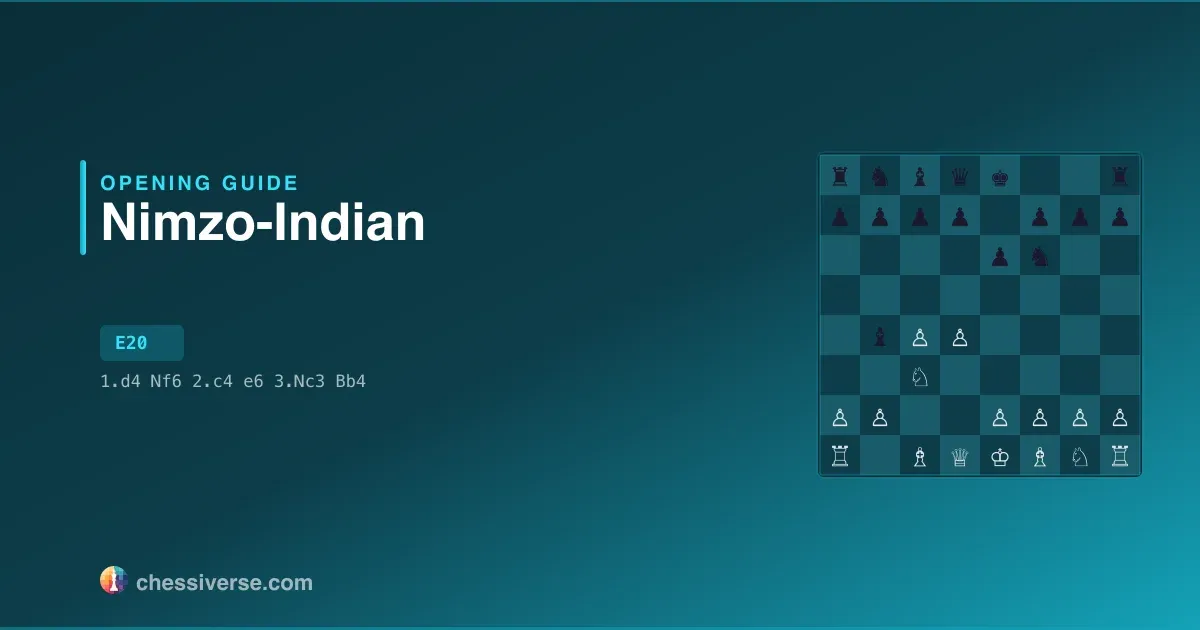
The Nimzo-Indian Defense arises after 1.d4 Nf6 2.c4 e6 3.Nc3 Bb4 and falls under ECO code E20. With 3...Bb4, Black places the dark-squared bishop on its most active diagonal and pins the c3 knight, creating problems for White on multiple levels. The most important positional consequence is that the pin undermines White's control of e4: although White would like to advance e4 at some point, the f6 knight currently dominates the square and the pinned c3 knight cannot recapture. This means Black may be able to establish a knight on e4 or use the square to their advantage if White fails to contest it. Additionally, Black carries the constant threat of exchanging bishop for knight, doubling White's pawns on the c-file. Should this exchange occur, the game becomes structurally unbalanced: White will seek to open the position to maximize the bishop pair, while Black aims to keep things closed and exploit the weakened pawn structure. White must weigh these factors carefully when choosing a fourth move. The Nimzo-Indian offers both sides a wealth of systems to explore. Notably, the seemingly logical 4. Bd2, which breaks the pin and eliminates the doubled-pawn threat, is almost never played at the top level because it is far less ambitious than the alternatives. With 13.1 million Lichess games across all rating levels, it is a well-established opening choice.
- Black pins the c3-knight to stop White's planned e4, and is often happy to trade the bishop to saddle White with doubled c-pawns.
- Play revolves around the light squares e4 and d5: Black blockades White's pawn centre and keeps the position closed so White's bishop pair stays passive.
- Unlike most Indian defences there is no immediate fianchetto, though ...b6 and ...Bb7 often follow; delaying the pawn structure keeps Black flexible.
History and Notable Players
It arises from the Indian Defense Systems. Among the most prolific practitioners on the White side are Svetozar Gligoric (364 games), Aleksej Aleksandrov (266 games), Jan Hein Donner (218 games). On the Black side, notable exponents include Ivan Farago (178 games), Viktor Korchnoi (174 games), Anatoly Karpov (160 games).
The position first appeared in Englisch versus Blackburne, London 1883, but it was Aron Nimzowitsch who turned it into a real system in the early 1900s. It became one of the most respected answers to 1.d4, played at every level, and every world champion since Capablanca has used it.
Named after: Named after Aron Nimzowitsch, who introduced the system into master-level chess in the early twentieth century.
Notable players: Mikhail Botvinnik, Samuel Reshevsky, Anatoly Karpov, Garry Kasparov
It is so well respected that many White players choose 3.Nf3 or 3.g3 specifically to dodge it, and every world champion since Capablanca has kept the Nimzo-Indian in their repertoire.
Statistics
Based on 13.1 million Lichess games across all rating levels:
- White wins: 48.5%
- Black wins: 46.2%
- Draws: 5.2%
The statistics show a roughly balanced opening where both sides have equal chances.
Main Lines and Variations
After 1.d4 Nf6 2.c4 e6 3.Nc3 Bb4, the main continuations include:
- Nimzo-Indian Defense: Three Knights Variation
- Nimzo-Indian Defense: Spielmann Variation
- Nimzo-Indian Defense: Leningrad Variation
- Nimzo-Indian Defense: Classical Variation
- Nimzo-Indian Defense: Rubinstein System
- Nimzo-Indian Defense: Sämisch Variation (ECO E24)
Each of these lines leads to distinct types of positions and requires its own understanding of the resulting pawn structures and piece placements.
Common Mistakes to Avoid
- Allowing White to build an overwhelming center: Hypermodern openings allow White space in the center, but you need to strike back at the right moment. Delaying the counterattack too long can leave you without active play.
Practice on Chessiverse
The best way to learn the Nimzo-Indian Defense is through practice. On Chessiverse, you can play chess against computer opponents that specialize in this opening. Our AI bots range from beginner to grandmaster level, each with unique playing styles — from aggressive attackers to solid defenders. Choose a bot that matches your rating and work your way up as you master the opening's key ideas.
Performance Across Rating Levels
The picture changes a lot as you climb the rating ladder. At 1200 Elo, the opening shows up in 0.07% of games (505,067 samples). White scores 50.2%, Black 46.4%, draws 3.4%. Move up to 1800 Elo and the share shifts to 0.42%, with White winning 48.1% versus Black's 46.9%. At the top end (2500+ Elo), popularity is 1.79% with 9.7% draws — a clear sign of how much theory rules the line at master level.
Time Control Patterns
The Nimzo-Indian Defense skews toward blitz chess. In bullet, it appears in 0.20% of games (5,329,051); White wins 50.1%. Blitz shows 0.31% adoption across 11,040,420 games, White scoring 48.8%. In rapid, the share rises to 0.19% — 2,073,793 games, White 47.2%. White's score swings 2.9pp across formats, so time control isn't just a stylistic choice here — it shifts the actual results.
Move Diversity and Theory Depth
Looking at move selection shows how forcing — or not — the position really is. At 1200 Elo (505,067 games), the top reply is Bd2, played 30.3% of the time. Five other moves each take at least 5% of games, and the top three moves account for 61.5% of games. Entropy: 2.87. By 2500 (243,983 games), e3 takes over as the top reply at 34.7%; only four other moves still reach 5% and the top three moves account for 72.1% of games. Entropy drops to 2.58.