



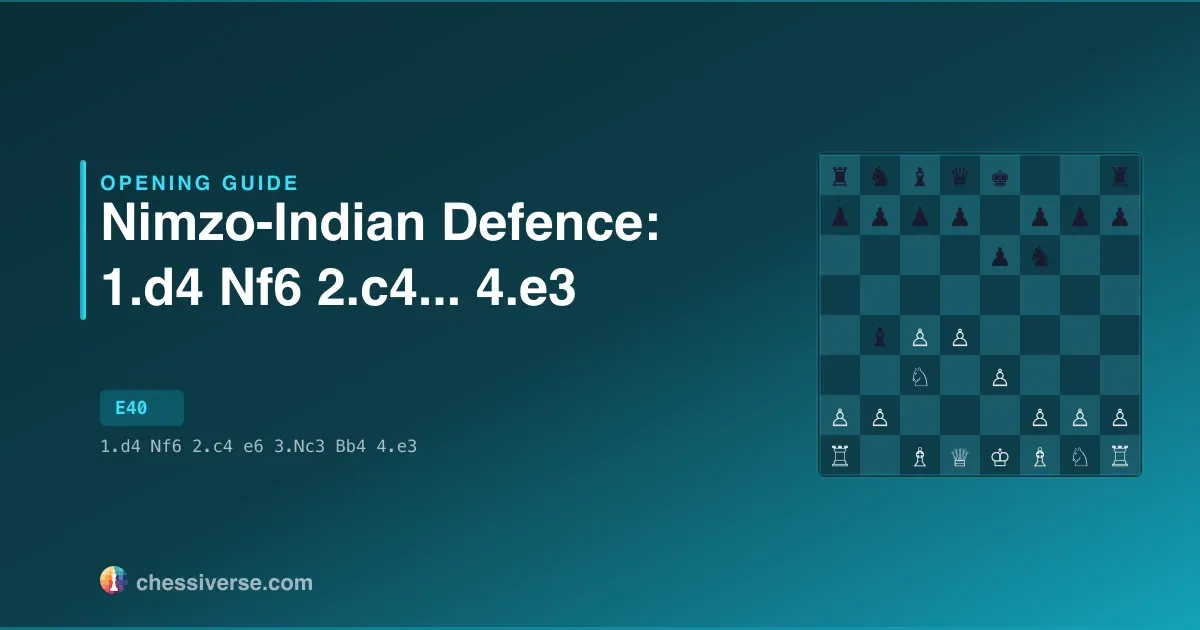
Starting from 1.d4 Nf6 2.c4 e6 3.Nc3 Bb4 4.e3, players enter the Nimzo-Indian Defense: Rubinstein System — ECO E40. The Rubinstein system. White doesn't bother preventing ...Bxc3+ and doesn't kick the bishop with a3. Instead, the focus shifts to development, with Bd3 ready to contest e4.
Strategic Overview
4.e3 is the workhorse of Nimzo theory and probably the most flexible system available to White. The move is unambitious in appearance — it simply opens a diagonal for the light-squared bishop — but the practical effect is significant. White accepts that ...Bxc3+ might come at some point, develops without committing the c1 bishop, and prepares to plant the bishop on d3 where it controls e4 and aims at Black's kingside. Black has three main paths. 4...O-O is the most flexible, completing kingside development before showing any cards. 4...c5 hits the centre immediately; here White cannot recapture on c5 with the b-pawn without creating tripled isolated pawns after a later ...Bxc3+, so White typically lets the tension stand and continues developing. 4...b6 is the St. Petersburg, preparing ...Bb7 (and sometimes ...Ba6) to reinforce control of e4 from the queenside. In each of these branches White has the choice between 5.Nge2 — keeping the c1 bishop flexible and supporting the d4-e3 chain from behind — and 5.Bd3, the natural developing move that puts the bishop where it belongs. Both are theoretically respectable and produce different middlegame characters.
Key Ideas
When players succeed in this line, they usually do so by leaning on the following themes:
- Pure development without prophylaxis — Unlike 4.Qc2 or 4.a3, this move doesn't address ...Bxc3+ at all. White trusts that doubled c-pawns can be lived with and prioritises rapid, flexible development.
- Bd3 contests e4 from the natural square — Opening the diagonal for the light-squared bishop is the immediate payoff. Once Bd3 is in place, the bishop joins the fight for the e4 square — the recurring strategic battleground of every Nimzo.
- 4...O-O is the universal flexible response — Castling kingside is always useful in the Nimzo because Black almost never castles queenside. The move commits to nothing else and waits to see how White develops before choosing a structural plan.
- 4...c5 hits the centre and forbids bxc5 — Pushing the c-pawn challenges d4 directly. Taking with the b-pawn would lead to tripled isolated pawns after a later ...Bxc3+, so White typically leaves the tension and develops further.
- 4...b6 (St. Petersburg) doubles down on e4 control — Preparing ...Bb7 reinforces Black's grip on e4 from another angle. Sometimes the bishop reroutes to a6 to pressure the c4 pawn instead, depending on White's setup.
History and Notable Players
It arises from the Nimzo-Indian Defense. Among the most prolific White practitioners are Svetozar Gligoric (337 games), Aleksej Aleksandrov (251 games), Jan Hein Donner (177 games). Black-side regulars include Viktor Korchnoi (89 games), Ratmir Kholmov (75 games), Aleksandar Matanovic (72 games).
Performance Across Rating Levels
The picture changes a lot as you climb the rating ladder. At 1200 Elo, the opening shows up in 0.01% of games (51,449 samples). White scores 50.8%, Black 45.8%, draws 3.4%. By 1800, popularity is 0.05% and White's score is 49.5% to Black's 45.7%. At the top end (2500+ Elo), popularity is 0.62% with 9.6% draws — a clear sign of how much theory rules the line at master level. Positions also become less sharp as level rises (sharpness 0.97 → 0.90).
Time Control Patterns
The Nimzo-Indian Defense: Rubinstein System skews toward blitz chess. In bullet, it appears in 0.03% of games (922,102); White wins 50.3%. Blitz shows 0.05% adoption across 1,720,099 games, White scoring 49.5%. In rapid, the share rises to 0.02% — 242,741 games, White 49.1%.
Move Diversity and Theory Depth
Looking at move selection shows how forcing — or not — the position really is. At 1200 Elo (51,361 games), the top reply is O-O, played 27.9% of the time. Five other moves each take at least 5% of games, and the top three moves account for 66% of games. Entropy: 2.75. By 2500 (84,528 games), O-O dominates at 65.3% of replies; only three other moves still reach 5% and the top three moves account for 90.9% of games. Entropy drops to 1.63. The narrowing is significant — strong players consolidate around a small set of best moves, while amateurs scatter across many plausible-looking options.
Main Lines and Variations
After 1.d4 Nf6 2.c4 e6 3.Nc3 Bb4 4.e3, the established follow-ups are:
- Nimzo-Indian Defense: Rubinstein System (4...c5)
- Nimzo-Indian Defense: St. Petersburg Variation
- Nimzo-Indian Defense: Normal Variation
Each branch leads to a different middlegame character — the resulting pawn structure decides what kind of game you get.
Common Mistakes
- Drifting away from main theory — At 400 Elo, the three most-played moves cover 67.1% of games, against 75.1% at 2000. The most popular deviation is Bxc3+ (played 25.6% of the time at 400, much less so up top). It looks fine but quietly hands the better-prepared side an edge.
- Neglecting development — It can feel productive to make extra pawn moves early, but falling behind in piece development is what loses most amateur games — especially in open positions where active pieces find squares fast.
- Letting White own the centre — Hypermodern openings concede central space on purpose, but only if you strike back in time. Delay the counter-blow and you end up squeezed.
Practice on Chessiverse
Ready to try the Nimzo-Indian Defense: Rubinstein System against a bot? Pick an opponent at your level and play a game.