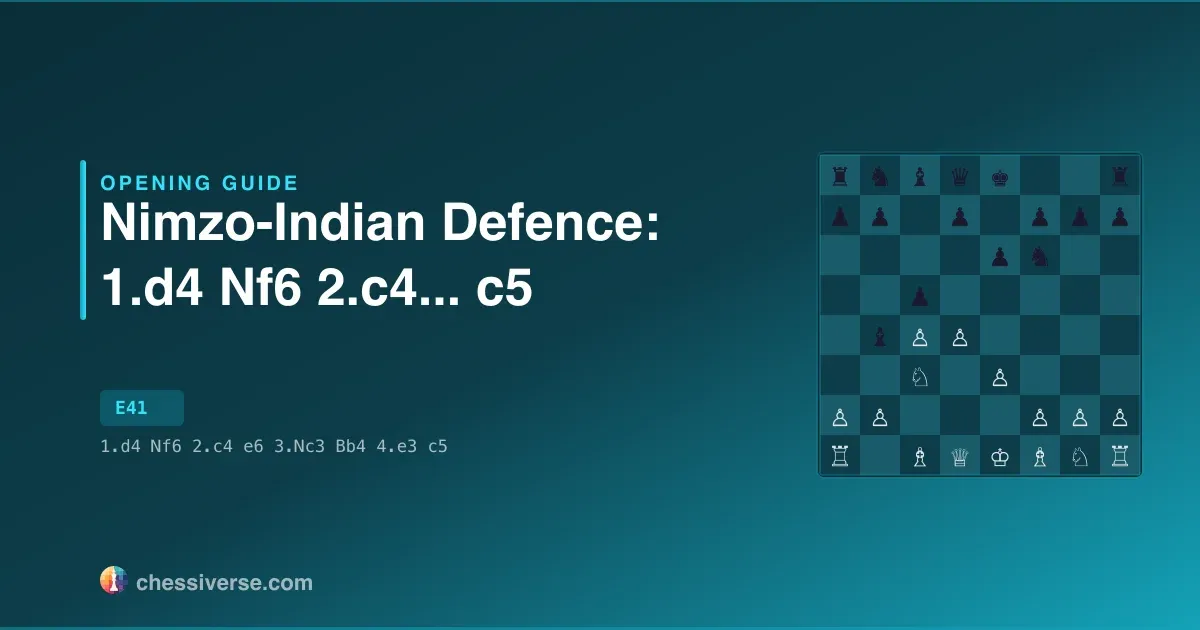
The Nimzo-Indian Defense: Rubinstein System (4...c5) begins with 1.d4 Nf6 2.c4 e6 3.Nc3 Bb4 4.e3 c5 (ECO E41). Lichess records 351,456 games in this line, which gives us a reliable view of how it actually performs in practice.
History and Notable Players
It arises from the Nimzo-Indian Defense: Rubinstein System. On the White side, Svetozar Gligoric (111 games), Jan Hein Donner (81 games), Rainer Knaak (73 games) top the database. Notable Black exponents: Aleksandar Matanovic (52 games), Ulf Andersson (46 games), Bruno Parma (39 games).
Performance Across Rating Levels
How well the Nimzo-Indian Defense: Rubinstein System (4...c5) works depends on what level you're playing at. At 1200 Elo, the opening shows up in 0.00% of games (4,082 samples). White scores 51%, Black 45.7%, draws 3.3%. By 1800, popularity is 0.01% and White's score is 49.1% to Black's 45.9%. At the top end (2500+ Elo), popularity is 0.08% with 10.5% draws — a clear sign of how much theory rules the line at master level. White's edge erodes by 3.5pp from 1200 to 2500 Elo, suggesting Black's counterplay is easier to find with experience.
Move Diversity and Theory Depth
What players actually play after the opening moves depends heavily on rating. At 1200 Elo (4,073 games), the top reply is a3, played 27.8% of the time. Six other moves each take at least 5% of games, and the top three moves account for 65.8% of games. Entropy: 2.75. By 2500 (10,786 games), Ne2 takes over as the top reply at 50.6%; only three other moves still reach 5% and the top three moves account for 87.9% of games. Entropy drops to 1.88. The narrowing is significant — strong players consolidate around a small set of best moves, while amateurs scatter across many plausible-looking options.
Historical Trends
Tracking the Nimzo-Indian Defense: Rubinstein System (4...c5) year over year shows a clear story. Adoption peaked in 2015 at 0.015% (3,242 games). By 2025 it sits at 0.006%, 58% below the peak and 34% under its 2013 level, leaving the line in decline.
Main Lines and Variations
After 1.d4 Nf6 2.c4 e6 3.Nc3 Bb4 4.e3 c5, the established follow-ups are:
Each branch leads to a different middlegame character — the resulting pawn structure decides what kind of game you get.
Common Mistakes
- Drifting away from main theory — At 400 Elo, the three most-played moves cover 68.6% of games, against 80.1% at 2000. The most popular deviation is Bd2 (played 15.7% of the time at 400, much less so up top). It looks fine but quietly hands the better-prepared side an edge.
- Neglecting development — Extra pawn moves in the opening are tempting, especially when you "know the moves". Developing a piece each turn is the simple correction.
- Letting White own the centre — Hypermodern openings concede central space on purpose, but only if you strike back in time. Delay the counter-blow and you end up squeezed.
Practice on Chessiverse
Ready to try the Nimzo-Indian Defense: Rubinstein System (4...c5) against a bot? Pick an opponent at your level and play a game.