



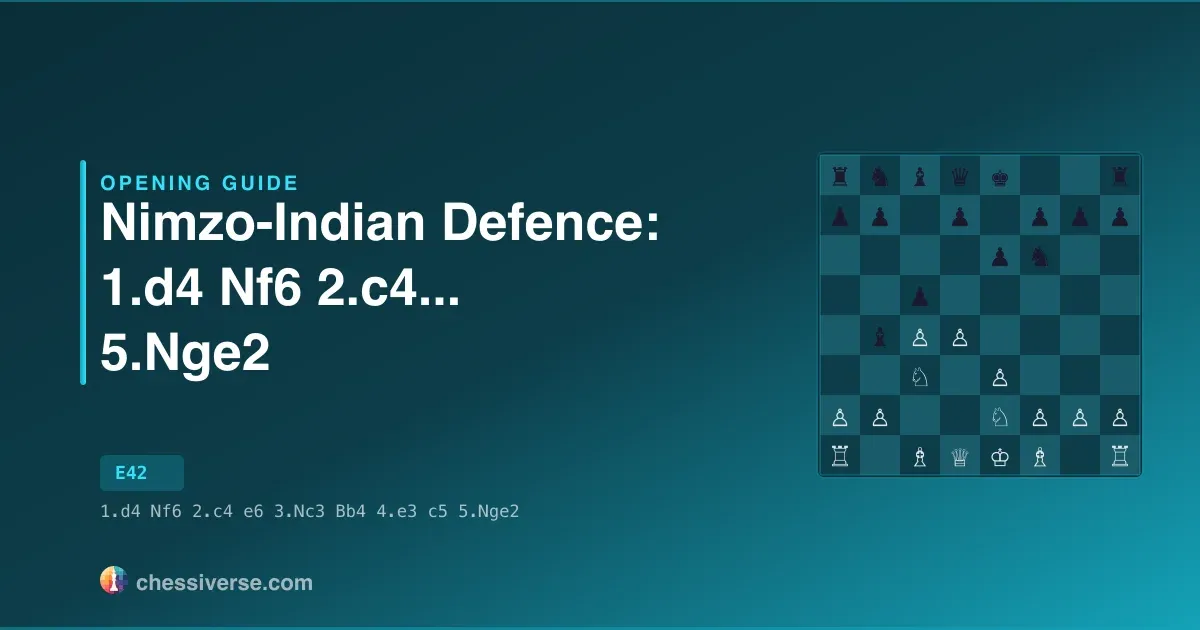
1.d4 Nf6 2.c4 e6 3.Nc3 Bb4 4.e3 c5 5.Nge2 opens the Nimzo-Indian Defense: Rubinstein System, Rubinstein Variation, ECO E42. Lichess records 92,874 games in this line, which gives us a reliable view of how it actually performs in practice.
History and Notable Players
It arises from the Nimzo-Indian Defense: Rubinstein System (4...c5). Among the most prolific White practitioners are Anatoly Vaisser (27 games), Svetozar Gligoric (26 games), Sarhan Guliev (22 games). Black-side regulars include John TH Van der Wiel (15 games), Walter S Browne (14 games), Ulf Andersson (14 games).
Performance Across Rating Levels
The picture changes a lot as you climb the rating ladder. The 1200 bracket has 365 games (0.00% of all games at that level); White wins 49.6%, Black 47.1%, 3.3% are drawn. At 1800 the opening surfaces in 0.00% of games; White wins 52.6%, Black 41.7%, draws 5.7%. At 2500, 0.04% of games go into this opening; draws sit at 10.9% — the line is well-mapped at this level. Positions also become less sharp as level rises (sharpness 0.97 → 0.89).
Move Diversity and Theory Depth
Move choice is far from uniform in the Nimzo-Indian Defense: Rubinstein System, Rubinstein Variation. At 1200 Elo (365 games), the top reply is cxd4, played 33.4% of the time. Four other moves each take at least 5% of games, and the top three moves account for 71% of games. Entropy: 2.57. By 2500 (5,459 games), cxd4 is still the top reply, at 47.7%; four other moves reach 5% and the top three moves account for 80.3% of games. Entropy drops to 2.15.
Common Mistakes
- Neglecting development — It can feel productive to make extra pawn moves early, but falling behind in piece development is what loses most amateur games — especially in open positions where active pieces find squares fast.
- Letting White own the centre — Hypermodern openings concede central space on purpose, but only if you strike back in time. Delay the counter-blow and you end up squeezed.
Practice on Chessiverse
Ready to try the Nimzo-Indian Defense: Rubinstein System, Rubinstein Variation against a bot? Pick an opponent at your level and play a game.