

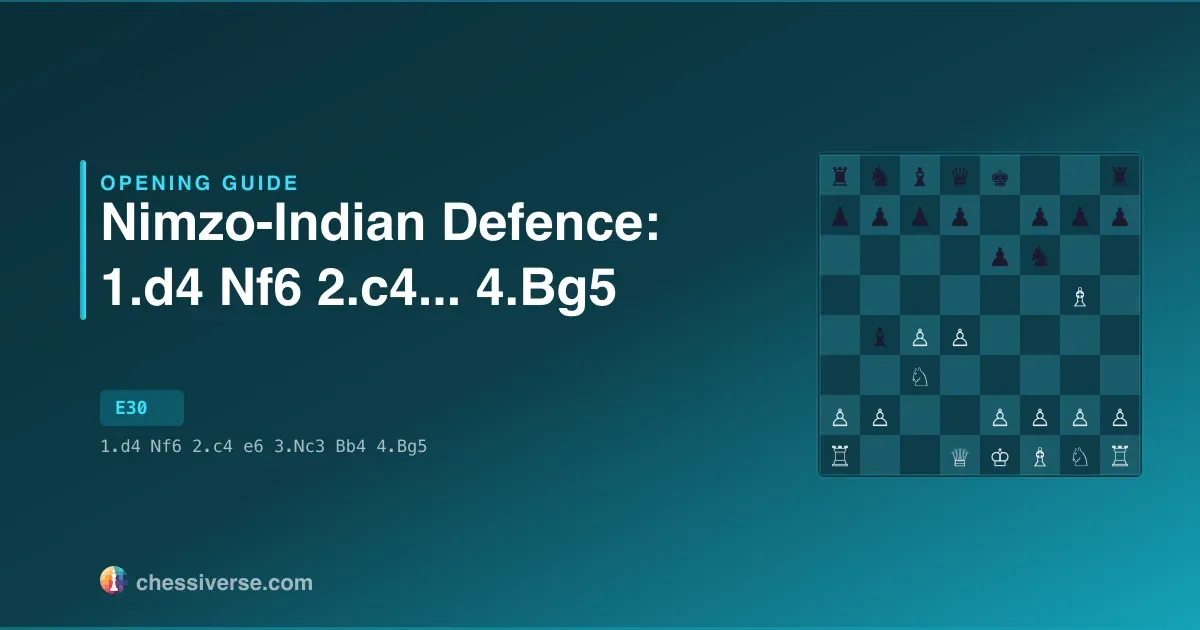
The Nimzo-Indian Defense: Leningrad Variation begins with 1.d4 Nf6 2.c4 e6 3.Nc3 Bb4 4.Bg5 (ECO E30). The Leningrad-style reply. Pin meets pin, the e4 square becomes neutral territory, and the position takes on a flavour you rarely see in mainstream Nimzo theory.
Strategic Overview
Pinning the f6 knight in answer to Black's pin of the c3 knight is a quietly clever move. Both sides have committed to bishops on aggressive squares, neither knight controls e4 cleanly any more, and the d5 square has been deprived of one of its key defenders. The strategic consequence is concrete: a d5 push by White becomes one of the main themes, since the knight on f6 can no longer block it without dropping the queen on d8. Black's standard reactions are 4...h6 5.Bh4 c5 6.d5 or the immediate 4...c5 5.d5 h6 6.Bh4, both leading into structures where the central pawn break has already happened and the players reorganise around it. The variation is uncommon at master level — appearing in something like 2% of Nimzo games on the larger databases — because it gives White less direct pressure than the main lines and Black has fewer structural concessions to worry about. Unlike the Ragozin or QGD where 4.Bg5 threatens to win the d5 pawn, here there's no d5 pawn to win yet. The system is more of an off-beat surprise weapon than a critical test of the Nimzo.
Key Ideas
A few ideas come up again and again in this opening:
- Pin meets pin and e4 goes neutral — Both sides have pinned a knight against the queen, and neither side cleanly controls the e4 square anymore. The fight for that central square becomes the strategic backbone of the position.
- d5 push is the natural follow-up — Without the f6 knight reliably defending d5, White's d4-d5 advance gains weight. The standard sequences with ...c5 and d5 are both sides preparing for that critical pawn break before anything else happens.
- Standard sequences feature ...h6 and ...c5 — Whether 4...h6 5.Bh4 c5 6.d5 or 4...c5 5.d5 h6 6.Bh4, the moves are roughly the same — Black challenges the centre and pushes the bishop, and White grabs space with d5. The order varies but the result is similar.
- Off the beaten Nimzo path — 4.Bg5 is rare at the highest levels because it doesn't carry the structural threats of 4.Qc2 or 4.e3, and Black has no immediate weakness to defend. It works better as an occasional surprise than as a main repertoire choice.
History and Notable Players
It arises from the Nimzo-Indian Defense. Among the most prolific White practitioners are Boris V Spassky (30 games), Guntram Gaertner (28 games), Lluis Comas Fabrego (26 games). Black-side regulars include Wolfgang Unzicker (8 games), Gyula Sax (8 games), Viktor Korchnoi (7 games).
Performance Across Rating Levels
The picture changes a lot as you climb the rating ladder. At 1200 Elo, the opening shows up in 0.01% of games (79,530 samples). White scores 52.3%, Black 44.2%, draws 3.4%. Move up to 1800 Elo and the share shifts to 0.07%, with White winning 46.8% versus Black's 48.3%. At the top end (2500+ Elo), popularity is 0.04% with 9.2% draws — a clear sign of how much theory rules the line at master level. White's edge erodes by 5.8pp from 1200 to 2500 Elo, suggesting Black's counterplay is easier to find with experience.
Time Control Patterns
The Nimzo-Indian Defense: Leningrad Variation skews toward blitz chess. In bullet, it appears in 0.03% of games (721,132); White wins 49.8%. Blitz shows 0.04% adoption across 1,594,411 games, White scoring 48%. In rapid, the share rises to 0.03% — 342,027 games, White 46.7%. White's score swings 3.1pp across formats, so time control isn't just a stylistic choice here — it shifts the actual results.
Move Diversity and Theory Depth
Move choice is far from uniform in the Nimzo-Indian Defense: Leningrad Variation. At 1200 Elo (79,334 games), the top reply is O-O, played 29.1% of the time. Four other moves each take at least 5% of games, and the top three moves account for 73.4% of games. Entropy: 2.67. By 2500 (6,047 games), h6 takes over as the top reply at 44.6%; only two other moves still reach 5% and the top three moves account for 90.2% of games. Entropy drops to 1.82. The narrowing is significant — strong players consolidate around a small set of best moves, while amateurs scatter across many plausible-looking options.
Historical Trends
Year-over-year data tells you whether this opening is a contemporary fixture or a fading one. Adoption peaked in 2015 at 0.06% (12,559 games). By 2025 it sits at 0.04%, 37% below the peak and roughly back to its 2013 level, leaving the line flat over the full period.
Main Lines and Variations
After 1.d4 Nf6 2.c4 e6 3.Nc3 Bb4 4.Bg5, the established follow-ups are:
Each branch leads to a different middlegame character — the resulting pawn structure decides what kind of game you get.
Common Mistakes
- Neglecting development — It can feel productive to make extra pawn moves early, but falling behind in piece development is what loses most amateur games — especially in open positions where active pieces find squares fast.
- Letting White own the centre — Hypermodern openings concede central space on purpose, but only if you strike back in time. Delay the counter-blow and you end up squeezed.
Practice on Chessiverse
Ready to try the Nimzo-Indian Defense: Leningrad Variation against a bot? Pick an opponent at your level and play a game.