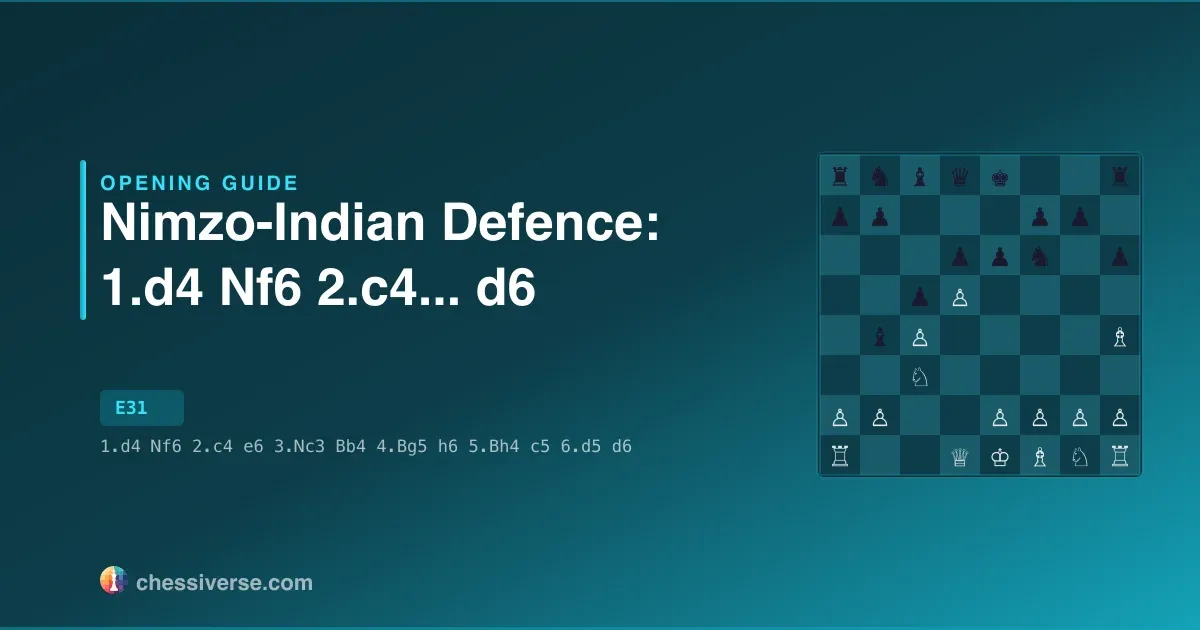
Starting from 1.d4 Nf6 2.c4 e6 3.Nc3 Bb4 4.Bg5 h6 5.Bh4 c5 6.d5 d6, players enter the Nimzo-Indian Defense: Leningrad Variation, Benoni Defense — ECO E31. With 7,757 games on record, the patterns below come from the largest practical sample available.
History and Notable Players
It arises from the Nimzo-Indian Defense: Leningrad Variation. On the White side, Jan H Timman (11 games), Dorian Rogozenco (9 games), Lluis Comas Fabrego (6 games) top the database. Notable Black exponents: Mihai Suba (5 games), Paul Keres (4 games), Craig William Pritchett (4 games).
Move Diversity and Theory Depth
What players actually play after the opening moves depends heavily on rating. Below 1400 the samples are small (84 games at 1200), so the comparison starts at 1400, with 350 games. There, the top reply is e4, played 28.6% of the time. Five other moves each take at least 5% of games, and the top three moves account for 70% of games. Entropy: 2.75. By 2500 (295 games), e3 takes over as the top reply at 82.7%; no other move reaches 5% and the top three moves account for 89.8% of games. Entropy drops to 1.13. The narrowing is significant — strong players consolidate around a small set of best moves, while amateurs scatter across many plausible-looking options.
Common Mistakes
- Neglecting development — Extra pawn moves in the opening are tempting, especially when you "know the moves". Developing a piece each turn is the simple correction.
- Letting White own the centre — Hypermodern openings concede central space on purpose, but only if you strike back in time. Delay the counter-blow and you end up squeezed.
Practice on Chessiverse
Ready to try the Nimzo-Indian Defense: Leningrad Variation, Benoni Defense against a bot? Pick an opponent at your level and play a game.