



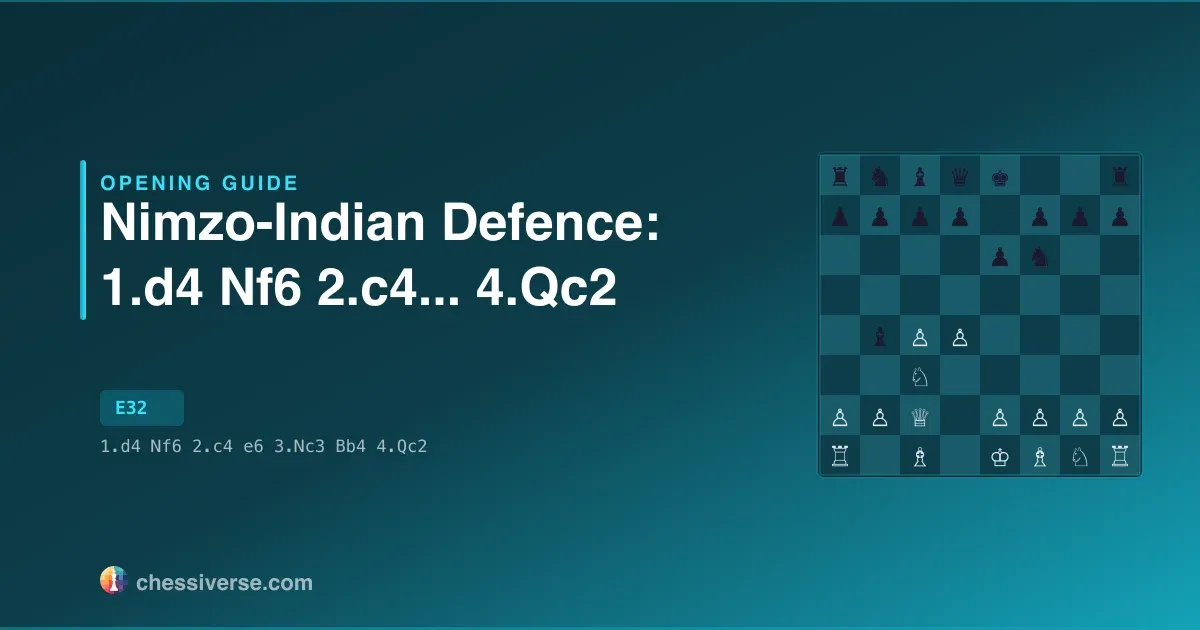
The Nimzo-Indian Defense: Classical Variation begins with 1.d4 Nf6 2.c4 e6 3.Nc3 Bb4 4.Qc2 (ECO E32). The Classical Variation, and arguably the single most direct response to the Nimzo-Indian. White solves the doubled-pawn problem before it appears and joins the fight for e4 in one move.
Strategic Overview
4.Qc2 is the move that turned the Nimzo-Indian from a fashion experiment into one of the most respected defences against 1.d4. The queen does two things at once: she protects the knight on c3 so that Black's ...Bxc3+ no longer cripples White's pawn structure, and she joins the battle for e4, which is the central strategic square in nearly every Nimzo middlegame. The cost is a tempo and the usual caveats about early queen development. Here those caveats matter less than usual. The queen on c2 isn't camping in enemy territory — she's just on a useful square, supporting White's pawns and aimed at Black's kingside. Black is unlikely to harass her with simple developing moves, and the position offers White a clear long-term plan: contest e4, complete development, and convert the bishop pair into a small but lasting structural advantage. Black's main responses are 4...O-O (the universal flexible move), 4...c5 (the most principled, immediately attacking the centre), 4...d5 (a Ragozin-like challenge), and 4...Nc6 (the Zürich, going for piece play). Each leads to its own pawn structure but the strategic poles are constant: White wants the bishop pair and central control, Black wants active piece play before White consolidates.
Key Ideas
The recurring motifs below distinguish a confident handler of this opening from a beginner:
- Defends c3 so ...Bxc3+ no longer doubles pawns — The whole point of the Nimzo is the threat to inflict doubled c-pawns on White. 4.Qc2 protects the knight so that exchanging on c3 now wastes a tempo on a trade that has lost its sting.
- Joins the fight for e4 immediately — Control of e4 is the defining strategic theme of nearly every Nimzo-Indian. The queen on c2 contributes a third defender of that central square, supplementing the knight on c3 and the f-pawn.
- The bishop pair as long-term compensation — If Black still chooses to trade on c3, White recaptures with the queen and keeps the bishop pair. That bishop pair, combined with central control, is the long-term asset White builds the entire middlegame plan around.
- Early queen move is justified here — The usual warning against early queen moves doesn't apply: Black cannot easily attack the queen on c2 with developing moves, and the queen performs concrete functions rather than just sitting in the open.
History and Notable Players
It arises from the Nimzo-Indian Defense. Among the most prolific White practitioners are Aleksey Dreev (137 games), Reynaldo Vera Gonzalez Quevedo (106 games), Vladimir Lazarev (102 games). Black-side regulars include Ivan Farago (70 games), Sergei Tiviakov (64 games), Jan H Timman (56 games).
Performance Across Rating Levels
The picture changes a lot as you climb the rating ladder. Among 1200-rated players, it appears in 0.01% of games — 41,287 of them on record — with White winning 52.6% and Black 44.4%. By 1800, popularity is 0.08% and White's score is 50% to Black's 44.9%. At the top end (2500+ Elo), popularity is 0.46% with 10.8% draws — a clear sign of how much theory rules the line at master level. White's edge erodes by 5.8pp from 1200 to 2500 Elo, suggesting Black's counterplay is easier to find with experience.
Time Control Patterns
Time control matters here: blitz players reach for this opening more than others. In bullet, it appears in 0.03% of games (757,042); White wins 50.7%. Blitz shows 0.06% adoption across 2,114,703 games, White scoring 49.7%. In rapid, the share rises to 0.03% — 365,416 games, White 48.8%.
Move Diversity and Theory Depth
What players actually play after the opening moves depends heavily on rating. At 1200 Elo (41,175 games), the top reply is O-O, played 34.1% of the time. Five other moves each take at least 5% of games, and the top three moves account for 66.6% of games. Entropy: 2.68. By 2500 (62,704 games), O-O is still the top reply, at 44.7%; only three other moves still reach 5% and the top three moves account for 83.6% of games. Entropy drops to 2.20.
Historical Trends
Long-term, the trajectory of this opening is informative. Adoption peaked in 2015 at 0.08% (18,766 games). By 2025 it sits at 0.04%, 48% below the peak but still 22% above its 2013 level, so the line is up over the full period despite easing from the high.
Main Lines and Variations
From the position after 1.d4 Nf6 2.c4 e6 3.Nc3 Bb4 4.Qc2, the recognised continuations are:
- Nimzo-Indian Defense: Classical Variation, Zurich Variation
- Nimzo-Indian Defense: Classical Variation, Noa Variation
- Nimzo-Indian Defense: Classical Variation, Berlin Variation
Each branch leads to a different middlegame character — the resulting pawn structure decides what kind of game you get.
Common Mistakes
- Drifting away from main theory — At 400 Elo, the three most-played moves cover 68.1% of games, against 77.3% at 2000. The most popular deviation is Nc6 (played 16.5% of the time at 400, much less so up top). It looks fine but quietly hands the better-prepared side an edge.
- Neglecting development — It can feel productive to make extra pawn moves early, but falling behind in piece development is what loses most amateur games — especially in open positions where active pieces find squares fast.
- Letting White own the centre — Hypermodern openings concede central space on purpose, but only if you strike back in time. Delay the counter-blow and you end up squeezed.
Practice on Chessiverse
Ready to try the Nimzo-Indian Defense: Classical Variation against a bot? Pick an opponent at your level and play a game.