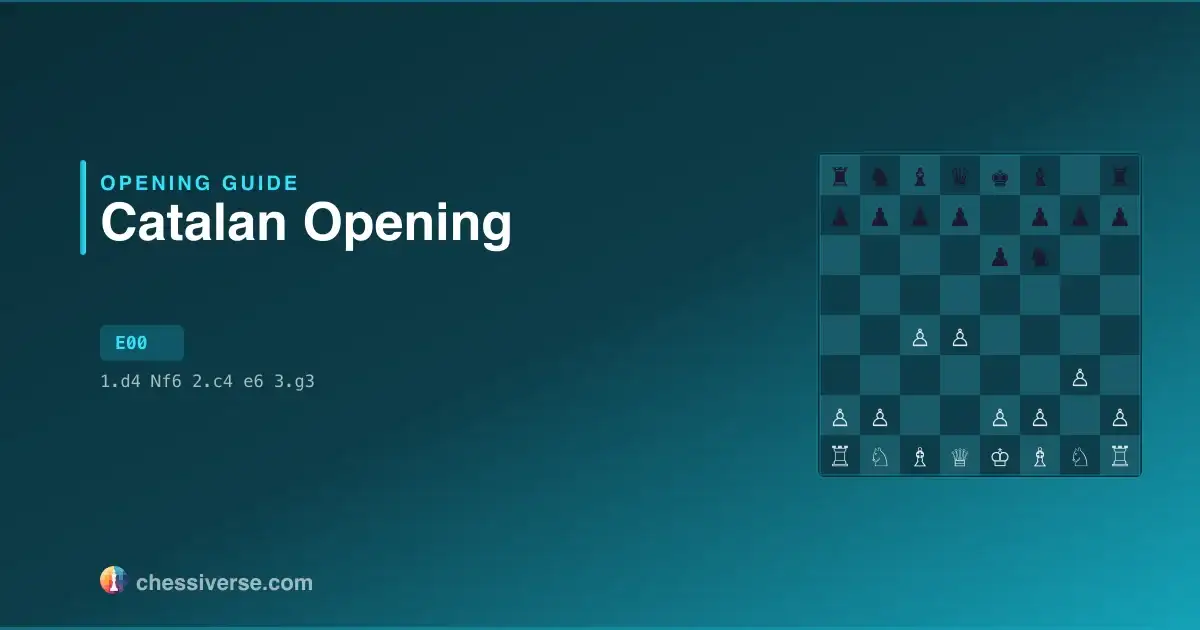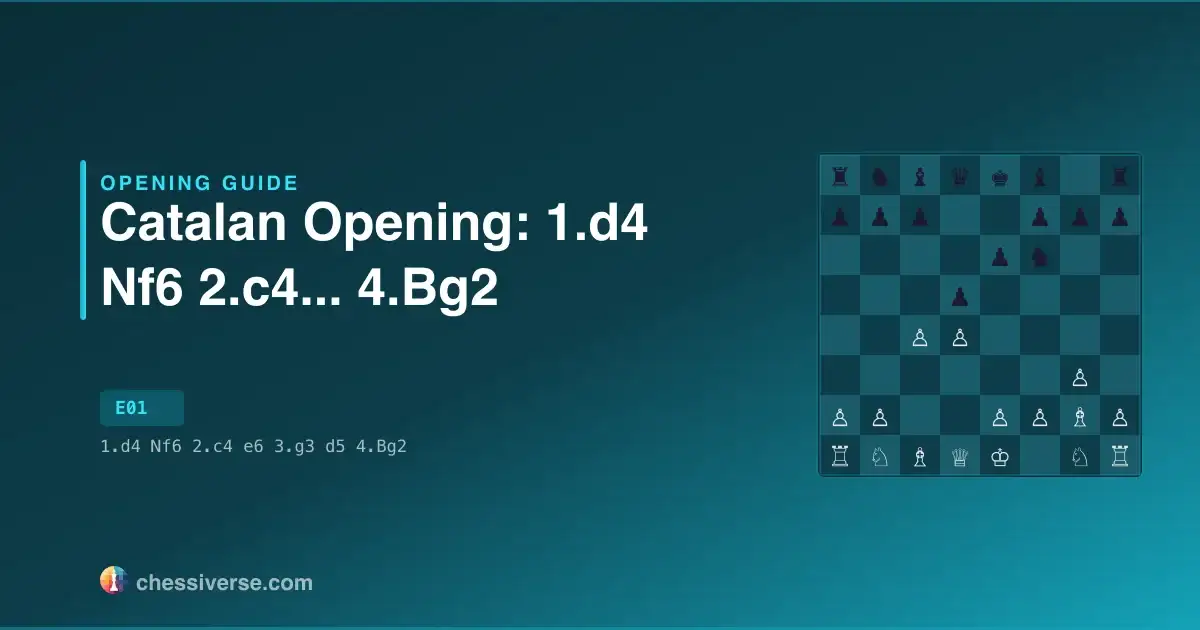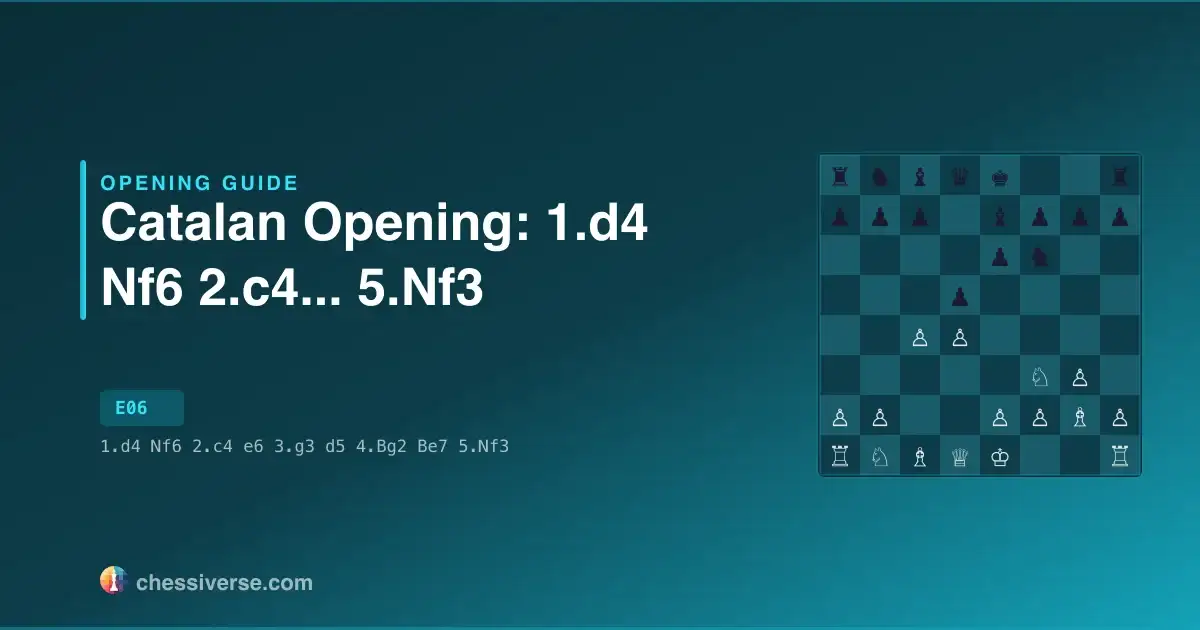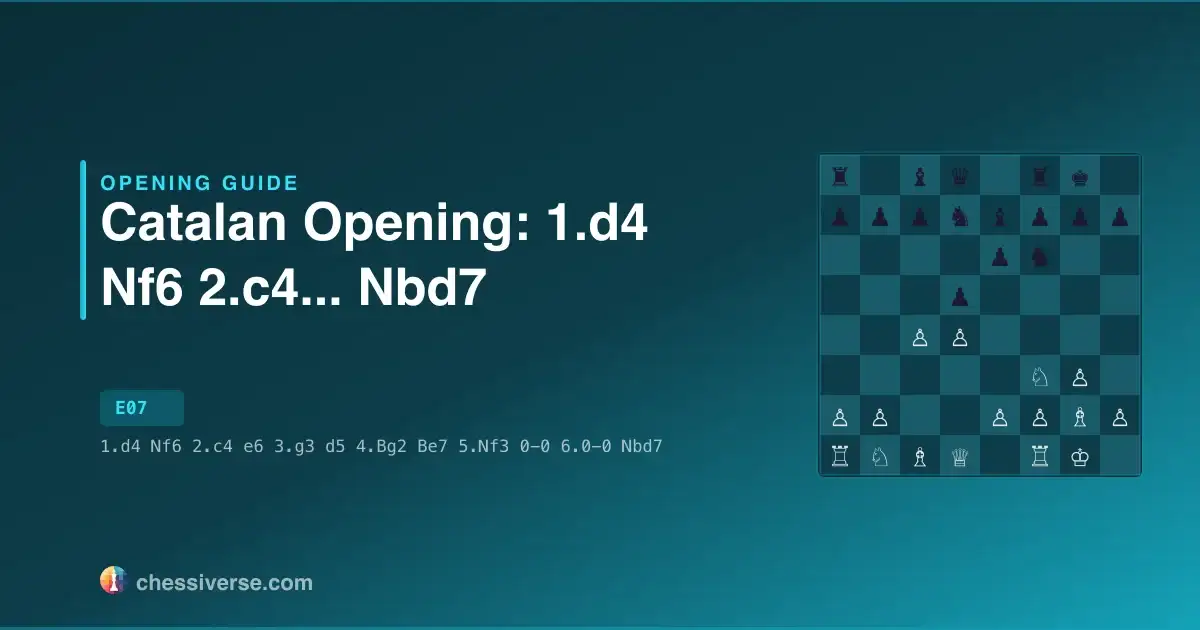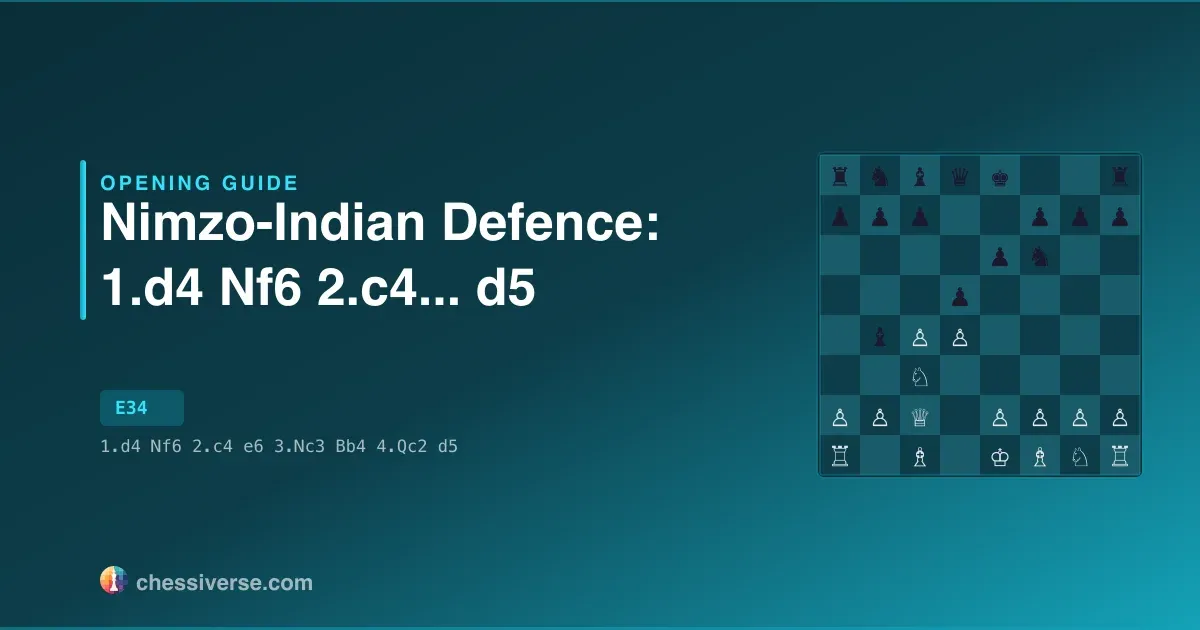
The Nimzo-Indian Defense: Classical Variation, Noa Variation begins with 1.d4 Nf6 2.c4 e6 3.Nc3 Bb4 4.Qc2 d5 (ECO E34). Across rating levels it shows up in 619,917 recorded games — enough data to map exactly where it succeeds and where it stalls.
History and Notable Players
It arises from the Nimzo-Indian Defense: Classical Variation. Among the most prolific White practitioners are Aleksey Dreev (36 games), Vitali Golod (23 games), Anatoly Karpov (22 games). Black-side regulars include Nigel D Short (27 games), Michael Adams (26 games), Oleg M Romanishin (25 games).
Performance Across Rating Levels
Popularity and results vary sharply by rating level. Among 1200-rated players, it appears in 0.00% of games — 21,521 of them on record — with White winning 53.1% and Black 43.7%. Move up to 1800 Elo and the share shifts to 0.02%, with White winning 51.4% versus Black's 43.5%. Among 2500-rated players the line appears in 0.11% of games and draws spike to 11.1%, indicating tight preparation. White's edge erodes by 7.3pp from 1200 to 2500 Elo, suggesting Black's counterplay is easier to find with experience.
Time Control Patterns
Look at the same opening across time controls and blitz stands out. In bullet, it appears in 0.01% of games (153,966); White wins 51.9%. Blitz shows 0.01% adoption across 507,362 games, White scoring 51%. In rapid, the share rises to 0.01% — 111,474 games, White 50.3%.
Move Diversity and Theory Depth
Move choice is far from uniform in the Nimzo-Indian Defense: Classical Variation, Noa Variation. At 1200 Elo (21,481 games), the top reply is Bg5, played 22.7% of the time. Five other moves each take at least 5% of games, and the top three moves account for 59.7% of games. Entropy: 2.90. By 2500 (14,719 games), cxd5 takes over as the top reply at 52.4%; only three other moves still reach 5% and the top three moves account for 90.2% of games. Entropy drops to 1.74. The narrowing is significant — strong players consolidate around a small set of best moves, while amateurs scatter across many plausible-looking options.
Historical Trends
Long-term, the trajectory of this opening is informative. Adoption peaked in 2018 at 0.02% (35,440 games). By 2025 it sits at 0.01%, 44% below the peak but still 41% above its 2013 level, so the line is up over the full period despite easing from the high.
Main Lines and Variations
After 1.d4 Nf6 2.c4 e6 3.Nc3 Bb4 4.Qc2 d5, the established follow-ups are:
- Nimzo-Indian Defense: Classical Variation, Noa Variation (5.a3)
- Nimzo-Indian Defense: Classical Variation, Noa Variation (5.cxd5 5...exd5)
Each branch leads to a different middlegame character — the resulting pawn structure decides what kind of game you get.
Common Mistakes
- Drifting away from main theory — At 400 Elo, the three most-played moves cover 52.7% of games, against 64% at 2000. The most popular deviation is Bd2 (played 13.8% of the time at 400). It looks fine but quietly hands the better-prepared side an edge.
- Neglecting development — It can feel productive to make extra pawn moves early, but falling behind in piece development is what loses most amateur games — especially in open positions where active pieces find squares fast.
- Letting White own the centre — Hypermodern openings concede central space on purpose, but only if you strike back in time. Delay the counter-blow and you end up squeezed.
Practice on Chessiverse
Ready to try the Nimzo-Indian Defense: Classical Variation, Noa Variation against a bot? Pick an opponent at your level and play a game.