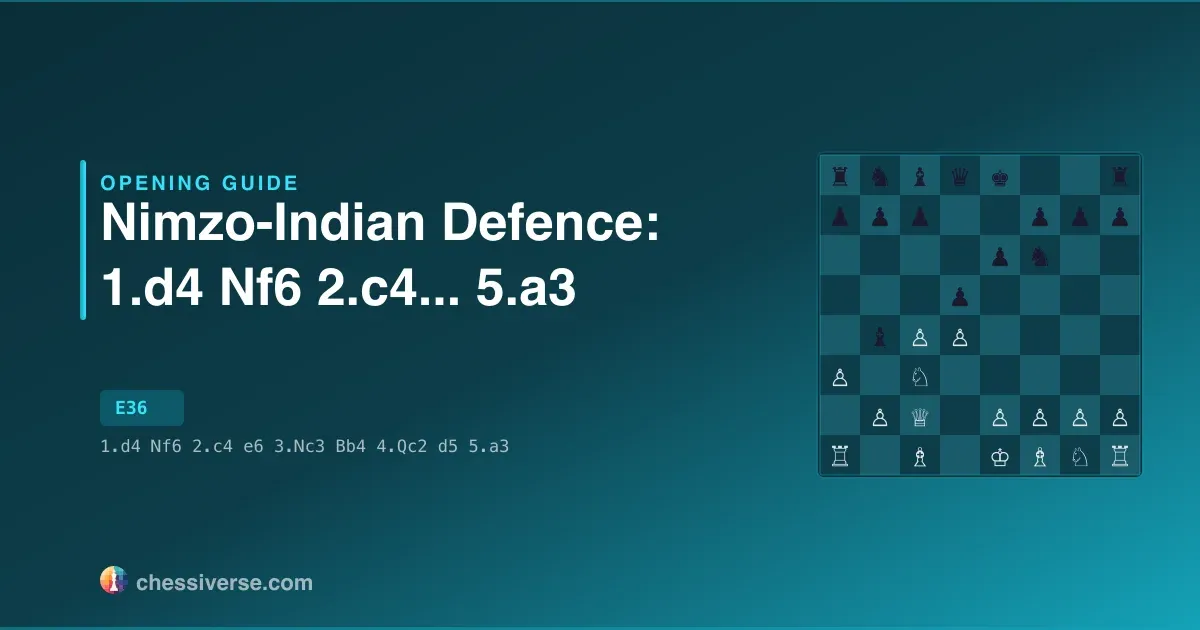
1.d4 Nf6 2.c4 e6 3.Nc3 Bb4 4.Qc2 d5 5.a3 opens the Nimzo-Indian Defense: Classical Variation, Noa Variation (5.a3), ECO E36. Lichess records 114,334 games in this line, which gives us a reliable view of how it actually performs in practice.
History and Notable Players
It arises from the Nimzo-Indian Defense: Classical Variation, Noa Variation. On the White side, Tomas Likavsky (13 games), Ivan Ivanisevic (12 games), Vitali Golod (11 games) top the database. Notable Black exponents: Yifan Hou (11 games), Konstantin Landa (8 games), Alexander Moiseenko (7 games).
Performance Across Rating Levels
Popularity and results vary sharply by rating level. At 1200 Elo, the opening shows up in 0.00% of games (4,681 samples). White scores 52.8%, Black 43.8%, draws 3.4%. Move up to 1800 Elo and the share shifts to 0.00%, with White winning 50.1% versus Black's 44.4%. Among 2500-rated players the line appears in 0.03% of games and draws spike to 12.2%, indicating tight preparation. White's edge erodes by 7.2pp from 1200 to 2500 Elo, suggesting Black's counterplay is easier to find with experience.
Move Diversity and Theory Depth
Move choice is far from uniform in the Nimzo-Indian Defense: Classical Variation, Noa Variation (5.a3). At 1200 Elo (4,673 games), the top reply is Bxc3+, played 70.7% of the time. Three other moves each take at least 5% of games, and the top three moves account for 94% of games. Entropy: 1.34. By 2500 (4,441 games), Bxc3+ dominates at 93.7% of replies; only one other move still reaches 5% and the top three moves account for 100% of games. Entropy drops to 0.36. The narrowing is significant — strong players consolidate around a small set of best moves, while amateurs scatter across many plausible-looking options.
Main Lines and Variations
From the position after 1.d4 Nf6 2.c4 e6 3.Nc3 Bb4 4.Qc2 d5 5.a3, the recognised continuations are:
Each branch leads to a different middlegame character — the resulting pawn structure decides what kind of game you get.
Common Mistakes
- Drifting away from main theory — At 400 Elo, the three most-played moves cover 90.8% of games, against 99.4% at 2000. The most popular deviation is Ba5 (played 24.2% of the time at 400, much less so up top). It looks fine but quietly hands the better-prepared side an edge.
- Neglecting development — Extra pawn moves in the opening are tempting, especially when you "know the moves". Developing a piece each turn is the simple correction.
- Letting White own the centre — Hypermodern openings concede central space on purpose, but only if you strike back in time. Delay the counter-blow and you end up squeezed.
Practice on Chessiverse
Ready to try the Nimzo-Indian Defense: Classical Variation, Noa Variation (5.a3) against a bot? Pick an opponent at your level and play a game.