



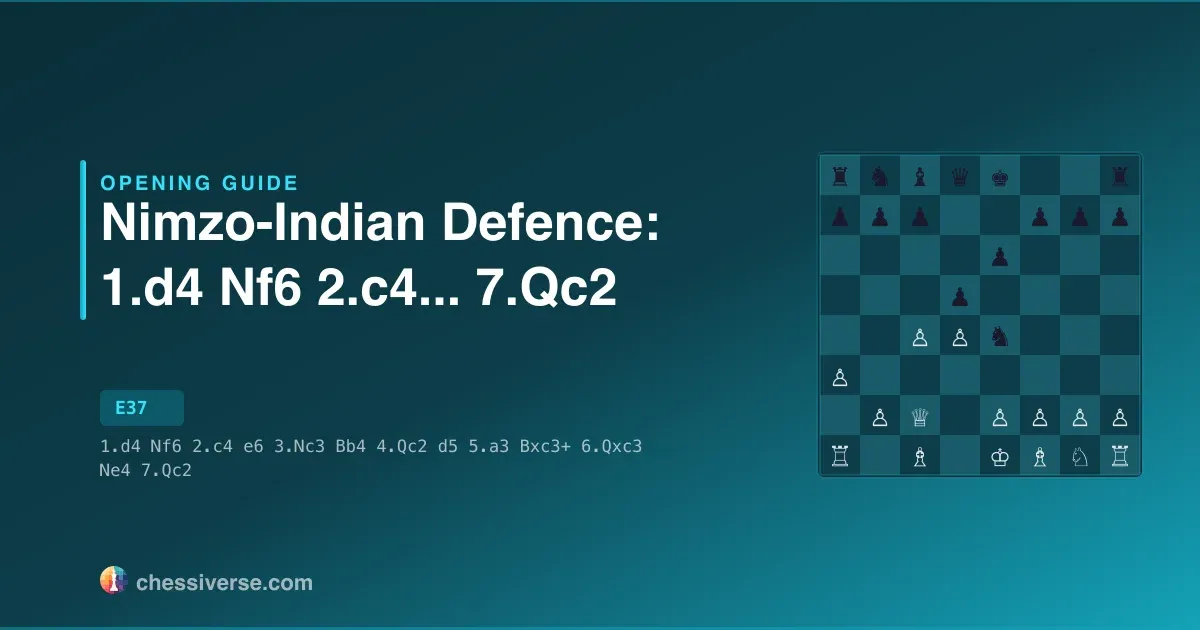
1.d4 Nf6 2.c4 e6 3.Nc3 Bb4 4.Qc2 d5 5.a3 Bxc3+ 6.Qxc3 Ne4 7.Qc2 opens the Nimzo-Indian Defense: Classical Variation, Noa Variation (6...Ne4 7.Qc2), ECO E37. Lichess records 18,966 games in this line, which gives us a reliable view of how it actually performs in practice.
History and Notable Players
It arises from the Nimzo-Indian Defense: Classical Variation, Noa Variation (5.a3). Among the most prolific White practitioners are Ivan Ivanisevic (8 games), Petr Kiriakov (6 games), Vladimir Alatortsev (6 games). Black-side regulars include Yifan Hou (11 games), Sergey Karjakin (7 games), Konstantin Landa (6 games).
Move Diversity and Theory Depth
Move choice is far from uniform in the Nimzo-Indian Defense: Classical Variation, Noa Variation (6...Ne4 7.Qc2). At 1200 Elo (524 games), the top reply is Qf6, played 47.5% of the time. Two other moves each take at least 5% of games, and the top three moves account for 84.2% of games. Entropy: 2.28. By 2500 (474 games), c5 takes over as the top reply at 59.1%; three other moves reach 5% and the top three moves account for 90.1% of games. Entropy drops to 1.69. The narrowing is significant — strong players consolidate around a small set of best moves, while amateurs scatter across many plausible-looking options.
Common Mistakes
- Neglecting development — It can feel productive to make extra pawn moves early, but falling behind in piece development is what loses most amateur games — especially in open positions where active pieces find squares fast.
- Letting White own the centre — Hypermodern openings concede central space on purpose, but only if you strike back in time. Delay the counter-blow and you end up squeezed.
Practice on Chessiverse
Ready to try the Nimzo-Indian Defense: Classical Variation, Noa Variation (6...Ne4 7.Qc2) against a bot? Pick an opponent at your level and play a game.