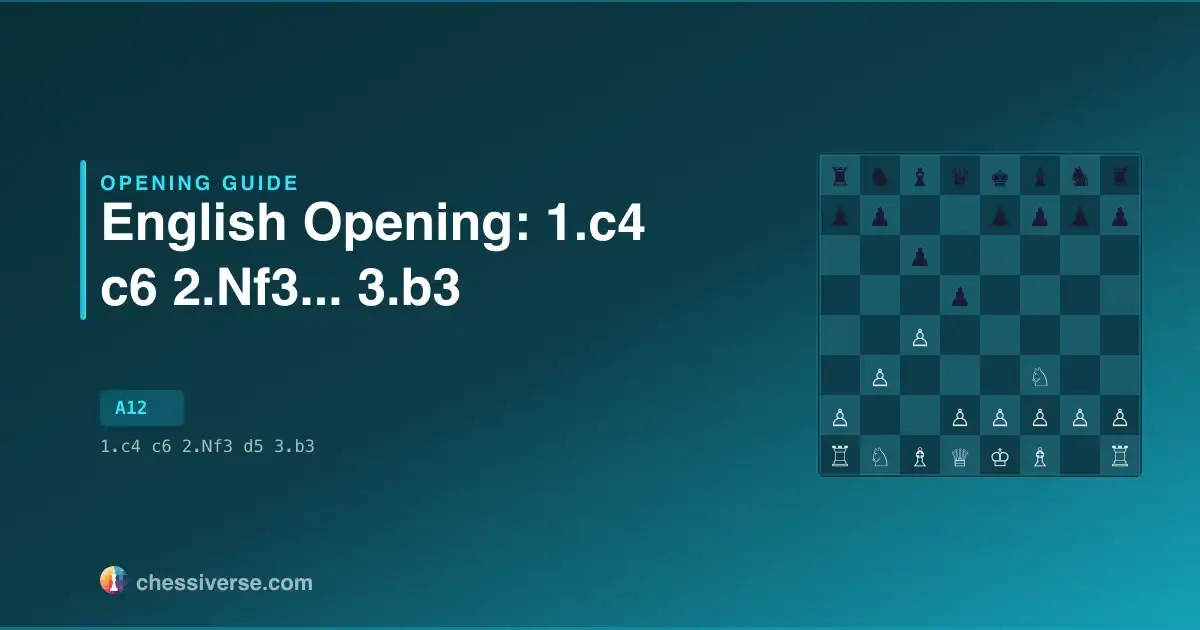


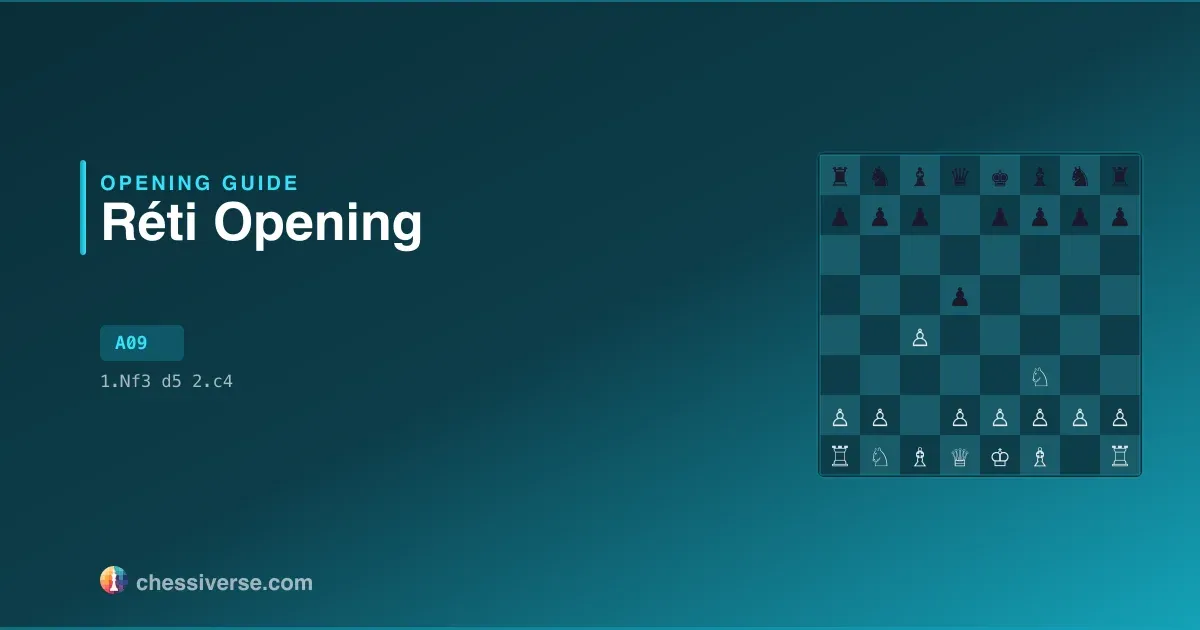
The Reti Opening arises after 1.Nf3 d5 2.c4 and falls under ECO code A09. A quintessential hypermodern opening, the Reti uses minor pieces rather than pawns to contest the center. Black has several ways to respond: moves like 2...c6 or 2...e6 typically lead to transpositions into the Queen's Gambit Declined or Slav Defense, though White can diverge with 3. g3, reaching positions resembling or directly transposing into the Catalan Opening (normally arrived at via 1. d4 Nf6 2. c4 e6 3. g3), or even 3. b3!?. If Black captures on c4 or pushes ...dxc4 and ...d4, the advanced d4 pawn can be annoying for White as it controls c3 and e3, squares where the knight and bishop would naturally develop. White then undermines this pawn with moves like e3, a3 followed by b4, while Black tries to maintain it with ...Nc6 and ...c5. The sharpest continuation is the Reversed Blumenfeld Gambit: 3. e3 c5 4. b4 dxe3 5. fxe3 cxb4 6. d4, where Black holds an extra pawn on b4 but it is weak, and White's central control and development provide adequate compensation, yielding roughly a 52% score in practice. With 7.1 million Lichess games across all rating levels, it is a well-established opening choice.
- Control the center from a distance instead of occupying it: hold back the d- and e-pawns and fianchetto at least one bishop.
- Hit Black's d5 pawn from the side with c4.
- Expand on the queenside, often by playing b4.
History and Notable Players
The earliest known analysis of this opening dates back to Réti–Rubinstein, Karlovy Vary, 1923. The opening is named after Richard Réti. It arises from the Zukertort Opening: d5. Among the most prolific practitioners on the White side are Peter Szekely (90 games), Aleksander Wojtkiewicz (56 games), Lutz Espig (54 games). On the Black side, notable exponents include Igor Khenkin (29 games), Aleksey Dreev (29 games), Michele Godena (28 games).
Réti introduced the system to master play in early 1923, and Hans Kmoch coined the name after Réti's game against Rubinstein at Karlovy Vary that year. Its most famous moment came at New York 1924, where Réti used it to beat reigning world champion Capablanca. A century later, Gukesh won game 11 of the 2024 World Championship with it.
Named after: Richard Réti (1889-1929), the Czechoslovak master and leading hypermodern who brought the system into top-level play.
Notable players: Richard Réti, Alexander Alekhine, Gukesh Dommaraju
Réti used this opening to beat reigning world champion Capablanca at New York 1924, and Tartakower quipped that this 'opening of the past' had become, around 1923, the opening of the future.
Statistics
Based on 7.1 million Lichess games across all rating levels:
- White wins: 53.3%
- Black wins: 41.8%
- Draws: 4.9%
White has a significant statistical advantage in this line, reflecting the initiative that comes with the first move.
Practice on Chessiverse
The best way to learn the Réti Opening is through practice. On Chessiverse, you can play chess against computer opponents from any opening or custom position. Our AI bots range from beginner to grandmaster level, each with unique playing styles — from aggressive attackers to solid defenders. Choose a bot that matches your rating and work your way up as you master the opening's key ideas.
Performance Across Rating Levels
How well the Réti Opening works depends on what level you're playing at. Among 1200-rated players, it appears in 0.07% of games — 467,239 of them on record — with White winning 53.1% and Black 43.5%. By 1800, popularity is 0.21% and White's score is 54.1% to Black's 41.3%. At 2500, 0.69% of games go into this opening; draws sit at 10.3% — the line is well-mapped at this level. White's edge erodes by 5.5pp from 1200 to 2500 Elo, suggesting Black's counterplay is easier to find with experience.
Time Control Patterns
The Réti Opening skews toward blitz chess. In bullet, it appears in 0.14% of games (3,779,674); White wins 53.8%. Blitz shows 0.17% adoption across 5,936,770 games, White scoring 53.2%. In rapid, the share rises to 0.11% — 1,190,488 games, White 53.8%.
Move Diversity and Theory Depth
Move choice is far from uniform in the Réti Opening. At 1200 Elo (467,239 games), the top reply is dxc4, played 45.1% of the time. Four other moves each take at least 5% of games, and the top three moves account for 72.7% of games. Entropy: 2.44. By 2500 (94,716 games), e6 takes over as the top reply at 34.3%; only three other moves still reach 5% and the top three moves account for 90% of games. Entropy drops to 2.04.
Historical Trends
Tracking the Réti Opening year over year shows a clear story. Adoption peaked in 2015 at 0.21% (46,351 games). By 2025 it sits at 0.16%, 24% below the peak but still 16% above its 2013 level, so the line is up over the full period despite easing from the high.