



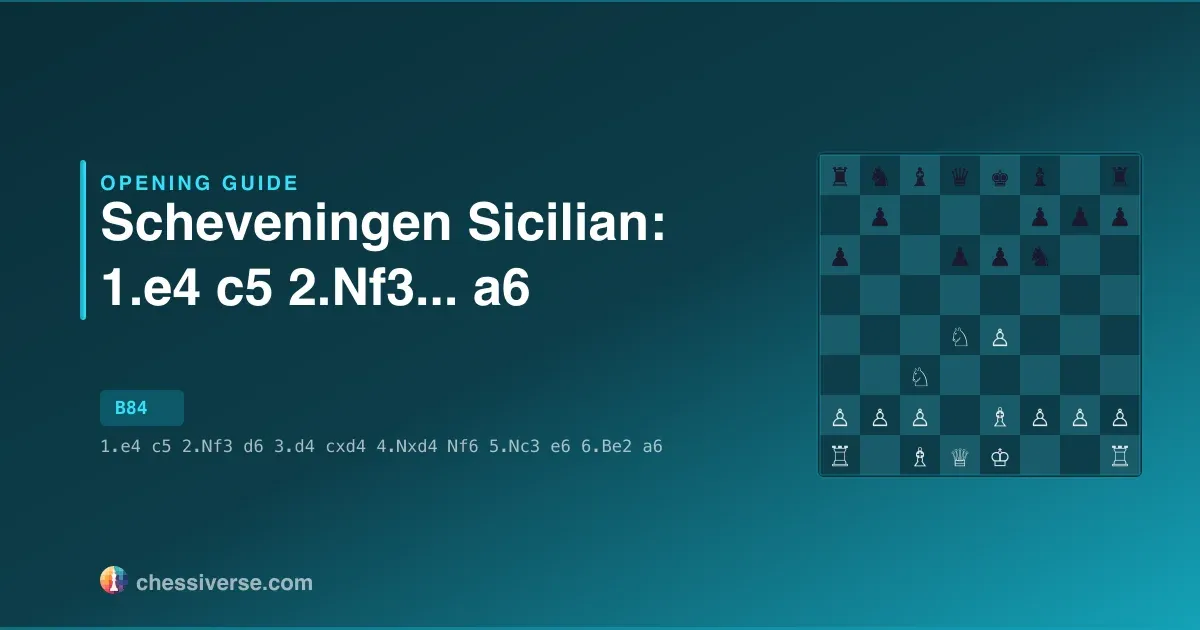
The Sicilian Defense: Scheveningen Variation, Classical Variation (6...a6) begins with 1.e4 c5 2.Nf3 d6 3.d4 cxd4 4.Nxd4 Nf6 5.Nc3 e6 6.Be2 a6 (ECO B84). With 754,784 games on record, the patterns below come from the largest practical sample available.
History and Notable Players
It arises from the Sicilian Defense: Scheveningen Variation, Classical Variation. Among the most prolific White practitioners are Vlastimil Jansa (41 games), Robert Zelcic (35 games), Robert Kuczynski (30 games). Black-side regulars include Lubomir Ftacnik (74 games), Loek Van Wely (59 games), Robert Kempinski (59 games).
Performance Across Rating Levels
How well the Sicilian Defense: Scheveningen Variation, Classical Variation (6...a6) works depends on what level you're playing at. At 1200 Elo, the opening shows up in 0.00% of games (10,344 samples). White scores 46.3%, Black 50.3%, draws 3.3%. Move up to 1800 Elo and the share shifts to 0.03%, with White winning 46.4% versus Black's 48.9%. At 2500, 0.05% of games go into this opening; draws sit at 7.6% — the line is well-mapped at this level.
Time Control Patterns
Time control matters here: blitz players reach for this opening more than others. In bullet, it appears in 0.01% of games (232,831); White wins 46%. Blitz shows 0.02% adoption across 625,957 games, White scoring 46.5%. In rapid, the share rises to 0.01% — 128,827 games, White 46.4%.
Move Diversity and Theory Depth
What players actually play after the opening moves depends heavily on rating. At 1200 Elo (10,344 games), the top reply is O-O, played 60.1% of the time. Two other moves each take at least 5% of games, and the top three moves account for 89.3% of games. Entropy: 1.91. By 2500 (6,599 games), O-O is still the top reply, at 46.2%; four other moves reach 5% and the top three moves account for 82.2% of games. Entropy rises to 2.16. Even elite players don't fully agree on the best continuation here, which keeps the position dynamic.
Historical Trends
Year-over-year data tells you whether this opening is a contemporary fixture or a fading one. Adoption peaked in 2014 at 0.03% (2,728 games). By 2025 it sits at 0.01%, 64% below the peak and 56% under its 2013 level, leaving the line in decline.
Main Lines and Variations
After 1.e4 c5 2.Nf3 d6 3.d4 cxd4 4.Nxd4 Nf6 5.Nc3 e6 6.Be2 a6, the established follow-ups are:
Each branch leads to a different middlegame character — the resulting pawn structure decides what kind of game you get.
Common Mistakes
- Neglecting development — It can feel productive to make extra pawn moves early, but falling behind in piece development is what loses most amateur games — especially in open positions where active pieces find squares fast.
- Ignoring the kingside attack — In sharp Sicilian lines, White typically castles long and pushes the h-pawn. Without your own counterplay on the queenside or in the centre, White's attack lands first.
Practice on Chessiverse
Ready to try the Sicilian Defense: Scheveningen Variation, Classical Variation (6...a6) against a bot? Pick an opponent at your level and play a game.