


Three Words, Three Meanings
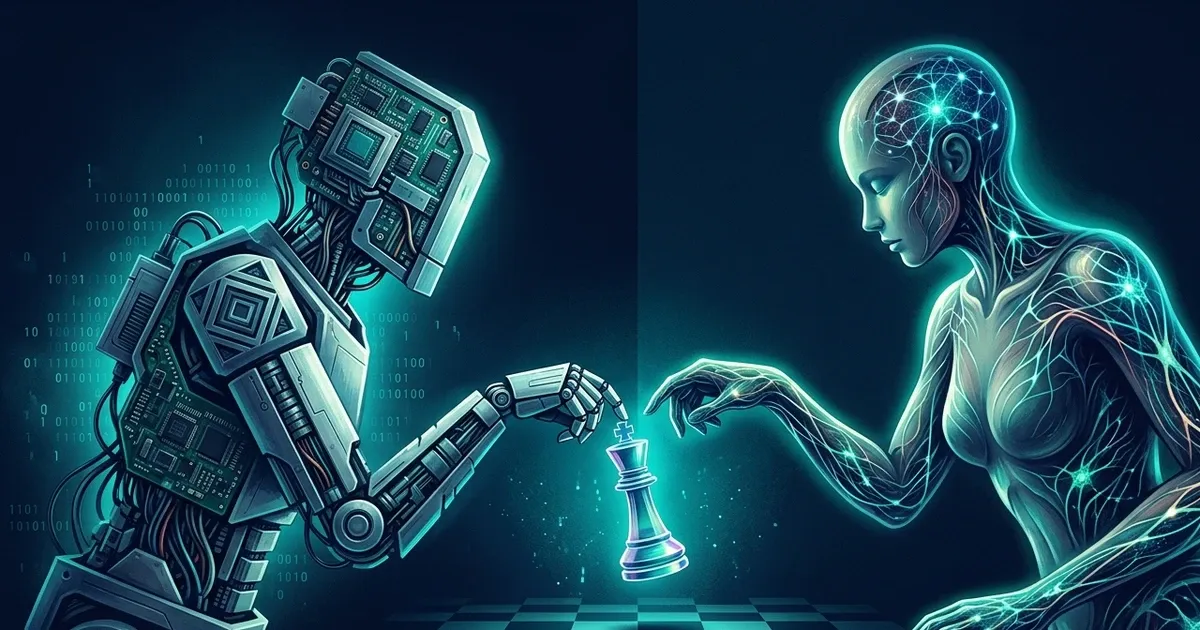
You'll see "chess AI", "chess engine", and "chess bot" used interchangeably across the internet — but they describe meaningfully different things, and which one you want depends on what you're trying to do.
Get it right and you save yourself months of unproductive practice. Get it wrong and you end up grinding against a dialled-down Stockfish, wondering why your improvement has stalled. This article walks through what each term actually means, why they differ, and which one you should be using.
Chess Engine: Built to Win
A chess engine is software designed to play the strongest move possible in any given position. Stockfish, Komodo, Leela Chess Zero, Houdini — these are all chess engines. Their job is to win.
Modern engines combine two techniques:
- Brute-force search: evaluate millions of positions per second across many possible moves and continuations
- Position evaluation: score each resulting position using a learned or hand-tuned evaluation function
At full strength, every modern engine plays well above human world-champion level. Stockfish has a rating well above 3500 — hundreds of points above Magnus Carlsen at his peak. They are not, in any meaningful sense, "trying to play like a human". They're trying to play perfectly.
Use a chess engine when: you want to analyze a position objectively, prepare openings against specific lines, find the strongest move in a study position, or evaluate whether a sacrifice is sound. The engine gives you the truth — what the best move actually is.
Chess AI Bot: Built to Play Like a Human
A chess AI bot is a different kind of system. Instead of optimizing for the strongest move, it's trained to play like a human at a specific rating level. The goal isn't to win — it's to be a believable opponent.
The training process looks roughly like this:
- Collect millions of real human games at a target rating range
- Train a neural network to predict what a human at that rating would play
- Calibrate the network until its results align with the target Elo
The result is a system that doesn't know grandmaster moves and forget them. It genuinely doesn't see them. A 1200-rated chess AI bot looks at a board the way a 1200-rated human does: it spots the obvious tactics, misses the subtle ones, follows opening principles imperfectly, and drifts in quiet positions where deep strategy is required.
The Chessiverse bot roster is built on this principle: 1000+ chess AI bots, each a separately trained neural network designed to play believably at its rating. The technical breakdown is in How We Build Human-Like Chess Bots.
Maia bots on Lichess take a similar approach at three specific ratings (1100, 1500, 1900). Noctie.ai uses a different architecture but pursues the same goal of realistic play across difficulty levels.
Use a chess AI bot when: you want a practice opponent who plays like a real human at your level. Training against AI bots transfers directly to your games against humans because the mistakes, patterns, and rhythms are similar.
"Chess Bot" — A Loose Umbrella Term
Chess bot is the most common phrase but also the loosest. In casual usage it covers everything from a handicapped Stockfish to a purpose-built AI like Maia or Chessiverse's PersonaPlay bots.
When someone says "I played a chess bot online", they could mean any of:
- A chess engine with reduced calculation depth (Lichess Stockfish levels 1–8)
- A chess engine with random move insertion to simulate weakness (older chess.com bots)
- A purpose-built AI trained for realistic play (Chessiverse, Maia, Noctie)
- A community-created Python bot of varying quality
The umbrella usage isn't wrong — they're all "bots" in the sense that they're computer opponents. But it means you have to read closely to know what kind you're actually getting when a platform advertises chess bots.
Why the Distinction Matters for Training
This is where the difference becomes practical. If you're trying to improve at chess, the kind of bot you train against shapes what you actually learn.
Training against an engine (handicapped Stockfish) teaches you to play against a flawed engine. You get used to its peculiarities — long stretches of strong play, sudden random blunders, no consistent positional weaknesses to exploit. The patterns you learn don't map cleanly to real human opponents.
Training against a chess AI bot teaches you to play against a believable simulation of a human at your level. The bot's mistakes look like the mistakes you'll face on chess.com or in a local tournament. The opening patterns it follows are the ones a real player would. Your intuitions transfer.
For context on this difference, see Why Playing a Chess Bot Feels More Real Than Ever and The Benefits of Playing Against AI Bots.
Example: The Same Position, Two Different "Bots"
Concrete example. Imagine you're playing as Black, you're rated 1300, and you've just played a slightly weak move that opens up your kingside. The opponent has a tactical opportunity — a sacrifice on h7 that wins material in five moves.
Handicapped Stockfish at "1300 level" might find the sacrifice (it's still Stockfish underneath) or might play a completely random move depending on how the handicap is implemented. The behavior is unpredictable in a way that doesn't match how real 1300 players play.
A 1300-rated chess AI bot trained on human games at that level will probably miss the sacrifice — not because it's been told to miss it, but because the neural network has learned that 1300 players consistently miss tactics of that depth. It might find a shallower threat or play a calmer move. The behavior matches what you'd see across the board from a real 1300-rated opponent.
When you analyze the game afterwards, the AI bot game gives you a realistic record of where a 1300 would have gone wrong (and didn't). The handicapped engine game gives you a record of where the engine inserted random noise.
A Better Training Stack
The right setup uses both engines and AI bots, each for what they're best at:
- Play against chess AI bots. This is your training opponent — calibrated to your rating, realistic in mistakes, varied in style. Chessiverse's chess bot roster covers the full range.
- Analyze your games with a chess engine. Run a Stockfish post-game review to find what you missed, where the critical moments were, and what the objectively best moves would have been. Lichess has free analysis with Stockfish built in.
- Repeat. The cycle of realistic play + objective analysis is the most effective training loop available.
You don't have to choose between AI and engines. They serve different functions, and combining them is how you actually improve.
For a practical perspective on how to use this stack productively, see How to Actually Improve Using a Chess Bot Without Getting Worse.
The Short Version
If you remember nothing else: engines are for analysis, AI bots are for training. A chess engine like Stockfish tells you what the best move is. A chess AI bot like the ones on Chessiverse plays like a real opponent at your level. Use the right one for what you're trying to do, and your improvement curve will steepen noticeably.
Ready to try it? Create a free Chessiverse account and play a chess AI bot in your range — about 30 seconds to start, no credit card.