




Two pawn mascots and the en passant capture
Animated en passant capture: after 1.e4 Nf6 2.e5 d5, White's pawn captures on d6
Summary
En passant is a special pawn capture. When an enemy pawn advances two squares from its starting rank and lands directly beside your pawn, you may capture it as if it had moved only one square, landing on the square it skipped. The capture must be made immediately, on your very next move, or the right disappears. This guide shows the rule step by step for both colors, the three conditions, and the myths.
Practice en passant against 1000+ human-like bots on Chessiverse - free
Contents
- What is en passant?
- How en passant works
- The three conditions
- En passant for Black
- Why the rule exists
- En passant in notation
- Is it legal, or cheating?
- Common misunderstandings
- Practice against a bot
- FAQ
- Sources
What is en passant?
En passant is the rule that lets a pawn capture an enemy pawn which has just used its two-square first move to slip past. You capture diagonally onto the square the enemy pawn crossed, exactly as if it had advanced a single square. The term is French for "in passing", and it is the only capture where your piece does not land on the captured piece's square.
How en passant works, step by step
The rule sounds strange until you see it once. Here is the classic setup from White's side:
- White plays e4, then advances to e5.
- Black answers with d5, pushing two squares so the pawn lands beside White's e5 pawn.
- White may now capture with exd6, exactly as if the black pawn had stopped on d6.
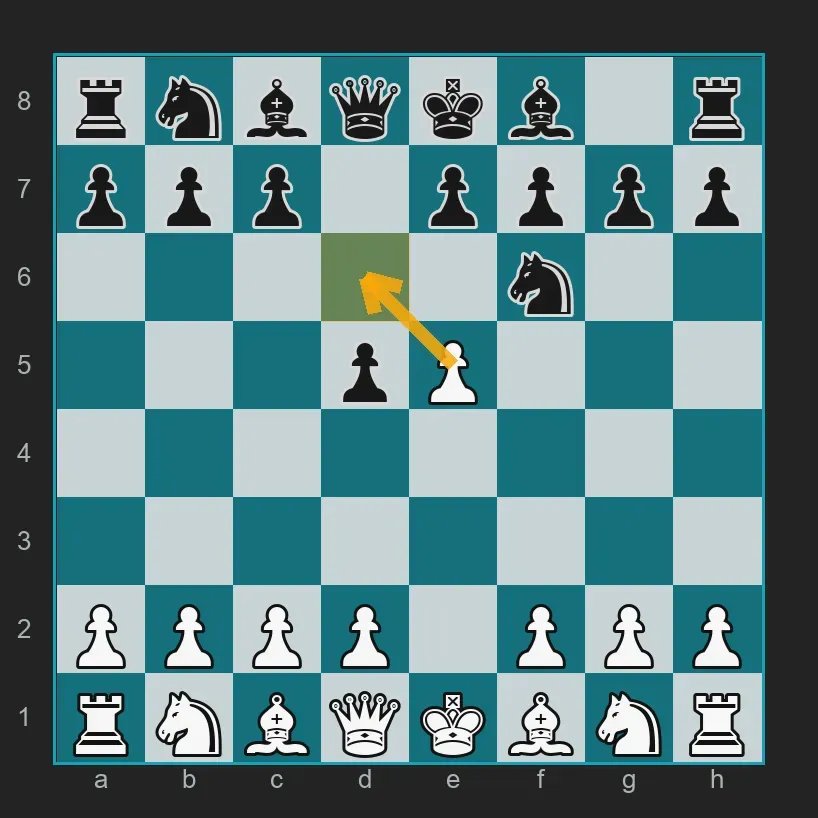

Position after 1.e4 Nf6 2.e5 d5 with the en passant capture on d6 available
The unusual part
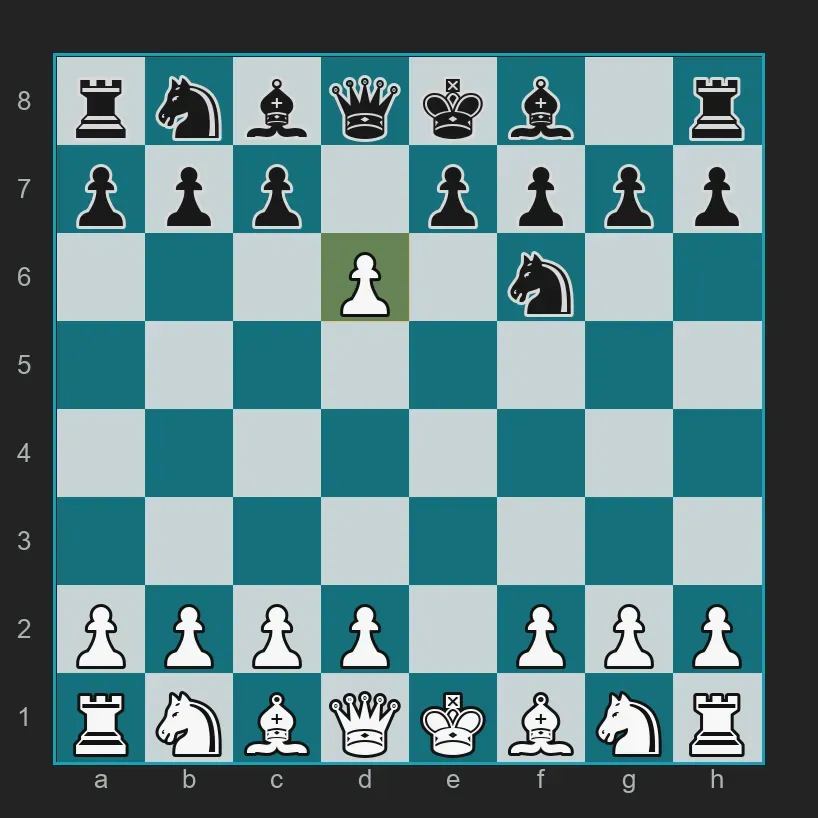
Position after the en passant capture exd6: the white pawn stands on d6 and the d5 pawn is gone
The capturing pawn does not land on the victim's square. It lands on the square the enemy pawn skipped over. En passant is the only capture in chess where the capturing piece does not replace its victim, which is exactly why it confuses new players.
The three conditions for en passant
All three must be true at the same time, per the FIDE Laws of Chess (no-follow):
| Condition | Meaning |
|---|---|
| Fifth rank | Your pawn stands on its fifth rank (fifth row from your side) |
| Two-square advance | An enemy pawn just moved two squares and landed beside yours |
| Immediately | You capture on the very next move, or the right is gone |
The one-move window
The timing rule catches everyone once. If you play any other move first, en passant against that pawn is lost forever. In rare positions en passant is even the only legal move, which makes the window a matter of rules, not politeness. It never carries over to a later turn.
En passant works for Black too
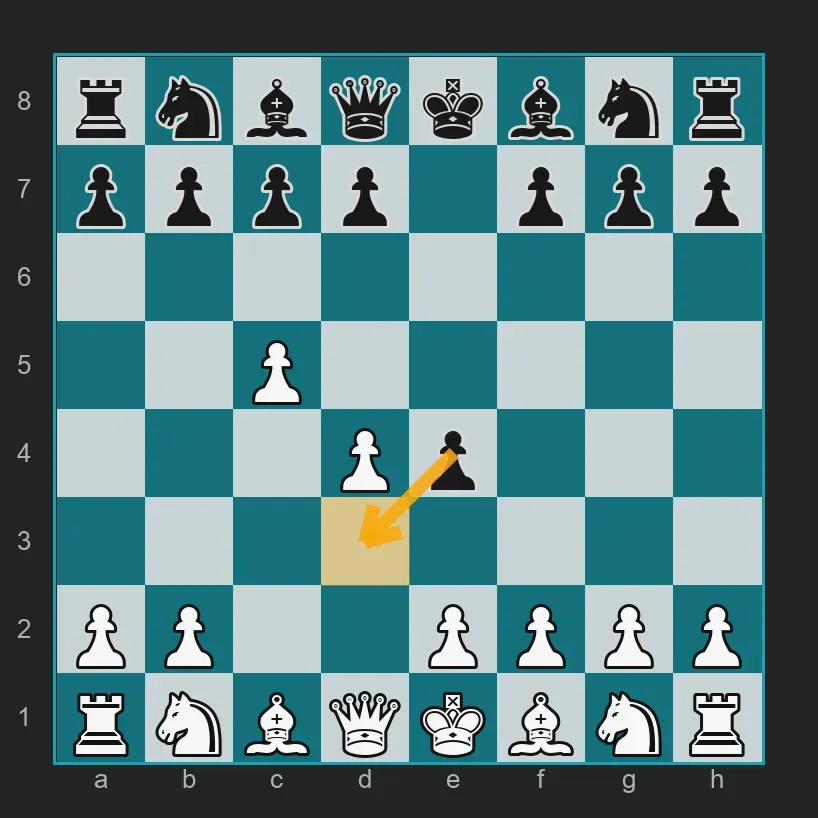
Position where Black's e4 pawn can capture White's d4 pawn en passant on d3
Black captures en passant on the fourth rank, the mirror of White's fifth. In the diagram Black's pawn reached e4, White answered d2-d4, and Black may reply exd3.
Animated black-side en passant: Black's e4 pawn captures on d3 after White plays d4
Why does en passant exist?
The rule arrived in the 15th century together with the pawn's two-square first move (Wikipedia, no-follow). Without it, a pawn could sneak past an enemy pawn's control square unchallenged, making passed pawns far too easy to create. En passant closed that loophole: if the two-square jump tries to pass your pawn, you get to capture it in passing, keeping the older one-square logic intact.
En passant in notation
In algebraic notation the capture is written like any pawn capture, from-file times destination square: exd6 in our White example, exd3 in the Black one. Some sources add the suffix "e.p." for clarity, as in exd6 e.p., but the suffix is optional under FIDE rules. The move also spawned the well-known "google en passant" meme, which is simply players celebrating a legal but often overlooked rule.
Is en passant legal, or cheating?
En passant is entirely legal and always has been. Because it appears only a few times per game and captures without landing on the enemy pawn, newcomers sometimes suspect a trick or a bug. It is neither. Every rulebook from casual clubs to the world championship includes it, and refusing to accept it in a tournament game does not make it optional.
Common misunderstandings
- "It is optional, so it must be rare." Optional like any capture, but strong players use it whenever it wins material or opens lines.
- "Any side-by-side pawns can do it." No. Only immediately after the two-square advance. Pawns that became neighbors any other way cannot capture each other.
- "It only works for White." Both sides capture en passant, as the diagrams above show.
- "A one-square advance can be taken this way." No. The victim must have moved two squares in a single move.
Practice en passant against a bot
The fastest way to internalize the rule is to reach it in real games. Chessiverse bots at every level play the pawn advances that create en passant chances, and nobody gets impatient while you think through the conditions. Prefer video? IM John Bartholomew's Chess Fundamentals series on YouTube (external link) covers pawn play for beginners.
Play a human-like bot now and try it yourself
A mascot surprised by the en passant rule
Frequently asked questions
Is en passant still legal?
Yes. En passant is a standard rule in every form of chess, from casual play to the world championship, and has been for centuries. It cannot be switched off or declined in a rated game.
Is en passant cheating?
No. It is one of the official rules of chess, listed in the FIDE Laws of Chess. It only feels unfair to players who have not met it before, because the capturing pawn lands on an empty square rather than on the pawn it removes.
Do grandmasters use en passant?
Constantly. Any capture that wins material, opens a file, or improves the structure gets played at every level. The rule only feels rare because the exact conditions appear a few times per game at most, not because strong players avoid it.
Is an en passant checkmate possible?
Yes, though it is rare. In certain positions the en passant capture removes a defender or opens a line so that the same move delivers checkmate. Composed problems and a handful of real games show en passant ending the game on the spot.
Why is en passant so rare?
It requires a specific coincidence: your pawn on its fifth rank, an enemy pawn using its two-square jump to land right beside it, and your choice to capture immediately. Those conditions simply do not line up very often, which is why many casual players forget the rule exists.
Does en passant mean "in passing"?
Yes. The French term describes exactly what happens: the two-square advance tries to pass your pawn, and you capture it in passing, as if it had stopped one square short.
Start playing free on Chessiverse
Keep learning: castling explained, how to get better at chess, or play vs the computer.

A pawn mascot proud on the capture square
Sources
External links are no-follow.
- FIDE Laws of Chess, article 3.7 (the official en passant rule) - https://handbook.fide.com/chapter/E012023
- Wikipedia: En passant (history of the rule) - https://en.wikipedia.org/wiki/En_passant
- John Bartholomew, YouTube (video study) - https://www.youtube.com/@johnbartholomew