



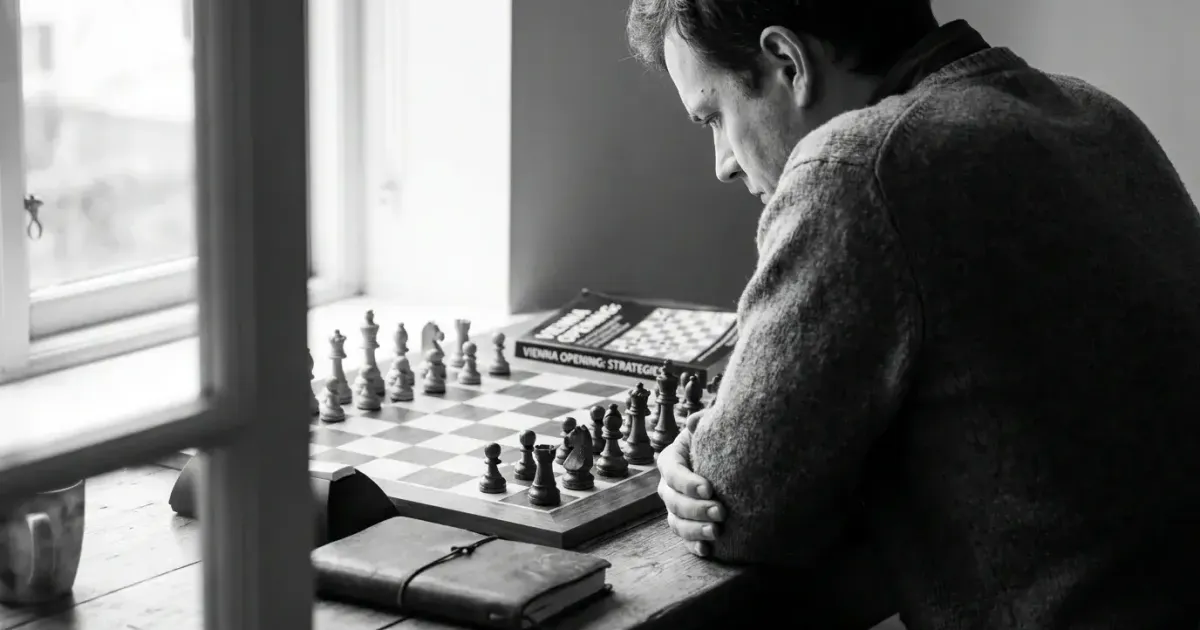
If you want an opening that feels aggressive, is easy to learn, and stays practical in club games, the Vienna Opening is well worth checking out. It starts with 1.e4 e5 2.Nc3, and that small knight move changes quite a bit, which is really the main idea. Instead of going into the most common main lines, you guide your opponent into positions they usually do not know all that well.
That is a big reason the Vienna often works so well at club level. Most players prepare for the Italian or the Ruy Lopez, but fewer spend real time on the Vienna, at least in typical club games. For chess for beginners and improving club players, that usually means less theory to remember and more chances to play based on ideas. That is a very practical tradeoff. In this guide, we will look at why the opening works, how to learn the key plans, and how to practice it in a stress-free way that fits your own playstyle.
Why the Vienna Opening Works So Well
The Vienna is often underrated because it gives White active play without forcing endless memorization. Plenty of openings look great in theory, but they can be awkward to handle in a real game, and that is usually where things get messy. The Vienna often feels different in that way. White will often put the bishop on c4, prepare or play f4, and start building pressure on the kingside before Black is fully organized.
The Vienna Game is a chess opening for attacking players who like tactical play, avoiding main line theory, and little chance of the game reaching an endgame.
— Hanging Pawns, YouTube
When people compare common White options at amateur level, the Vienna usually stands out for being practical, flexible, and easy to handle. In many games, you get attacking ideas, natural development, and plans that are genuinely easy to remember.
Why many club players find the Vienna easier to use in real games
| Opening | Theory Load | Club-Level Surprise | Style |
|---|---|---|---|
| Vienna Opening | Low to medium | High | Aggressive and flexible |
| Italian Game | Medium | Low | Positional with tactics |
| Ruy Lopez | High | Low | Strategic and deep |
As the table shows, the Vienna offers a strong mix of danger and simplicity, and that combination is pretty unusual. It also keeps working as a player gets stronger, which often matters more than people expect. So the same attacking ideas can help a 700-rated player and still stay useful much later on. For a wider overview of where the Vienna fits, see our top chess openings for beginners.
The Key Ideas You Actually Need to Know in the Vienna Opening
The best way to learn the Vienna Opening is to study plans, not just moves. That matters a lot because club opponents leave theory early all the time. If someone only memorizes lines, it is easy to get lost quickly. But when the setup makes sense, White can still find good moves and keep playing well. In most off-script games, that kind of understanding helps more than perfect memory.
A very useful idea comes up after Black plays ...Nf6. In many of those lines, White wants f4. If Black takes that pawn too early, White often gets strong play with e5, a simple idea that works very well in this position. It pushes the knight back and claims more central space. In quieter lines, White can start with Bc4 and only later bring in Qg4 to put pressure on g7 and f7, which is often hard to defend. These are not just cheap tricks. They come up in normal games because Black's natural moves can already be a little inaccurate. The position-by-position breakdown lives on the Vienna Game opening page.
The general tactical themes are to (i) take the centre (e.g., d4), (ii) develop pieces, (iii) recapture the pawn on f4, and then (iv) attack down the f-file.
— Vitualis, Chess.com
That quote gives the basic map: take space, develop quickly, win back material if needed, and then attack. That is really the core idea here, and it stays clear in practical games.
Against ...Nc6, the timing of f4 matters even more. White will often begin with Bc4 and wait for a moment. Later, ideas like Bg5 can pin a knight, and that can make Black's kingside awkward to handle. That is a big reason the Vienna feels so natural for players who like active chess and do not want heavy theory starting from move 2.
For further study, you can also explore the Relentless Aggressor archetype on Chessiverse, which matches players who enjoy sharp Vienna-style attacks.
A Better Way to Study the Vienna Opening Without Burnout
A lot of players get stuck on openings because they study too much and barely play. A simpler approach usually works better: learn one setup, play it again and again, review the mistakes that keep showing up, and repeat. For most players, that sticks better than trying to cram a bunch of theory all at once — see how to actually improve using a chess bot without getting worse for the broader version of this approach.
According to Nick Risko in instructional material from Lichess, the Vienna is a practical opening for White because it teaches players how to handle Black's main setups, along with the usual gambit structures, so it is not just one narrow line. That is likely one reason it helps with long-term improvement.
This is also where human-like chess bots can help. When players practice against bots that make realistic mistakes and reflect different player types, opening study often becomes more useful. On Chessiverse, players can train in a more stress-free way with bots built around human-like behavior and different personalities. Additionally, you can learn more about your chess personality to find which Vienna setups fit your natural style. Opening skill also usually gets better faster when practice feels closer to a real game instead of just an engine test, which can feel pretty artificial.
Make the Vienna Part of Your Playstyle
The Vienna Opening works best when it really fits the kind of player someone is. For players who like open lines, quick development, and direct attacks, it can easily become part of their playstyle, which is usually the main goal. If calmer positions feel more natural, that works too. The opening is flexible enough to move into slower structures, so it does not force anyone to attack on every move.
The Vienna game suits club players very well, because there is not a lot of theory.
— Chessklub
The Vienna is not just a trap opening. In real, everyday games, it is a practical choice for real players. One useful way to start is with the main patterns: Bc4, good f4 timing, pressure on f7 and g7, and control of d5. Then those ideas can be practiced in real games until they begin to feel natural. Simple ideas, repeated often, usually help more than trying to memorize long main lines from more famous openings. For chess for beginners, that is often the better way.
For anyone looking for a sharp but flexible and stress-free way to improve as White, the Vienna is one of the smartest openings to learn well.
Start the Vienna Course
The ChessGoals Vienna course is free on Chessiverse. It includes over two hours of video content across three chapters, 6,500+ words of instruction, 120+ annotated positions, and Course Bots that let you practice every line immediately.
Start the course for free — chessiverse.com/courses/vienna
If you want a structured approach, the built-in study plan walks you through the full repertoire over 10 days — as little as 15 minutes a day.