



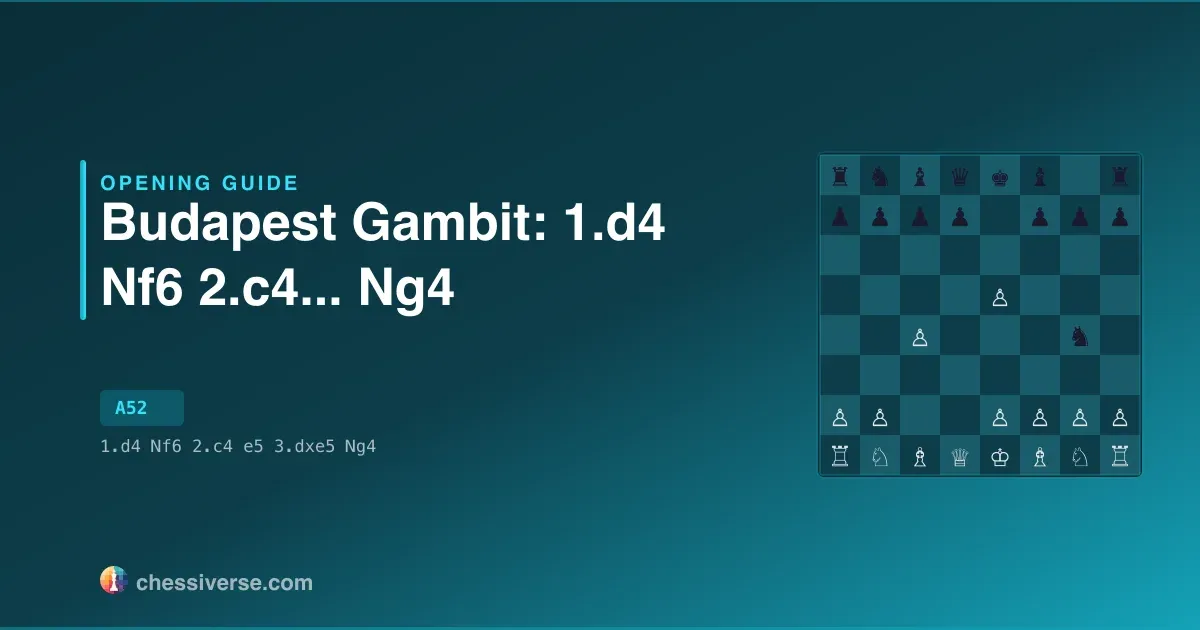
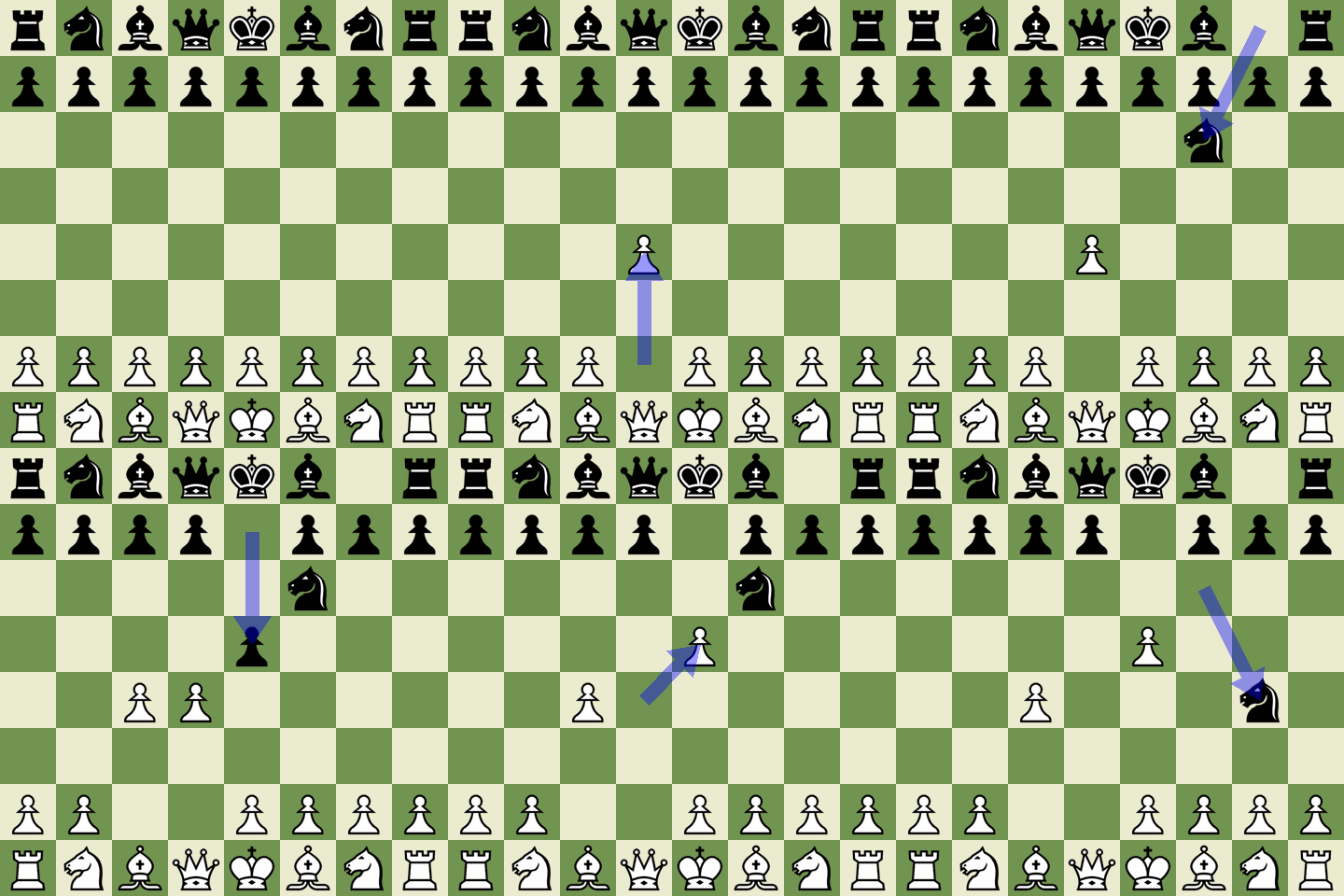
The Indian Defense: Budapest Gambit Accepted, Main Line begins with 1.d4 Nf6 2.c4 e5 3.dxe5 Ng4 (ECO A52). Black's knight retreats forward to harass the e5 pawn, daring White to either hand it back or contort the position trying to keep it. The right call usually costs structure, the wrong call costs the game.
Strategic Overview
Black is down a pawn and doesn't pretend otherwise — the gambit is built around active piece play and a concrete threat against e5 that White can't ignore for long. White's most respected reply is 4.Nf3, the Adler, which defends the pawn and develops, but Black answers 4...Bc5 and the pin against f2 makes it impossible to bring enough defenders to e5 in time. So Black recovers the pawn while White keeps a small spatial edge and a slightly easier middlegame. The other main road is 4.e4, the Alekhine Variation: White returns the pawn voluntarily to lock down d5 and grab central space, banking on the bind to outweigh Black's dynamic counterplay. After 4...Nxe5 5.f4, Black sends the knight to c6 or g6 and aims for the typical Budapest themes — pressure down the e-file, the ...Bb4+ idea to provoke Nc3 and inflict doubled, isolated c-pawns, and the famous rook lift via a6 to h6 to throw weight at the kingside. The opening tends to attract attackers and players who want a fight from move three; positionally it's slightly suspect, but practically it's a nuisance to face.
Key Ideas
When players succeed in this line, they usually do so by leaning on the following themes:
- 4...Bc5 forces White's hand on f2 — In the Adler with 4.Nf3, the bishop on c5 hits f2 and effectively bans Bf4. White has to play 5.e3, which means he can't gather enough firepower around e5 and Black wins back the pawn cleanly.
- Doubled c-pawns via ...Bb4+ — If White answers a check with Nc3, Black is happy to trade with ...Bxc3+ bxc3. The doubled isolated c-pawns are a structural weakness Black can target deep into the endgame, which is why Nbd2 is often the safer interposition.
- Rook lift to h6 — A signature Budapest plan: ...a5, ...Ra6, ...Rh6 swings a rook across the third rank toward White's king. It pairs naturally with ...Qh4 ideas and gives Black a real attacking force despite the slightly worse pawn structure.
- 4.e4 trades the pawn for a bind — The Alekhine Variation returns material to clamp down on d5 and grab central space. White accepts a calmer game with a long-term structural advantage rather than trying to cling to the extra pawn under pressure.
- Active pieces over material — The whole point of the gambit is that Black's pieces come out faster than White can coordinate. If White spends time defending e5 instead of developing, the initiative compounds and the pawn quickly becomes a liability.
History and Notable Players
It arises from the Budapest Gambit. On the White side, Ivan Farago (11 games), Tim Reilly (9 games), Rainer Siegmund (9 games) top the database. Notable Black exponents: Normunds Miezis (34 games), Evarth Kahn (29 games), Georg Mohr (23 games).
Performance Across Rating Levels
The picture changes a lot as you climb the rating ladder. The 1200 bracket has 116,856 games (0.02% of all games at that level); White wins 48.2%, Black 49%, 2.9% are drawn. Move up to 1800 Elo and the share shifts to 0.17%, with White winning 48.9% versus Black's 46.1%. At 2500, 0.14% of games go into this opening; draws sit at 9.1% — the line is well-mapped at this level. White's score improves by 3.2pp from the 1200 bracket to the 2500 bracket — the line rewards preparation.
Time Control Patterns
The Indian Defense: Budapest Gambit Accepted, Main Line skews toward blitz chess. In bullet, it appears in 0.05% of games (1,329,081); White wins 50%. Blitz shows 0.10% adoption across 3,620,383 games, White scoring 49.4%. In rapid, the share rises to 0.07% — 727,367 games, White 48.2%.
Move Diversity and Theory Depth
What players actually play after the opening moves depends heavily on rating. At 1200 Elo (116,856 games), the top reply is Nf3, played 54.3% of the time. Two other moves each take at least 5% of games, and the top three moves account for 73.6% of games. Entropy: 2.38. By 2500 (18,794 games), Bf4 takes over as the top reply at 37.6%; three other moves reach 5% and the top three moves account for 83.9% of games. Entropy drops to 2.15.
Historical Trends
Tracking the Indian Defense: Budapest Gambit Accepted, Main Line year over year shows a clear story. Adoption peaked in 2019 at 0.13% (377,617 games). By 2025 it sits at 0.07%, 44% below the peak and 32% under its 2013 level, leaving the line in decline.
Common Mistakes
- Drifting away from main theory — At 400 Elo, the three most-played moves cover 52.6% of games, against 84.1% at 2000. The most popular deviation is f3 (played 10.3% of the time at 400, much less so up top). It looks fine but quietly hands the better-prepared side an edge.
- Neglecting development — Extra pawn moves in the opening are tempting, especially when you "know the moves". Developing a piece each turn is the simple correction.
- Overextending the attack — Gambits look like permission to throw everything forward. They aren't — every attacking move should improve a piece. Random checks and threats burn the initiative once they fail to coordinate.
Practice on Chessiverse
Ready to try the Indian Defense: Budapest Gambit Accepted, Main Line against a bot? Pick an opponent at your level and play a game.