


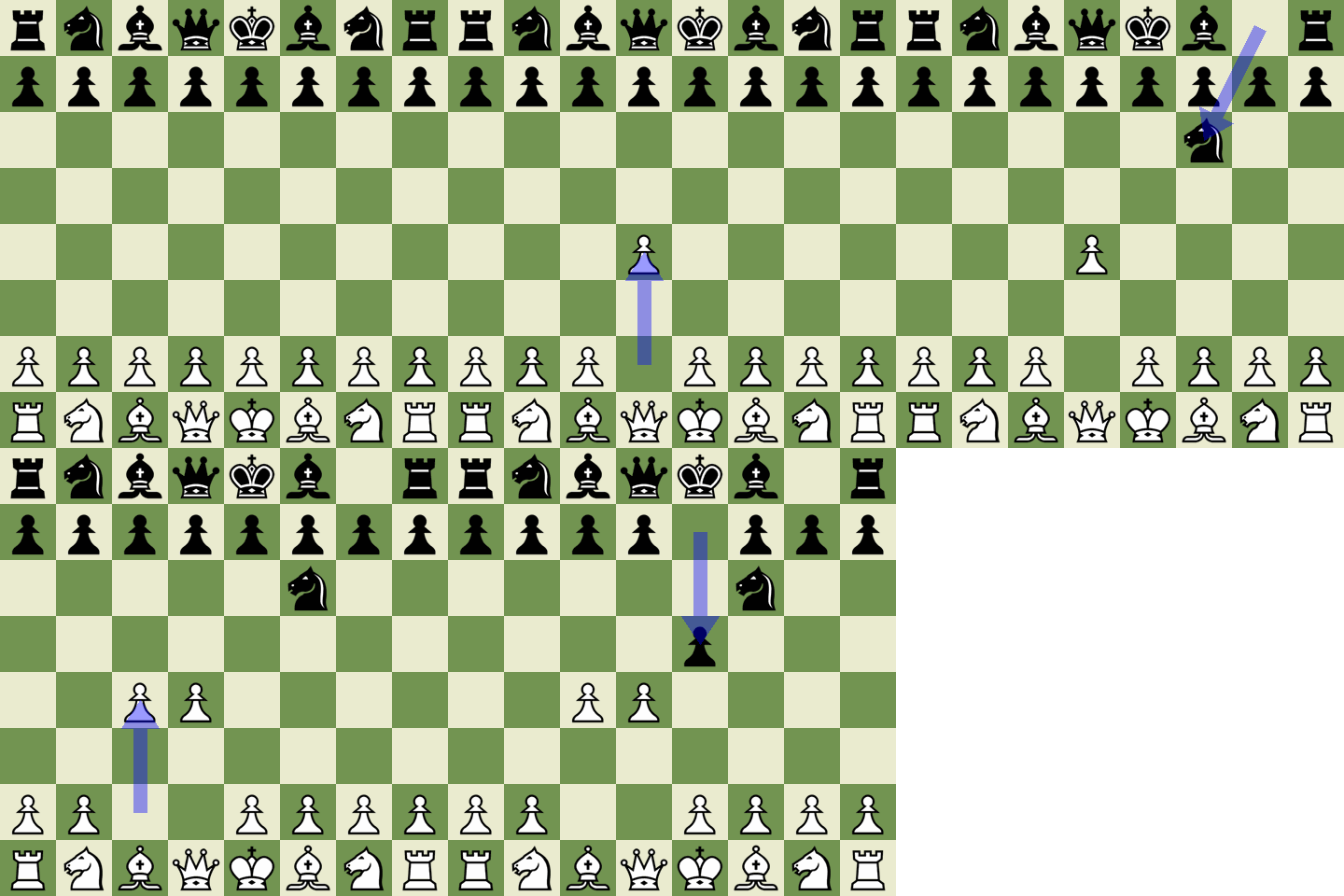
The Budapest Gambit arises after 1.d4 Nf6 2.c4 e5 and falls under ECO code A51. With 2...e5, Black immediately strikes at White's center, offering a pawn sacrifice that can typically be recovered while generating active piece play. The opening is generally considered slightly dubious at the highest level but is widely regarded as an effective surprise weapon, particularly in faster time controls. The main line proceeds with 3. dxe5, after which Black's knight must relocate, usually to g4 or e4. Although White wins a pawn, clinging to it too stubbornly tends to backfire — in the principal continuation 3...Ng4 4. Bf4 Nc6 5. Nf3 Bb4+ 6. Nbd2 Qe7, White finds it difficult to add another defender and typically returns the material. Declining the gambit is unusual and generally considered unnecessary, since allowing Black a free challenge to White's center seems overly cautious. The opening traces back to an 1896 game between the amateur Mor Adler and Geza Maroczy in Budapest, was taken up again in 1916 by Gyula Breyer against Johannes Esser in the same city, and gained wider attention when Milan Vidmar used it to upset Akiba Rubinstein. With 8.5 million Lichess games across all rating levels, it is a specialized opening choice.
- Black gives up the e5 pawn for rapid development and active pieces, usually hunting it down again with ...Ng4 rather than settling for a pawn-down game.
- The check ...Bb4+ forces White into awkward decisions, and the 'Budapest rook' lift Ra8-a6-h6 can swing over to fuel a kingside attack.
- White often plays for space instead of clinging to the pawn, with plans like the c4-c5 queenside advance or an f4-f5 pawn storm.
History and Notable Players
The earliest known analysis of this opening dates back to Adler vs. Maróczy, Budapest 1896. The opening is named after Budapest, Hungary. It arises from the Indian Defense Systems. Among the most prolific practitioners on the White side are Rainer Siegmund (12 games), Ivan Farago (12 games), Loek Van Wely (10 games). On the Black side, notable exponents include Evarth Kahn (37 games), Normunds Miezis (34 games), Georg Mohr (28 games).
First seen in an 1896 casual game between Adler and Maroczy in Budapest, the gambit was developed by Hungarians Abonyi, Barasz and Breyer. Milan Vidmar's win over Rubinstein in Berlin 1918 put it on the map, and stars like Reti, Spielmann and Tartakower took it up in the 1920s before theory turned against it.
Named after: Named for Budapest, Hungary, where an 1896 game first tried it and where Hungarian masters later worked out how to make it playable.
Notable players: Savielly Tartakower, Richard Réti, Rudolf Spielmann, Shakhriyar Mamedyarov
The Kieninger Trap (1925): after 4.Bf4 Nc6 5.Nf3 Bb4+ 6.Nbd2 Qe7 7.a3 Ngxe5, grabbing the bishop with 8.axb4 loses on the spot to the smothered mate 8...Nd3#.
Statistics
Based on 8.5 million Lichess games across all rating levels:
- White wins: 47.5%
- Black wins: 47.8%
- Draws: 4.8%
The statistics show a roughly balanced opening where both sides have equal chances.
Main Lines and Variations
After 1.d4 Nf6 2.c4 e5, the main continuations include:
Each of these lines leads to distinct types of positions and requires its own understanding of the resulting pawn structures and piece placements.
Common Mistakes to Avoid
- Overextending without backup: When playing a gambit, each attacking move should have a purpose. Random checks and threats without coordination can leave your own position exposed once the initiative fades.
Practice on Chessiverse
The best way to learn the Budapest Gambit is through practice. On Chessiverse, you can play chess against computer opponents that specialize in this opening. Our AI bots range from beginner to grandmaster level, each with unique playing styles — from aggressive attackers to solid defenders. Choose a bot that matches your rating and work your way up as you master the opening's key ideas.
Performance Across Rating Levels
The picture changes a lot as you climb the rating ladder. Among 1200-rated players, it appears in 0.04% of games — 280,018 of them on record — with White winning 47.9% and Black 49%. At 1800 the opening surfaces in 0.33% of games; White wins 47.1%, Black 48.2%, draws 4.8%. At 2500, 0.20% of games go into this opening; draws sit at 10% — the line is well-mapped at this level.
Time Control Patterns
Time control matters here: blitz players reach for this opening more than others. In bullet, it appears in 0.15% of games (3,887,240); White wins 49.3%. Blitz shows 0.20% adoption across 7,138,258 games, White scoring 47.7%. In rapid, the share rises to 0.12% — 1,355,281 games, White 46.5%. White's score swings 2.8pp across formats, so time control isn't just a stylistic choice here — it shifts the actual results.
Move Diversity and Theory Depth
Looking at move selection shows how forcing — or not — the position really is. At 1200 Elo (280,018 games), the top reply is dxe5, played 51.2% of the time. Four other moves each take at least 5% of games, and the top three moves account for 78.2% of games. Entropy: 2.14. By 2500 (26,641 games), dxe5 dominates at 89.8% of replies; no other move reaches 5% and the top three moves account for 96.5% of games. Entropy drops to 0.69. That entropy collapse is the signature of a line where preparation pays off: at the top, players know the best move and play it.
Historical Trends
Year-over-year data tells you whether this opening is a contemporary fixture or a fading one. Adoption peaked in 2019 at 0.25% (717,493 games). By 2025 it sits at 0.14%, 43% below the peak and 29% under its 2013 level, leaving the line in decline.