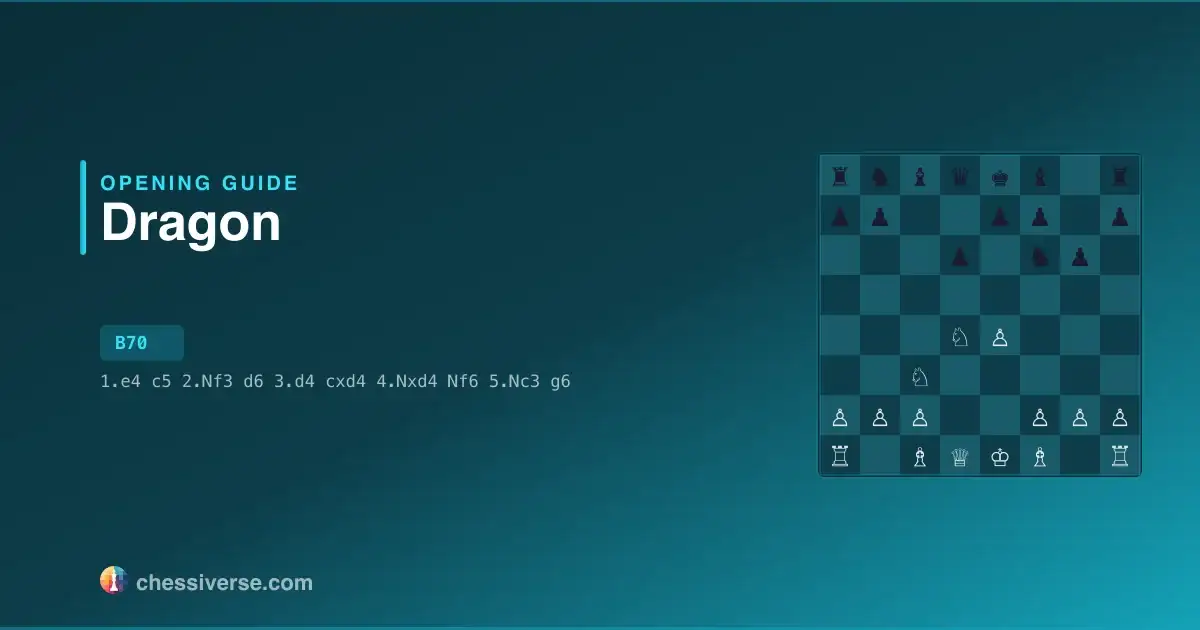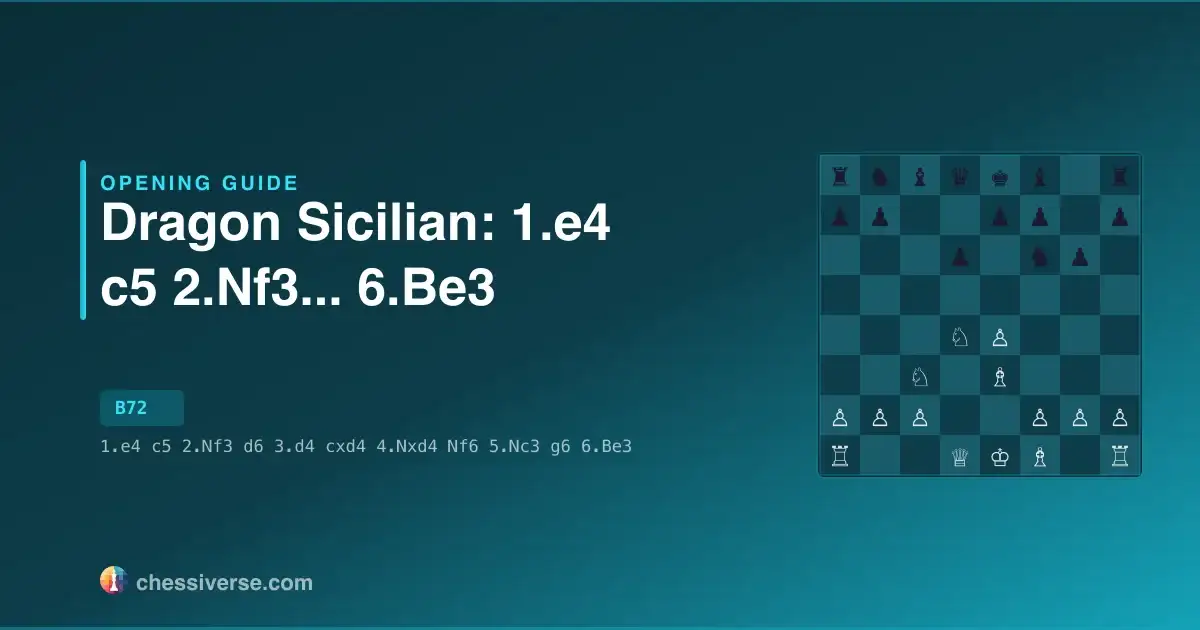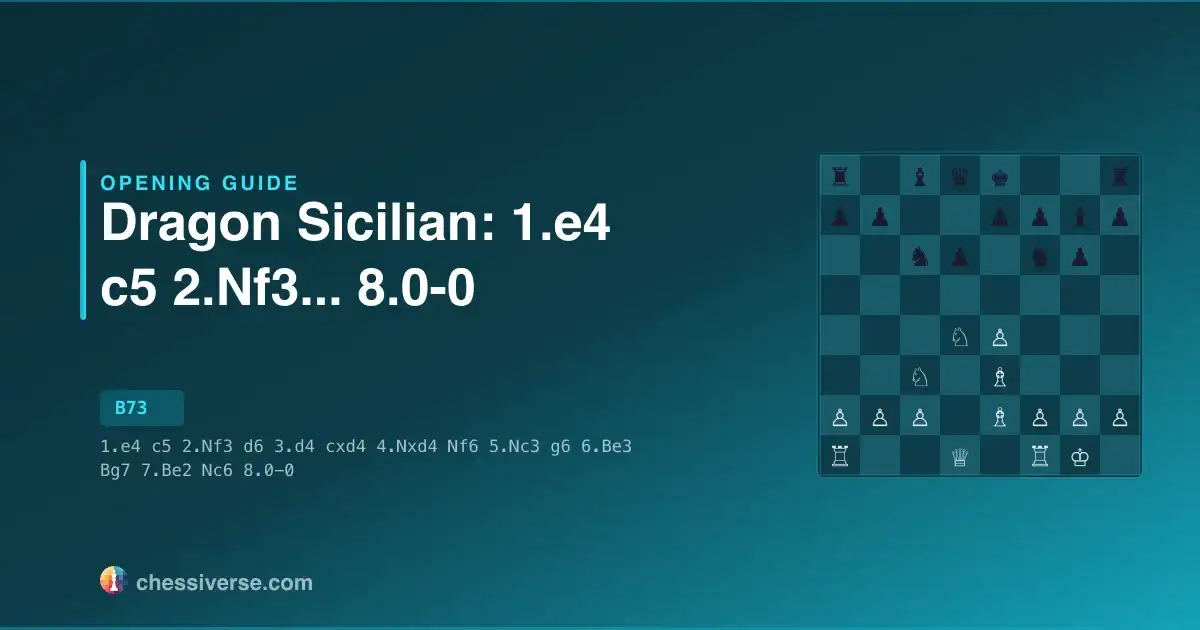


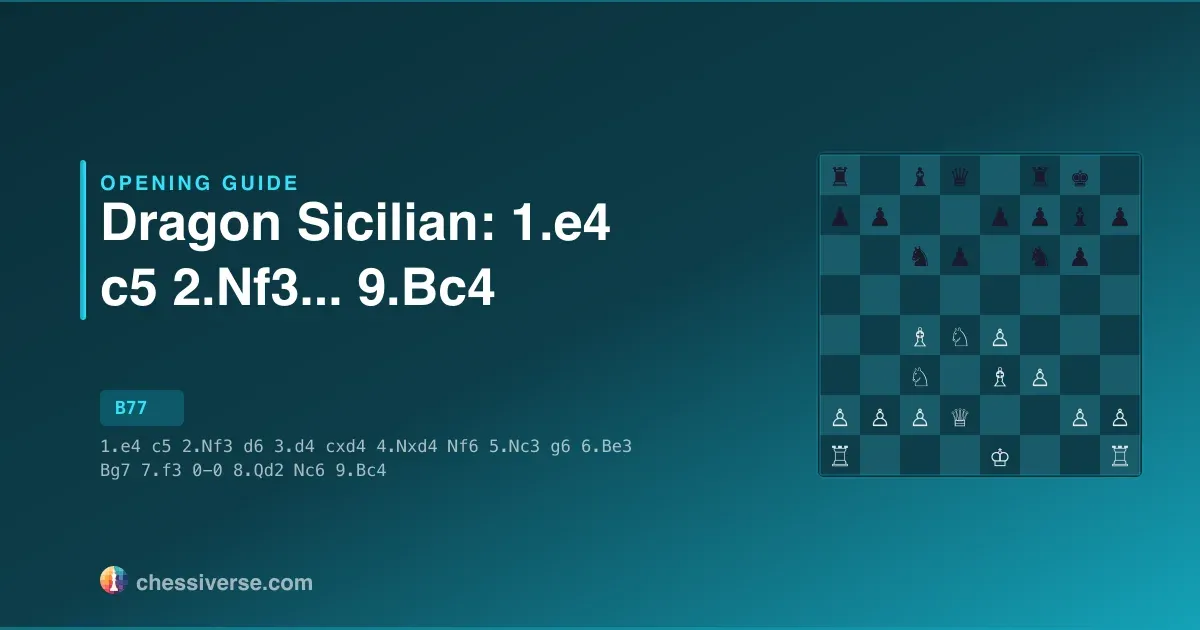
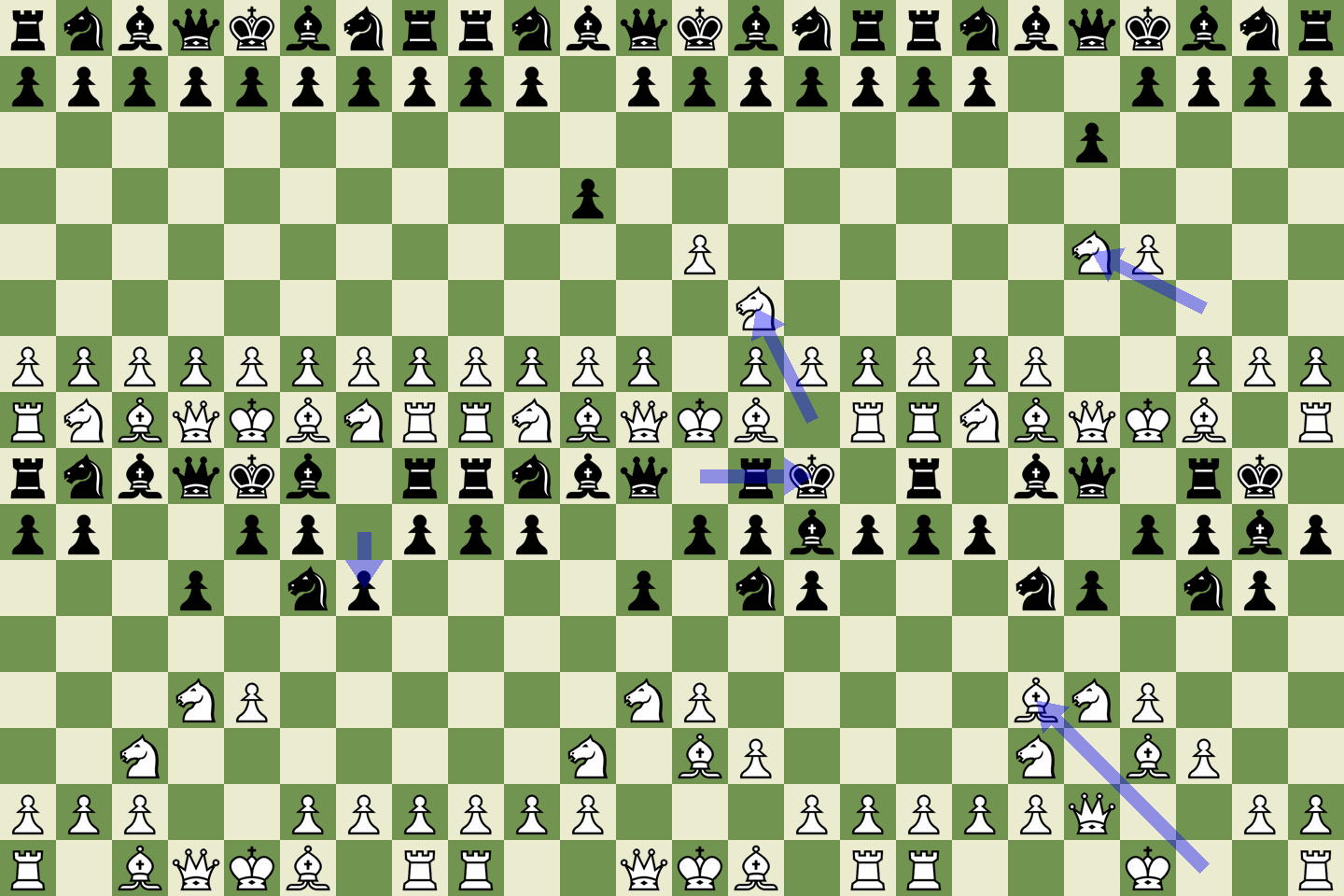
Starting from 1.e4 c5 2.Nf3 d6 3.d4 cxd4 4.Nxd4 Nf6 5.Nc3 g6 6.Be3 Bg7 7.f3 0-0 8.Qd2 Nc6 9.Bc4, players enter the Sicilian Defense: Dragon Variation, Yugoslav Attack, Main Line — ECO B77. With 973,182 games on record, the patterns below come from the largest practical sample available.
History and Notable Players
It arises from the Sicilian Defense: Dragon Variation, Yugoslav Attack (7...0-0). On the White side, Sandor Farago (20 games), Emanuel Berg (20 games), Viesturs Meijers (19 games) top the database. Notable Black exponents: Evarth Kahn (41 games), Miso Cebalo (39 games), Sandor Farago (34 games).
Performance Across Rating Levels
The picture changes a lot as you climb the rating ladder. At 1200 Elo, the opening shows up in 0.00% of games (6,520 samples). White scores 56.4%, Black 40.1%, draws 3.5%. At 1800 the opening surfaces in 0.03% of games; White wins 53.3%, Black 42.3%, draws 4.3%. Among 2500-rated players the line appears in 0.12% of games and draws spike to 8.7%, indicating tight preparation. White's edge erodes by 9.4pp from 1200 to 2500 Elo, suggesting Black's counterplay is easier to find with experience.
Time Control Patterns
Time control matters here: blitz players reach for this opening more than others. In bullet, it appears in 0.01% of games (369,648); White wins 51.2%. Blitz shows 0.02% adoption across 851,513 games, White scoring 50.6%. In rapid, the share rises to 0.01% — 121,669 games, White 52.3%.
Move Diversity and Theory Depth
Looking at move selection shows how forcing — or not — the position really is. At 1200 Elo (6,520 games), the top reply is Bd7, played 39.9% of the time. Six other moves each take at least 5% of games, and the top three moves account for 68.8% of games. Entropy: 2.77. By 2500 (15,910 games), Bd7 dominates at 74.7% of replies; only one other move still reaches 5% and the top three moves account for 94.2% of games. Entropy drops to 1.29. The narrowing is significant — strong players consolidate around a small set of best moves, while amateurs scatter across many plausible-looking options.
Historical Trends
Tracking the Sicilian Defense: Dragon Variation, Yugoslav Attack, Main Line year over year shows a clear story. Adoption peaked in 2020 at 0.03% (175,911 games). By 2025 it sits at 0.02%, 50% below the peak but still 43% above its 2013 level, so the line is up over the full period despite easing from the high.
Main Lines and Variations
From the position after 1.e4 c5 2.Nf3 d6 3.d4 cxd4 4.Nxd4 Nf6 5.Nc3 g6 6.Be3 Bg7 7.f3 0-0 8.Qd2 Nc6 9.Bc4, the recognised continuations are:
Each branch leads to a different middlegame character — the resulting pawn structure decides what kind of game you get.
Common Mistakes
- Neglecting development — Extra pawn moves in the opening are tempting, especially when you "know the moves". Developing a piece each turn is the simple correction.
- Ignoring the kingside attack — In sharp Sicilian lines, White typically castles long and pushes the h-pawn. Without your own counterplay on the queenside or in the centre, White's attack lands first.
Practice on Chessiverse
Ready to try the Sicilian Defense: Dragon Variation, Yugoslav Attack, Main Line against a bot? Pick an opponent at your level and play a game.