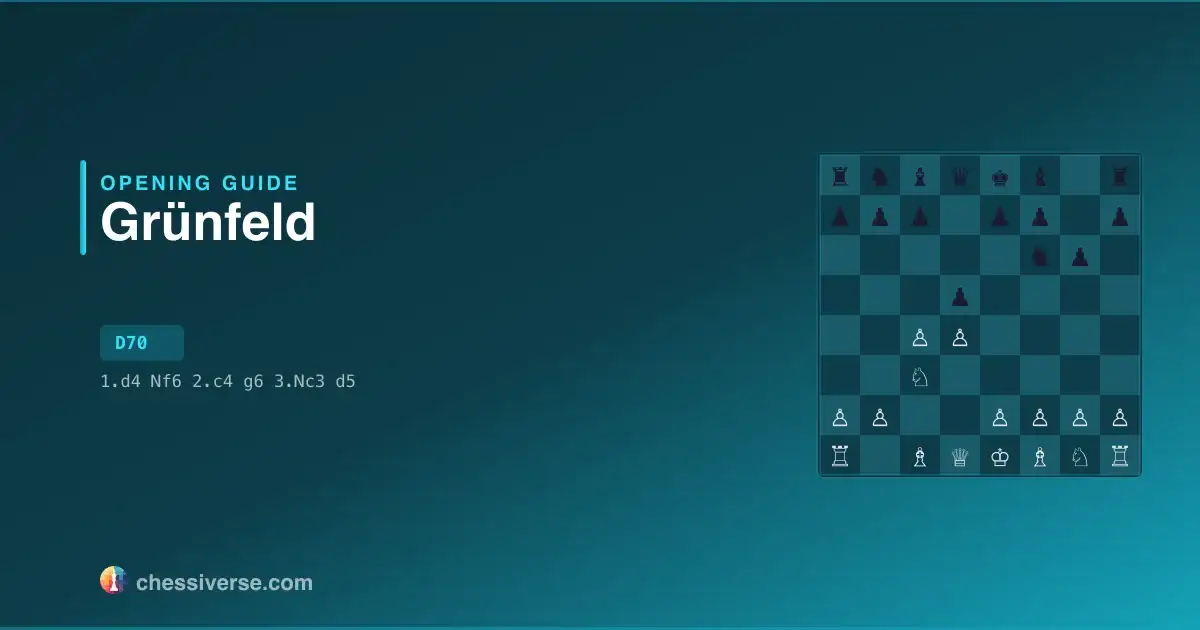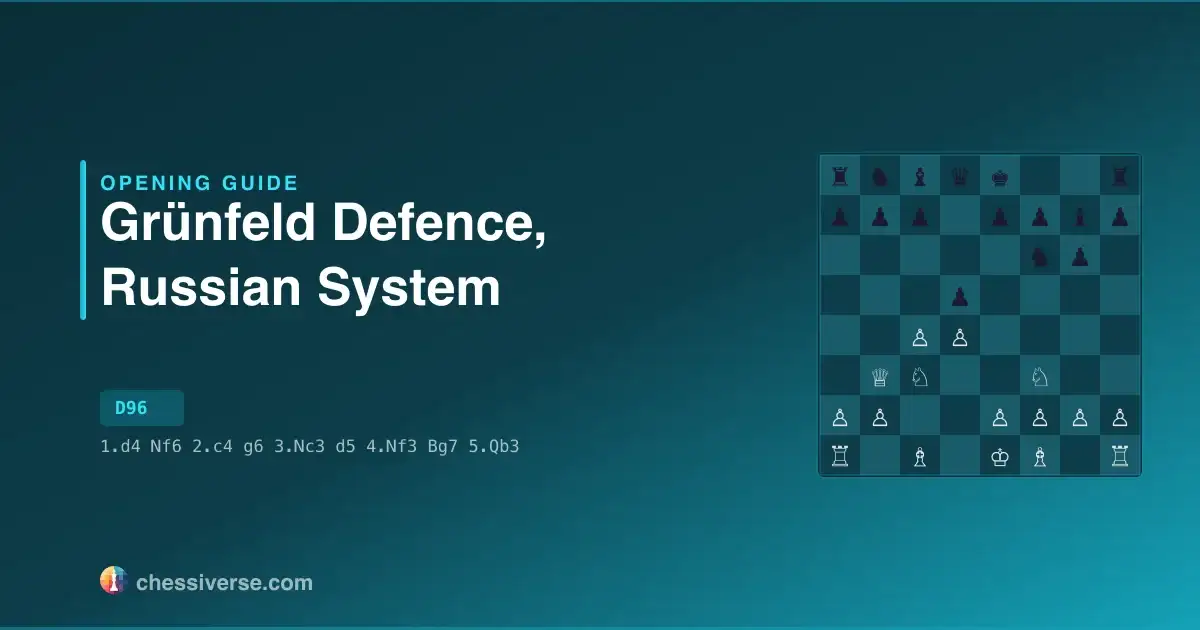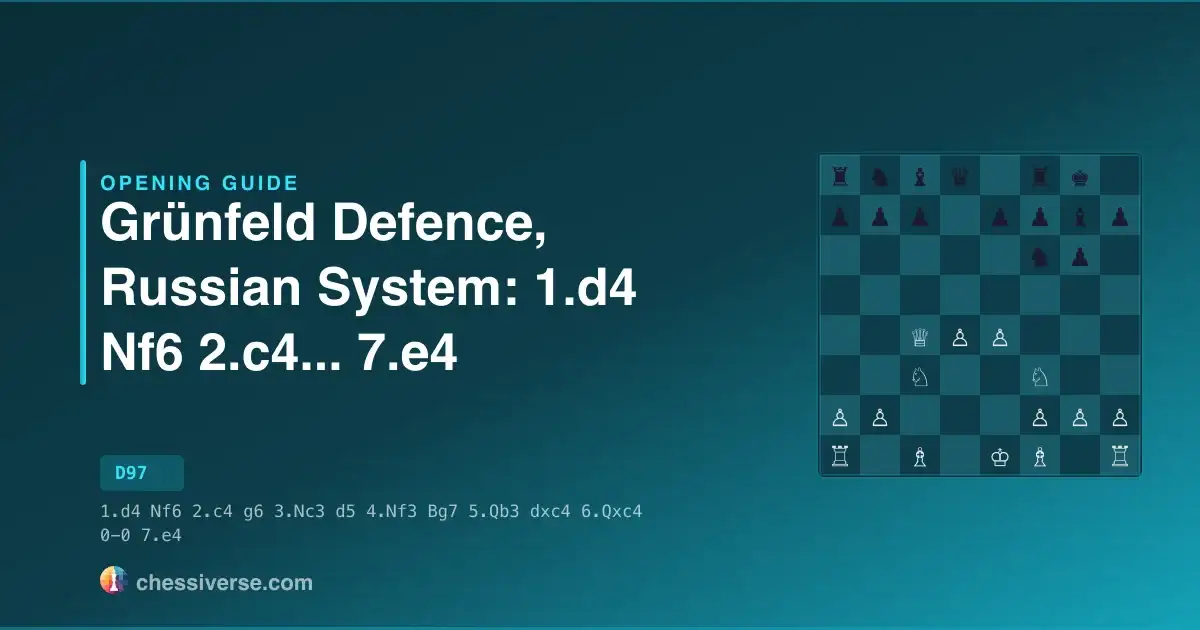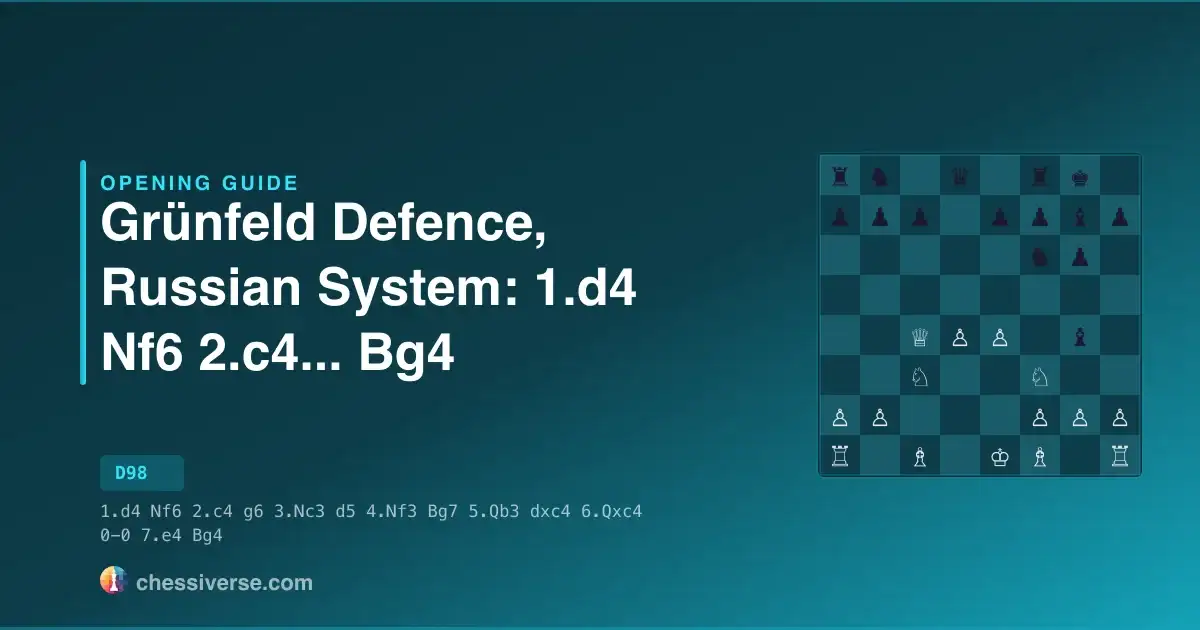




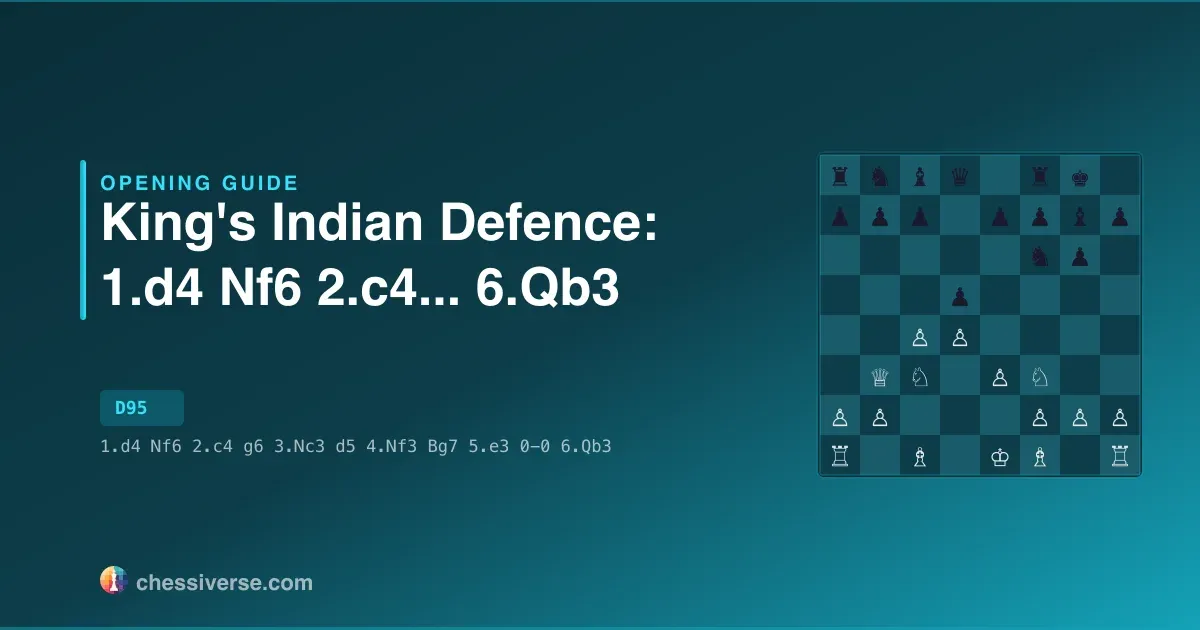
The Grünfeld Defense: Three Knights Variation, Vienna Variation begins with 1.d4 Nf6 2.c4 g6 3.Nc3 d5 4.Nf3 Bg7 5.e3 0-0 6.Qb3 (ECO D95). Across rating levels it shows up in 60,201 recorded games — enough data to map exactly where it succeeds and where it stalls.
History and Notable Players
It arises from the Grünfeld Defense: Three Knights Variation, Burille Variation. On the White side, Azer Mirzoev (9 games), Dragoljub Jacimovic (9 games), Arthur Bernard Bisguier (7 games) top the database. Notable Black exponents: Anthony Edward Santasiere (5 games), Jaroslav Sajtar (4 games), Rudolf Spielmann (4 games).
Performance Across Rating Levels
Popularity and results vary sharply by rating level. Among 1200-rated players, it appears in 0.00% of games — 1,352 of them on record — with White winning 50.5% and Black 46.7%. At 1800 the opening surfaces in 0.00% of games; White wins 50.4%, Black 44.7%, draws 4.8%. Among 2500-rated players the line appears in 0.01% of games and draws spike to 12.5%, indicating tight preparation. White's edge erodes by 3.4pp from 1200 to 2500 Elo, suggesting Black's counterplay is easier to find with experience.
Move Diversity and Theory Depth
What players actually play after the opening moves depends heavily on rating. At 1200 Elo (1,345 games), the top reply is c6, played 28.6% of the time. Six other moves each take at least 5% of games, and the top three moves account for 64.8% of games. Entropy: 2.92. By 2500 (2,002 games), dxc4 takes over as the top reply at 39.5%; only three other moves still reach 5% and the top three moves account for 92.5% of games. Entropy drops to 1.85. The narrowing is significant — strong players consolidate around a small set of best moves, while amateurs scatter across many plausible-looking options.
Common Mistakes
- Drifting away from main theory — At 1000 Elo, the three most-played moves cover 59.8% of games, against 89.9% at 2000. The most popular deviation is e6 (played 15.2% of the time at 1000, much less so up top). It looks fine but quietly hands the better-prepared side an edge.
- Neglecting development — Extra pawn moves in the opening are tempting, especially when you "know the moves". Developing a piece each turn is the simple correction.
- Playing without a plan — Each Grünfeld Defense: Three Knights Variation, Vienna Variation middlegame demands a specific approach. Decide whether the position calls for attack, manoeuvre, or simplification before reaching for a move.
Practice on Chessiverse
Ready to try the Grünfeld Defense: Three Knights Variation, Vienna Variation against a bot? Pick an opponent at your level and play a game.