



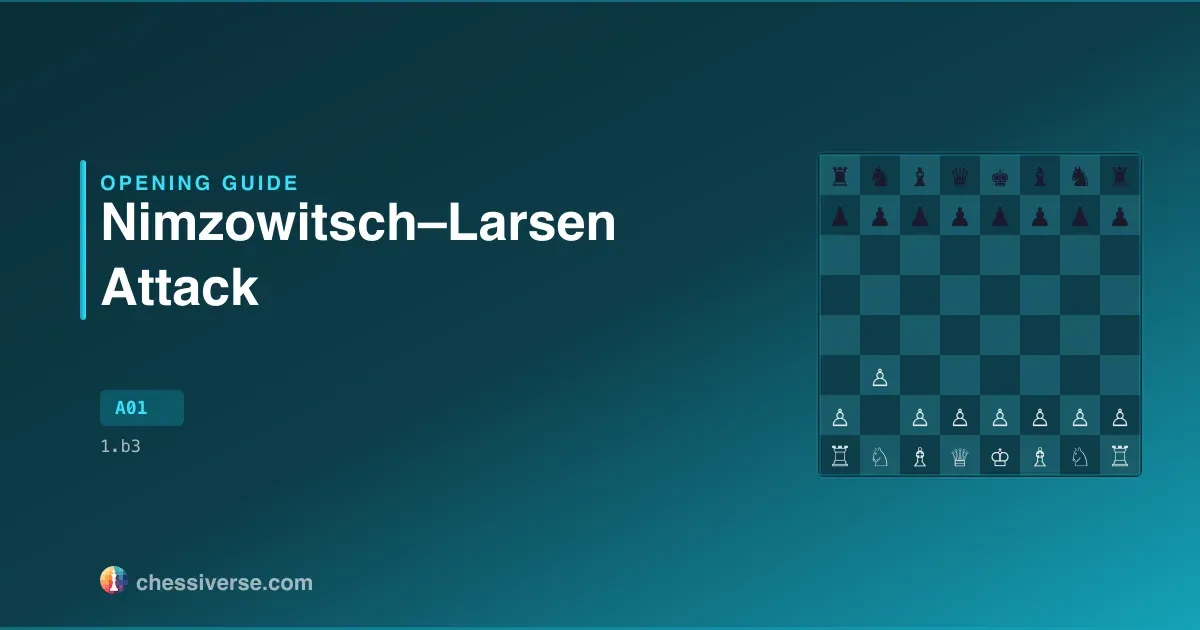
The Nimzowitsch-Larsen Attack arises after 1.b3 and falls under ECO code A01. This move prepares a fianchetto of the queen's bishop to b2, from where it will bear down on the central squares and aim toward Black's kingside. As a hypermodern opening, the idea is to influence the center with a piece rather than occupying it with pawns in the classical manner. This naturally allows Black to claim central space, which they usually do with 1...e5 or 1...d5, while 1...Nf6 is another common choice. The Modern Variation, 1...e5, is Black's most popular and ambitious reply, appearing in roughly 45% of games. Black typically constrains the b2 bishop's scope and builds a broad center with both the d- and e-pawns, for instance after 2. Bb2 Nc6 3. e3 d5. The Classical Variation, 1...d5 (about 27% of games), retains the possibility of fianchettoing Black's own bishop to g7 to challenge the one on b2, with White continuing 2. Bb2 or 2. Nf3. The Indian Variation, 1...Nf6 (around 15%), aims to fianchetto to g7 immediately to counter the b2 bishop, but Black must be careful: after 2. Bb2 g6, White can play 3. e4!, threatening to chase the f6 knight, and the greedy 3...Nxe4?? drops the rook to 4. Bxh8. With 46.4 million Lichess games across all rating levels, it is a well-established opening choice.
- White fianchettoes the queen's bishop to b2, pointing it down the long diagonal at the center and Black's kingside.
- A hypermodern flank opening: White holds back the central pawns, invites Black to build a big center, then works to undermine it.
- White's plan adapts to Black's setup: fight against an e5/d5 center, allow ...e5 while contesting d5, or take on a c5/d5 formation.
History and Notable Players
Among the most prolific practitioners on the White side are Jorge A Gonzalez Rodriguez (158 games), Pavel Blatny (122 games), Vladimir Bagirov (94 games). On the Black side, notable exponents include Alexandra Kosteniuk (12 games), Harika Dronavalli (11 games), Sergey Karjakin (10 games).
English amateur John Owen played the idea at master level back in the 1870s. Nimzowitsch adopted it in the 1920s, often via 1.Nf3 and 2.b3, and Bent Larsen played it frequently between 1968 and 1972. It suffered a setback in Belgrade in 1970, at the match between the USSR and a Rest of the World team, when Spassky beat Larsen in 17 moves.
Named after: Aron Nimzowitsch, who experimented with the setup in the 1920s, and Danish grandmaster Bent Larsen, who played it frequently around 1970.
Notable players: Bent Larsen, Aron Nimzowitsch, Bobby Fischer, Vladimir Bagirov
Bobby Fischer used 1.b3 five times in 1970 — the very year Larsen lost with it in just 17 moves to reigning world champion Boris Spassky. Soviet GM Vladimir Bagirov later played it around 100 times, scoring roughly 54% wins.
Statistics
Based on 46.4 million Lichess games across all rating levels:
- White wins: 49.4%
- Black wins: 46.1%
- Draws: 4.5%
The statistics show a roughly balanced opening where both sides have equal chances.
Practice on Chessiverse
The best way to learn the Nimzowitsch–Larsen Attack is through practice. On Chessiverse, you can play chess against computer opponents from any opening or custom position. Our AI bots range from beginner to grandmaster level, each with unique playing styles — from aggressive attackers to solid defenders. Choose a bot that matches your rating and work your way up as you master the opening's key ideas.
Performance Across Rating Levels
Popularity and results vary sharply by rating level. At 1200 Elo, the opening shows up in 0.86% of games (5,832,674 samples). White scores 49.8%, Black 46.3%, draws 3.8%. By 1800, popularity is 1.04% and White's score is 49.3% to Black's 46%. Among 2500-rated players the line appears in 1.45% of games and draws spike to 9.6%, indicating tight preparation.
Time Control Patterns
The Nimzowitsch–Larsen Attack skews toward bullet chess. In bullet, it appears in 2.56% of games (67,996,104); White wins 50.9%. Blitz shows 1.06% adoption across 38,232,135 games, White scoring 49.5%. In rapid, the share rises to 0.74% — 8,168,318 games, White 48.8%. White's score swings 2.1pp across formats, so time control isn't just a stylistic choice here — it shifts the actual results.
Move Diversity and Theory Depth
Move choice is far from uniform in the Nimzowitsch–Larsen Attack. At 1200 Elo (5,832,674 games), the top reply is e5, played 46.3% of the time. Three other moves each take at least 5% of games, and the top three moves account for 76.6% of games. Entropy: 2.44. By 2500 (198,049 games), e5 is still the top reply, at 28.3%; three other moves reach 5% and the top three moves account for 75% of games. Entropy rises to 2.72. Even elite players don't fully agree on the best continuation here, which keeps the position dynamic.
Historical Trends
Tracking the Nimzowitsch–Larsen Attack year over year shows a clear story. Adoption peaked in 2025 at 1.04% (7,698,521 games). 2025 marks the high — the opening is rising, currently at 1.04%.