



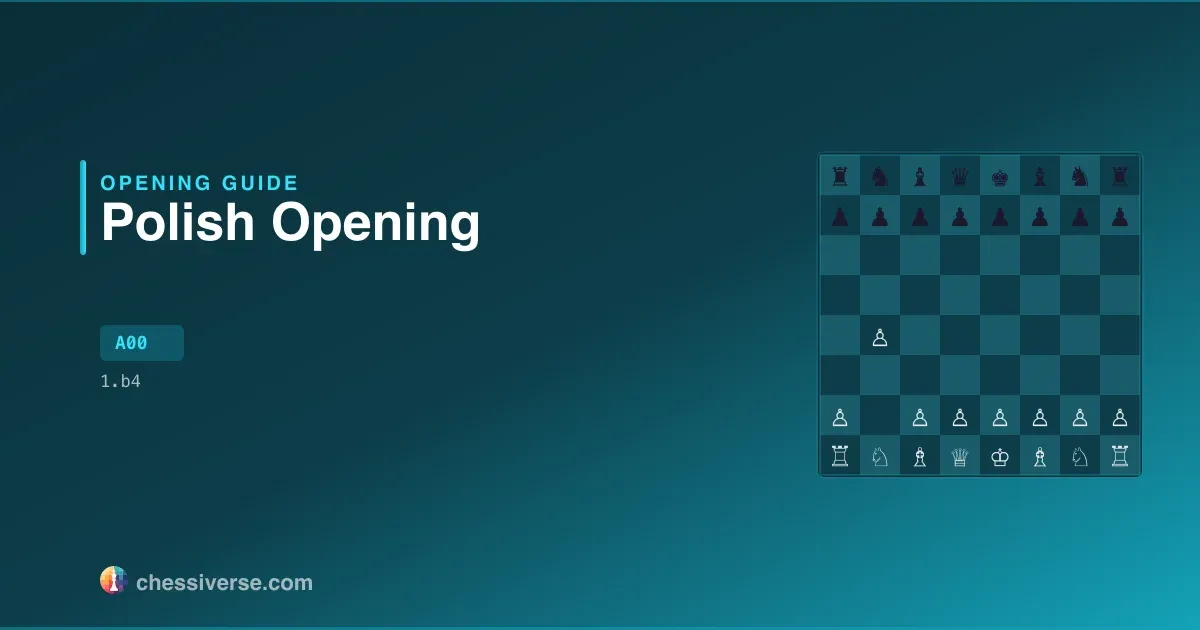
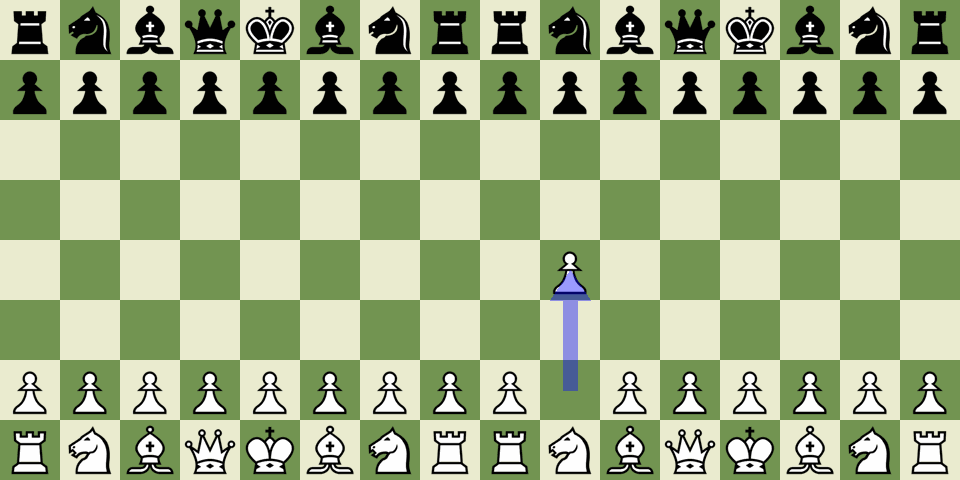
Starting from 1.b4, players enter the Polish Opening — ECO A00. Also known as the Orangutan, this flank thrust skips the centre entirely and goes straight for queenside space. It's offbeat, occasionally seen at the top, and surprisingly hard to refute.
Strategic Overview
1.b4 is a serious sideline rather than a serious main line. The move grabs queenside space immediately, prepares to fianchetto the queen's bishop on b2 where it eyes the long diagonal, and delays the central fight to a later phase of the game. The trade-off is obvious — the b-pawn is somewhat exposed and pushed early, the centre isn't contested directly, and Black has multiple sound replies that aim to use the time White spends on the flank. Tartakower and Carlsen have both used 1.b4 in tournament play with success, so dismissing it outright is a mistake. White's typical plans involve completing development with Bb2 and Nf3, eventually challenging the centre with a delayed c4 or e3-d4 push. A timely b4-b5 can dislodge a knight from c6 and gain more queenside space. Trading the b-pawn for Black's c-pawn (via b5 capturing on c6 in some lines) can also give White central influence and an open b-file. The drawback is that White's pawn structure can become overextended; the b-pawn on b5 lacks defenders and may become a target. Most lines lead to roughly balanced middlegames, with the choice of opening more about taste and surprise value than objective advantage.
Key Ideas
A few ideas come up again and again in this opening:
- Queenside space before the centre — Pushing the b-pawn immediately grabs a flank advantage rather than fighting for the centre. The space gained on the queenside supports later development and longer-term plans.
- The fianchetto on b2 is the natural follow-up — Almost every Polish Opening setup features Bb2 to put the bishop on the long diagonal. The bishop pressures the kingside and centre simultaneously and becomes one of White's main pieces throughout the game.
- b4-b5 can dislodge a knight on c6 — If Black develops the knight to c6, the further push b4-b5 kicks it back, gaining yet more space. It's a small but recurring tactical theme of the opening.
- Risk of overextension — The b-pawn on b5 has no defenders and can become a target. Pushing too aggressively without finishing development sometimes leaves the queenside thin enough for Black to exploit.
Performance Across Rating Levels
How well the Polish Opening works depends on what level you're playing at. Among 1200-rated players, it appears in 0.31% of games — 2,075,377 of them on record — with White winning 52.1% and Black 44.2%. Move up to 1800 Elo and the share shifts to 0.52%, with White winning 50.6% versus Black's 44.7%. At 2500, 0.11% of games go into this opening; draws sit at 8.7% — the line is well-mapped at this level. White's edge erodes by 6.3pp from 1200 to 2500 Elo, suggesting Black's counterplay is easier to find with experience.
Time Control Patterns
Look at the same opening across time controls and bullet stands out. In bullet, it appears in 0.45% of games (12,003,048); White wins 52%. Blitz shows 0.43% adoption across 15,502,142 games, White scoring 51.2%. In rapid, the share rises to 0.35% — 3,926,839 games, White 50.4%.
Move Diversity and Theory Depth
Move choice is far from uniform in the Polish Opening. At 1200 Elo (2,075,377 games), the top reply is e5, played 48.2% of the time. Three other moves each take at least 5% of games, and the top three moves account for 77.6% of games. Entropy: 2.42. By 2500 (14,954 games), e5 is still the top reply, at 37%; five other moves reach 5% and the top three moves account for 69.3% of games. Entropy rises to 2.75. Even elite players don't fully agree on the best continuation here, which keeps the position dynamic.
Historical Trends
Long-term, the trajectory of this opening is informative. Adoption peaked in 2014 at 0.61% (55,355 games). By 2025 it sits at 0.41%, 33% below the peak and 32% under its 2013 level, leaving the line in decline.
Bernhard Fleissig played 1.b4 against Schlechter in 1893, and Nikolai Bugaev used it to beat Steinitz in a simul. Tartakower scored with it against Reti in 1919 and Colle in 1926, and Sokolsky's 1963 monograph gave it real theory. Carlsen dusted it off against Nakamura and So in 2021.
Named after: Also called the Sokolsky Opening after Soviet theorist Alexei Sokolsky, and the Orangutan after Tartakower's famous 1924 zoo visit.
Notable players: Savielly Tartakower, Alexei Sokolsky, Boris Spassky, Magnus Carlsen
The Orangutan name comes from New York 1924: legend has it Tartakower consulted an orangutan named Susan at the zoo the day before playing Maroczy, and credited the ape, an excellent climber, with inspiring the b-pawn's climb up the board.
Main Lines and Variations
The main branches off 1.b4 include:
Each branch leads to a different middlegame character — the resulting pawn structure decides what kind of game you get.
Common Mistakes
- Neglecting development — Extra pawn moves in the opening are tempting, especially when you "know the moves". Developing a piece each turn is the simple correction.
- Playing without a plan — Each Polish Opening middlegame demands a specific approach. Decide whether the position calls for attack, manoeuvre, or simplification before reaching for a move.
Practice on Chessiverse
Ready to try the Polish Opening against a bot? Pick an opponent at your level and play a game.