



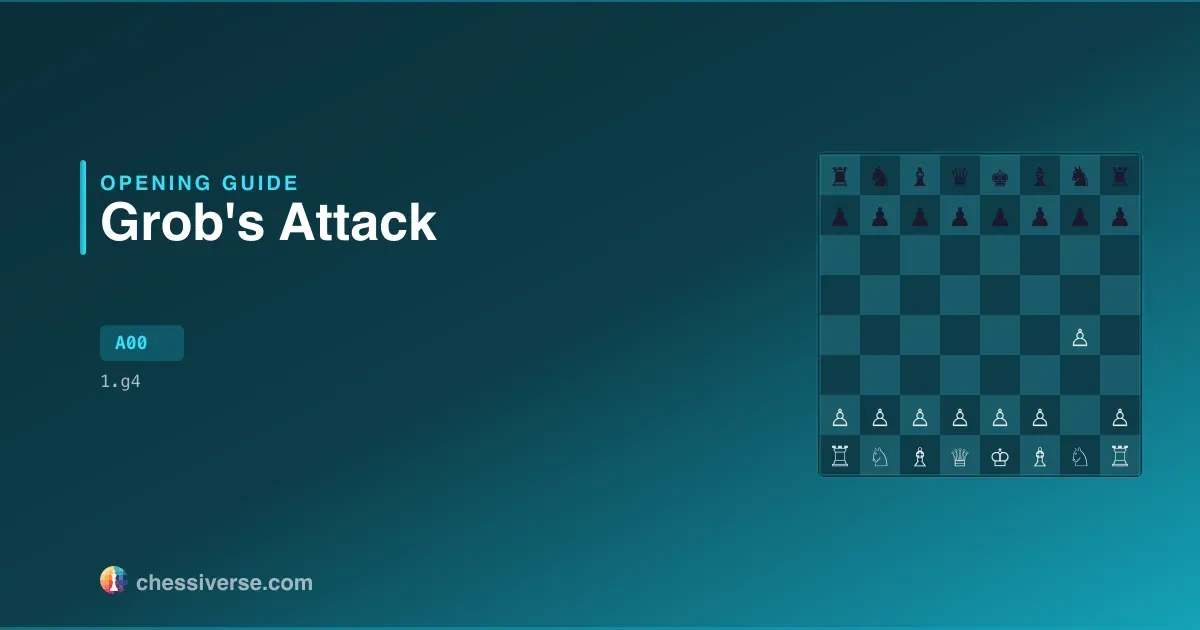
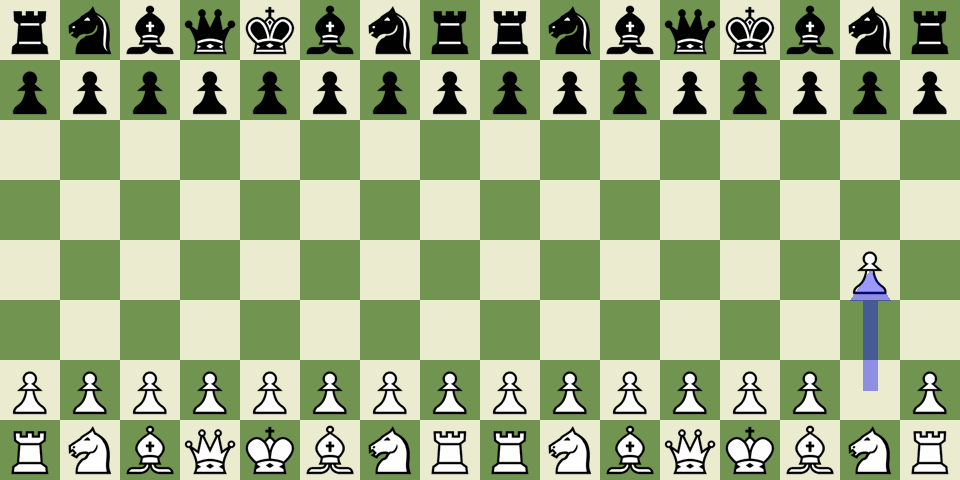
The Grob's Attack begins with 1.g4 (ECO A00). Widely regarded as one of the worst first moves available — though as with all great heresies, it's not without its committed defenders. 1.g4 weakens the kingside, ignores the centre, and dares Black to punish it.
Strategic Overview
1.g4 is more provocation than opening. The pawn move grabs a square that doesn't help with development, weakens the kingside structurally, and makes kingside castling positively dangerous. In return, White claims a sliver of kingside space, prepares a fianchetto for the king's bishop on g2 (or a more bizarre setup), and tries to dissuade ...Nf6 because of the latent g5 kick. None of this is enough to justify the move against careful play. An unprepared Black, however, can blunder by trying to win the g4 pawn directly and walking into preparation. Lines tend to vary depending on Black's reply. The Grob's Gambit (after 1...d5 2.Bg2) tries to confuse matters with piece play. Quieter tries like 2.h3, 2.e3, or 2.c4 (which can transpose into more standard structures) are also seen. The Coca-Cola Gambit is one of the few named variations. None of these lines hold up well at master level — Black's standard reply is simply to claim the centre with ...d5, keep the pawn defended, and develop normally, gaining a significant advantage. It works mostly as a surprise weapon in fast time controls or against opponents unwilling to prepare against junk. The mirrored version of 1.b4 it isn't — there, the b-pawn is at least somewhat safe and on a square that helps queenside play.
Key Ideas
When players succeed in this line, they usually do so by leaning on the following themes:
- Weakens the kingside structurally — The g-pawn on g4 leaves holes on f4 and h4, undermines the king's natural shelter, and makes short castling extremely risky. These are permanent positional defects.
- Discourages ...Nf6 by threatening g5 — The one concrete idea behind the move is that any black knight on f6 can be kicked away by g4-g5. This rarely turns into a real advantage because Black has natural alternatives.
- Works best as a surprise weapon — Against an unprepared opponent who fixates on winning the g-pawn, the opening can produce dangerous play. Against accurate preparation, Black equalises or better with simple developing moves.
Performance Across Rating Levels
The picture changes a lot as you climb the rating ladder. At 1200 Elo, the opening shows up in 0.27% of games (1,840,096 samples). White scores 46.5%, Black 49.2%, draws 4.2%. At 1800 the opening surfaces in 0.30% of games; White wins 49.6%, Black 46.6%, draws 3.8%. At 2500, 0.08% of games go into this opening; draws sit at 8.4% — the line is well-mapped at this level.
Time Control Patterns
The Grob's Attack skews toward bullet chess. In bullet, it appears in 0.30% of games (7,956,476); White wins 49.9%. Blitz shows 0.30% adoption across 10,675,473 games, White scoring 48.2%. In rapid, the share rises to 0.25% — 2,756,338 games, White 44.9%. White's score swings 5.0pp across formats, so time control isn't just a stylistic choice here — it shifts the actual results.
Move Diversity and Theory Depth
Looking at move selection shows how forcing — or not — the position really is. At 1200 Elo (1,840,096 games), the top reply is e5, played 41.4% of the time. Two other moves each take at least 5% of games, and the top three moves account for 76.1% of games. Entropy: 2.51. By 2500 (10,894 games), d5 takes over as the top reply at 60.5%; two other moves reach 5% and the top three moves account for 78.6% of games. Entropy drops to 2.14.
Historical Trends
Year-over-year data tells you whether this opening is a contemporary fixture or a fading one. Adoption peaked in 2023 at 0.32% (2,512,118 games). By 2025 it sits at 0.30%, 4% below the peak but still 107% above its 2013 level, so the line is up over the full period despite easing from the high.
An early practitioner was Carl Ahlhausen of Berlin, and Tartakower tried 1.g4 in simultaneous displays, dubbing it the Genoa Opening. Henri Grob later gave it his name through deep analysis and hundreds of correspondence games, calling it the Spike in his newspaper column. IM Michael Basman is a modern advocate of the opening.
Named after: Henri Grob (1904-1974), a Swiss International Master who analyzed 1.g4 in depth and tested it in hundreds of correspondence games.
Notable players: Henri Grob, Michael Basman, Spyridon Skembris
In a 2005 friendly match against Susan Polgar in Lindsborg, Kansas, Anatoly Karpov was forced to play the Grob when Mikhail Gorbachev made the ceremonial first move 1.g4. Basman even beat GM John Nunn with it in 1978.
Main Lines and Variations
After 1.g4, the established follow-ups are:
Each branch leads to a different middlegame character — the resulting pawn structure decides what kind of game you get.
Common Mistakes
- Neglecting development — Extra pawn moves in the opening are tempting, especially when you "know the moves". Developing a piece each turn is the simple correction.
- Playing without a plan — Each Grob's Attack middlegame demands a specific approach. Decide whether the position calls for attack, manoeuvre, or simplification before reaching for a move.
Practice on Chessiverse
Ready to try the Grob's Attack against a bot? Pick an opponent at your level and play a game.