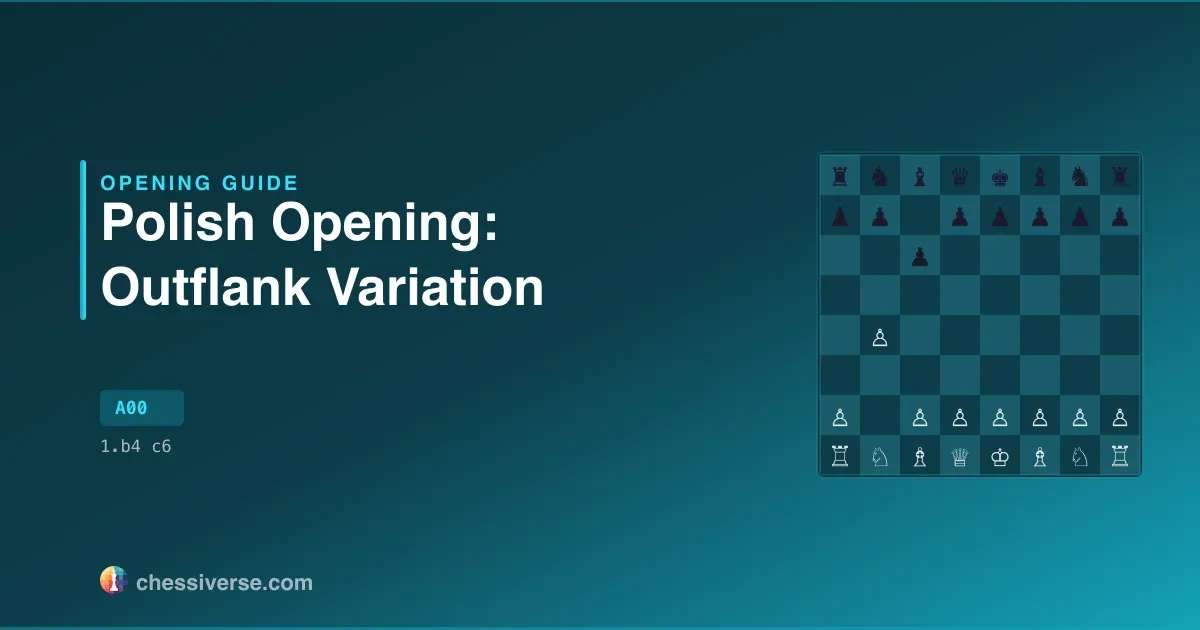
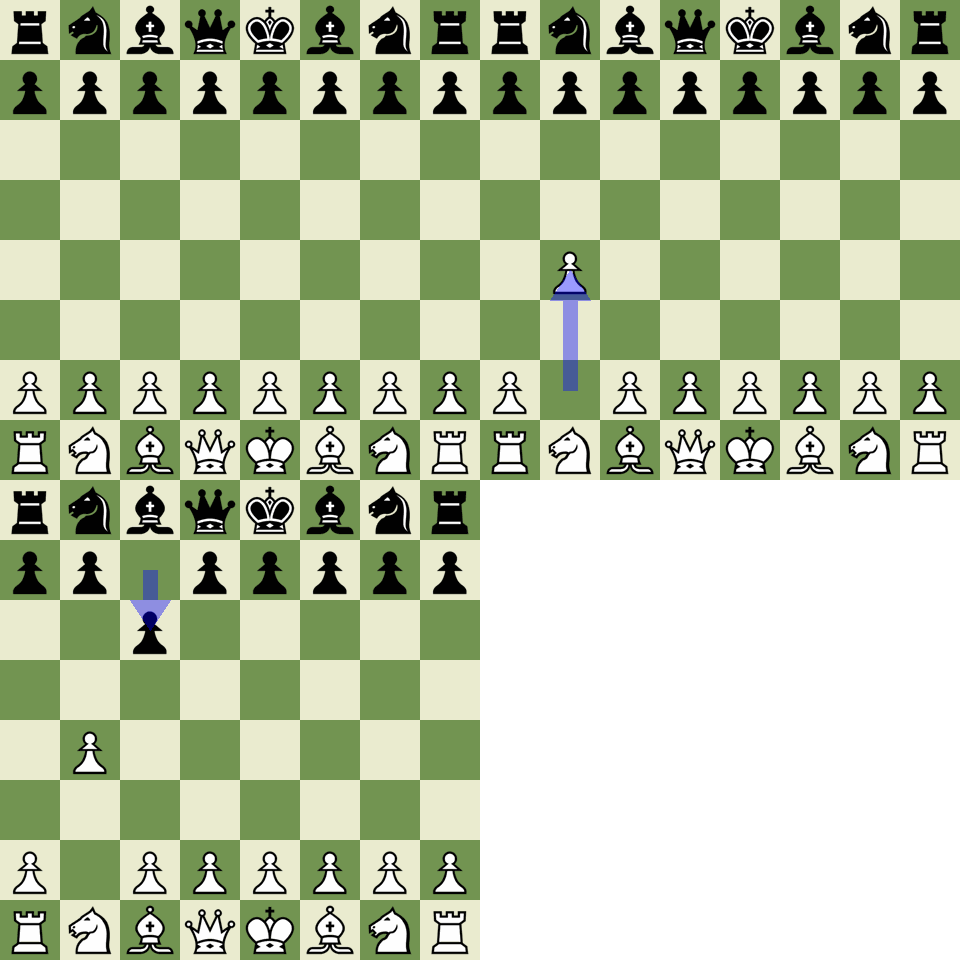
1.b4 c6 opens the Polish Opening: Outflank Variation, ECO A00. Black answers 1.b4 with a quiet little ...c6, planning to challenge the queenside with the queen and look for tactical chances on the flank.
Strategic Overview
The Outflank is one of Black's principled answers to the Polish Opening. The move ...c6 prepares ...Qb6, hitting the b-pawn directly and asking White to defend it without making positional concessions. After the natural 2.Bb2 Qb6, the game becomes a queenside duel — both sides have pieces aimed at the b-file, and the position is full of small tactical motifs around the b-pawn and the b2 bishop. The choice is fine but unambitious. By playing on White's terms (the flank) rather than seizing the centre with ...d5 or ...e5, Black gives up the chance to punish 1.b4 most directly. The middlegame tends to be quiet, with both sides reorganising pieces and looking for the right moment to break in the centre. For surprise value or for players who prefer manoeuvring chess to sharp central battles, the Outflank is a perfectly playable system. It rarely produces decisive opening advantages in either direction.
Key Ideas
A few ideas come up again and again in this opening:
- Prepares ...Qb6 to pressure the b-pawn — The pawn move ...c6 isn't just developing — it clears the b6 square for the queen, which puts immediate pressure on White's b4 pawn.
- Queenside duel rather than central fight — By accepting a flank battle on White's terms, Black plays a quiet positional game on the queenside rather than the more critical central counter-strategies.
History and Notable Players
It arises from the Polish Opening.
Performance Across Rating Levels
How well the Polish Opening: Outflank Variation works depends on what level you're playing at. Among 1200-rated players, it appears in 0.01% of games — 48,215 of them on record — with White winning 49.5% and Black 46.4%. By 1800, popularity is 0.02% and White's score is 47.6% to Black's 47.3%. Among 2500-rated players the line appears in 0.01% of games and draws spike to 10.3%, indicating tight preparation. White's edge erodes by 5.3pp from 1200 to 2500 Elo, suggesting Black's counterplay is easier to find with experience.
Time Control Patterns
The Polish Opening: Outflank Variation skews toward bullet chess. In bullet, it appears in 0.02% of games (656,501); White wins 48.4%. Blitz shows 0.02% adoption across 547,917 games, White scoring 48.2%. In rapid, the share rises to 0.01% — 95,867 games, White 48.4%.
Move Diversity and Theory Depth
Move choice is far from uniform in the Polish Opening: Outflank Variation. At 1200 Elo (48,215 games), the top reply is Bb2, played 73.5% of the time. One other move takes at least 5% of games, and the top three moves account for 83.6% of games. Entropy: 1.68. By 2500 (1,093 games), Bb2 dominates at 58.8% of replies; two other moves reach 5% and the top three moves account for 90.7% of games. Entropy rises to 1.76. Move diversity stays high even at master level, suggesting the opening doesn't force one specific response.
Historical Trends
Tracking the Polish Opening: Outflank Variation year over year shows a clear story. Adoption peaked in 2014 at 0.016% (1,462 games). By 2025 it sits at 0.015%, 5% below the peak and roughly back to its 2013 level, leaving the line flat over the full period.
Common Mistakes
- Drifting away from main theory — At 400 Elo, the three most-played moves cover 60.2% of games, against 92% at 2000. The most popular deviation is Nc3 (played 7.6% of the time at 400, much less so up top). It looks fine but quietly hands the better-prepared side an edge.
- Neglecting development — It can feel productive to make extra pawn moves early, but falling behind in piece development is what loses most amateur games — especially in open positions where active pieces find squares fast.
- Playing without a plan — Each Polish Opening: Outflank Variation middlegame demands a specific approach. Decide whether the position calls for attack, manoeuvre, or simplification before reaching for a move.
Practice on Chessiverse
Ready to try the Polish Opening: Outflank Variation against a bot? Pick an opponent at your level and play a game.