




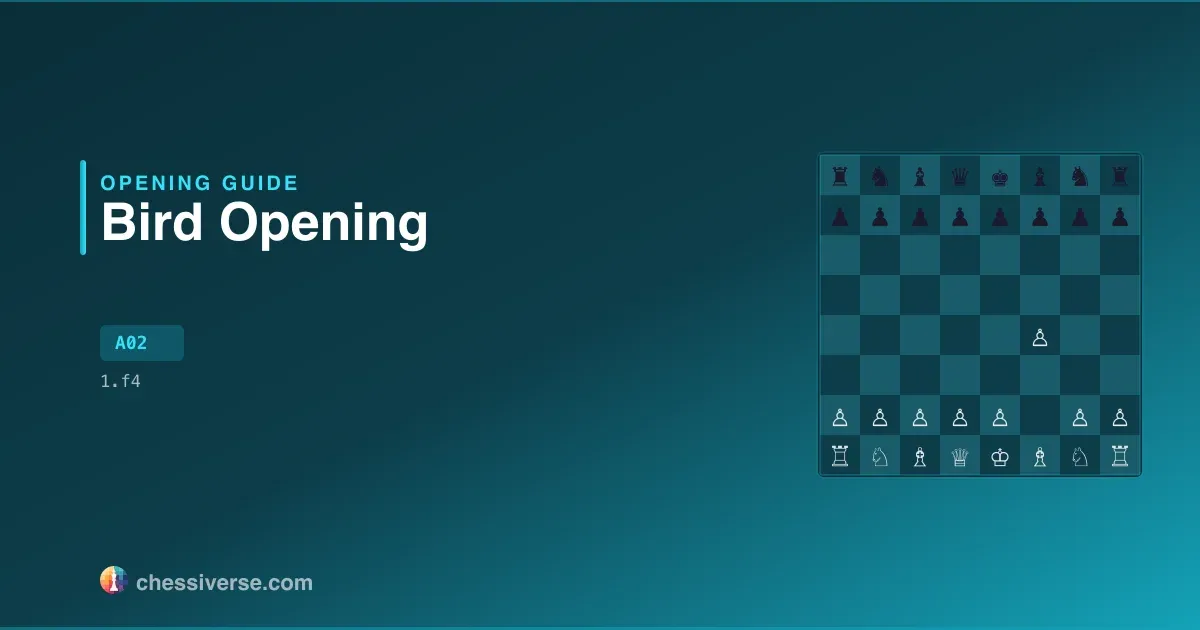
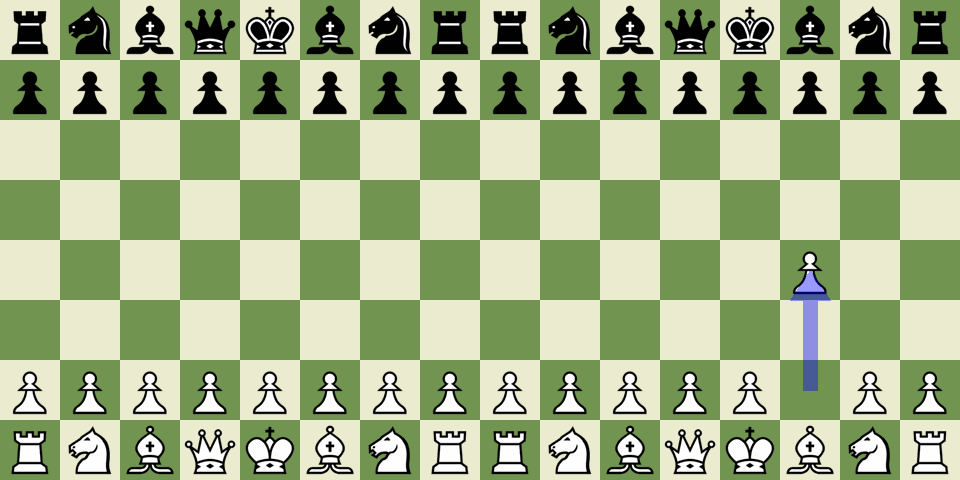
The Bird Opening arises after 1.f4 and falls under ECO code A02. An aggressive but relatively uncommon first move, 1.f4 stakes a claim on the e5 square from the flank and ensures that a later Nf3 will not be blocked by the f-pawn. The risk is that advancing the f-pawn so early weakens White's kingside, particularly the e1-h4 diagonal, which opponents can try to exploit. The main line is 1...d5, the Dutch Variation, where Black grabs central space and controls e4, producing positions that resemble a Dutch Defense with colors reversed. White typically continues with 2. Nf3, developing a piece while guarding h4, and can then adopt a reversed Leningrad Dutch formation with 3. g3, 4. Bg2, and 5. O-O, with plans of d3 and c3, or d3 and Qe1 aiming for the e4 break. Alternatively, a Stonewall-style setup with 3. e3, 4. Be2, and d3 or d4 is also viable. The move 1...Nf6, which similarly targets e5, usually transposes into the same structures. With 40.1 million Lichess games across all rating levels, it is a well-established opening choice.
- White grabs control of the e5-square and aims for attacking chances on the kingside.
- After 1...d5 the game resembles a Dutch Defense with colors reversed.
- The early f4 slightly loosens White's own kingside, so some care around the king is needed.
History and Notable Players
Among the most prolific practitioners on the White side are Manfred Thonig (153 games), Vladimir Babionyshev (83 games), Henrik Danielsen (82 games). On the Black side, notable exponents include Wolfgang Uhlmann (11 games), Joseph Henry Blackburne (10 games), Gedeon Barcza (9 games).
Lucena mentioned 1.f4 as early as around 1497, and La Bourdonnais and Elijah Williams tried it occasionally in the mid-1800s. Henry Bird first played it in 1855 and stuck with it for the next four decades; later advocates included Nimzowitsch, Tartakower and Bent Larsen.
Named after: English master Henry Bird, who played 1.f4 for some 40 years from 1855; the Hereford Times attached his name to it in 1885.
Notable players: Henry Bird, Aron Nimzowitsch, Savielly Tartakower, Bent Larsen
Bird adopted 1.f4 after a six-year break from chess left him unable to remember mainstream openings - and White must beware From's Gambit 1...e5, when the careless 2.g4 allows checkmate on the spot with 2...Qh4.
Statistics
Based on 40.1 million Lichess games across all rating levels:
- White wins: 49%
- Black wins: 46.5%
- Draws: 4.5%
The statistics show a roughly balanced opening where both sides have equal chances.
Main Lines and Variations
After 1.f4, the main continuations include:
Each of these lines leads to distinct types of positions and requires its own understanding of the resulting pawn structures and piece placements.
Practice on Chessiverse
The best way to learn the Bird Opening is through practice. On Chessiverse, you can play chess against computer opponents from any opening or custom position. Our AI bots range from beginner to grandmaster level, each with unique playing styles — from aggressive attackers to solid defenders. Choose a bot that matches your rating and work your way up as you master the opening's key ideas.
Performance Across Rating Levels
Popularity and results vary sharply by rating level. Among 1200-rated players, it appears in 0.50% of games — 3,354,421 of them on record — with White winning 47.6% and Black 48.2%. By 1800, popularity is 1.27% and White's score is 49.8% to Black's 45.7%. At the top end (2500+ Elo), popularity is 0.48% with 8.5% draws — a clear sign of how much theory rules the line at master level.
Time Control Patterns
The Bird Opening skews toward bullet chess. In bullet, it appears in 1.10% of games (29,140,687); White wins 50.3%. Blitz shows 0.92% adoption across 33,099,080 games, White scoring 49.3%. In rapid, the share rises to 0.63% — 6,967,352 games, White 47.8%. White's score swings 2.5pp across formats, so time control isn't just a stylistic choice here — it shifts the actual results.
Move Diversity and Theory Depth
Move choice is far from uniform in the Bird Opening. At 1200 Elo (3,354,421 games), the top reply is d5, played 41.3% of the time. Five other moves each take at least 5% of games, and the top three moves account for 61% of games. Entropy: 2.87. By 2500 (65,780 games), d5 is still the top reply, at 41.5%; five other moves reach 5% and the top three moves account for 65.2% of games. Entropy drops to 2.75.