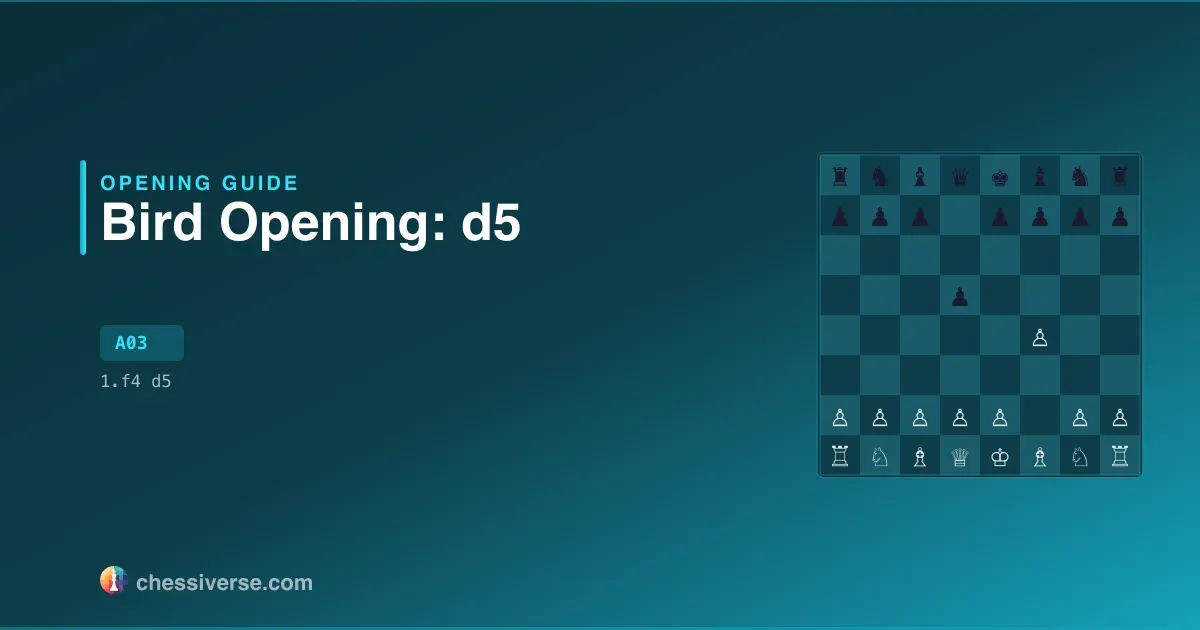
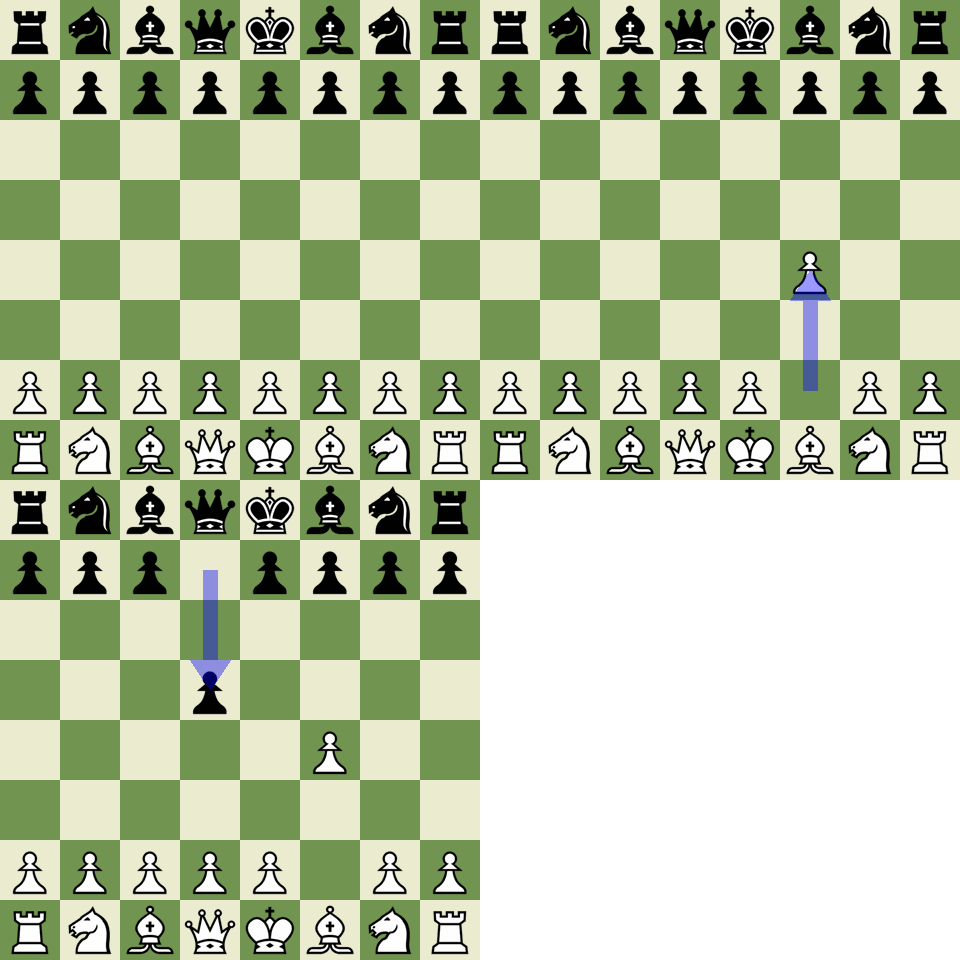
1.f4 d5 opens the Bird Opening: Dutch Variation, ECO A03. Black grabs the central square White declined to occupy, daring Bird's f-pawn to justify itself. The game now revolves around the e5-square and who gets to plant a knight there permanently.
Strategic Overview
With 1...d5 Black says: fine, I'll take the center you skipped. White's whole setup is now about fighting for e5 with pieces rather than pawns. The standard plan is Nf3, b3, Bb2, and at the right moment Ne5, supported by Qe1-g3 to stack pressure on the kingside. You can also treat the position as a reversed Dutch — fianchetto with g3 for a Leningrad-style structure, or build a Stonewall with e3, d4, and c3 if you like locked centers. A third path is more classical: prepare e4 with d3, Nd2, Qe1 and just blow the position open. The recurring headache is the b1-knight. On c3 or d2 it does fine in calm positions, but if Black expands with ...c5 and ...d4, the knight gets squeezed and Na3 (after a4) becomes the right re-route. Bishops are flexible too — Be2 covers Bg4 pins, Bb5 angles to swap off Black's c6-knight and clear e5. The whole opening rewards players who like piece play, dark-square mazes, and slow-burn kingside pressure rather than memorized theory.
Key Ideas
A few ideas come up again and again in this opening:
- Fight for e5 with pieces — The f4-pawn already covers e5; the goal is to land a knight there. Nf3, b3, Bb2, and eventually Ne5 builds a permanent outpost that radiates pressure on Black's kingside.
- Pick your structure — Leningrad, Stonewall, or pure Bird — g3 gives you a reversed Leningrad with smooth development. e3 followed by d4 and c3 sets up a Stonewall. The pure Bird ignores both and just plays for dark-square control with b3 and Bb2.
- Solve the b1-knight problem early — Nc3 and Nd2 are fine when the center stays fluid, but once Black plays ...c5 and ...d4 the knight needs an escape. a4 and Na3 gives it real queenside influence rather than a passive square.
- Reroute the queen via e1 to g3 — Qe1-g3 is the signature Bird maneuver: it adds a third attacker to e5, eyes Black's kingside, and supports Ne5 ideas without committing the queen prematurely.
- Keep e4 as a live threat — If Black gets passive, the break d3-Nd2-Qe1-e4 opens the position with White already well-coordinated. Just having that option restricts Black's setup choices.
History and Notable Players
It arises from the Bird Opening. On the White side, Manfred Thonig (70 games), Henry Edward Bird (44 games), Artur Jakubiec (37 games) top the database. Notable Black exponents: Wolfgang Uhlmann (10 games), Gedeon Barcza (9 games), Petr Haba (8 games).
Performance Across Rating Levels
Popularity and results vary sharply by rating level. The 1200 bracket has 1,356,927 games (0.20% of all games at that level); White wins 47.3%, Black 48.8%, 3.9% are drawn. At 1800 the opening surfaces in 0.48% of games; White wins 50.3%, Black 44.9%, draws 4.8%. At the top end (2500+ Elo), popularity is 0.20% with 9.3% draws — a clear sign of how much theory rules the line at master level. Positions also become less sharp as level rises (sharpness 0.96 → 0.91).
Time Control Patterns
Look at the same opening across time controls and blitz stands out. In bullet, it appears in 0.34% of games (8,915,793); White wins 51.4%. Blitz shows 0.35% adoption across 12,469,891 games, White scoring 49.5%. In rapid, the share rises to 0.26% — 2,828,745 games, White 47.4%. White's score swings 4.0pp across formats, so time control isn't just a stylistic choice here — it shifts the actual results.
Move Diversity and Theory Depth
Looking at move selection shows how forcing — or not — the position really is. At 1200 Elo (1,356,927 games), the top reply is Nf3, played 55.5% of the time. Two other moves each take at least 5% of games, and the top three moves account for 82.5% of games. Entropy: 2.20. By 2500 (26,654 games), Nf3 dominates at 88.5% of replies; no other move reaches 5% and the top three moves account for 94.2% of games. Entropy drops to 0.83. The narrowing is significant — strong players consolidate around a small set of best moves, while amateurs scatter across many plausible-looking options.
Common Mistakes
- Drifting away from main theory — At 400 Elo, the three most-played moves cover 72.4% of games, against 93% at 2000. The most popular deviation is d4 (played 16.9% of the time at 400, much less so up top). It looks fine but quietly hands the better-prepared side an edge.
- Neglecting development — Extra pawn moves in the opening are tempting, especially when you "know the moves". Developing a piece each turn is the simple correction.
- Playing without a plan — Each Bird Opening: Dutch Variation middlegame demands a specific approach. Decide whether the position calls for attack, manoeuvre, or simplification before reaching for a move.
Practice on Chessiverse
Ready to try the Bird Opening: Dutch Variation against a bot? Pick an opponent at your level and play a game.