



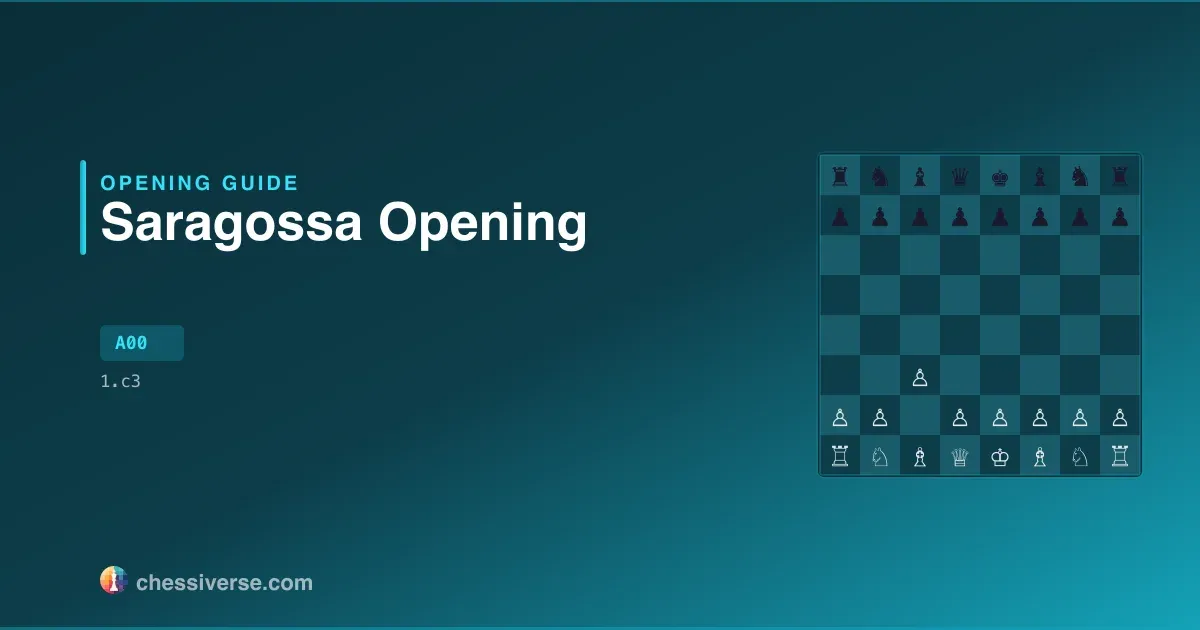
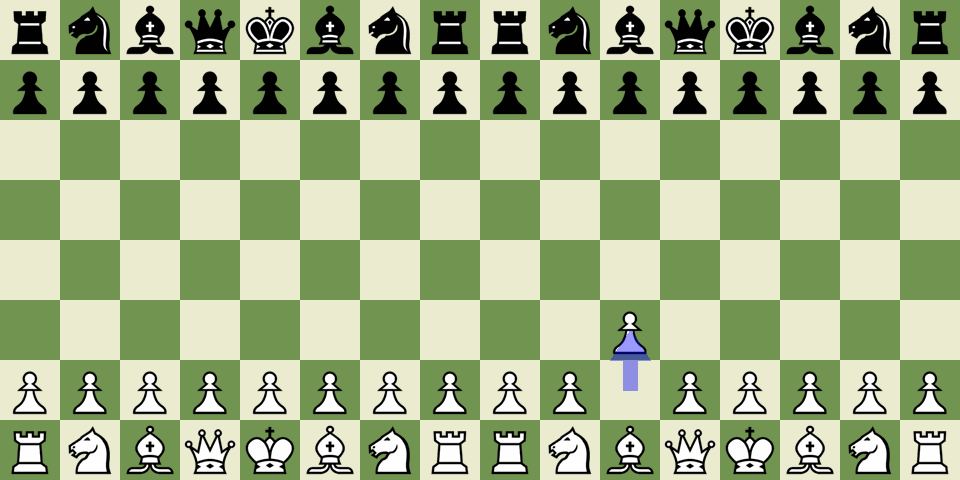
1.c3 opens the Saragossa Opening, ECO A00. A quiet first move that does very little on its own, but doesn't ruin anything either. 1.c3 mostly exists to transpose into something more familiar.
Strategic Overview
1.c3 is a flat, transpositional move. It doesn't claim the center, doesn't develop, and worst of all blocks the natural c3-square for the queen's knight. The redeeming feature is flexibility: after a follow-up d4, White is essentially playing a London System, Colle System, or Torre Attack a tempo behind, which is mostly fine but rarely better than the same setups reached via 1.d4. Against 1...c5, White can pivot into an Alapin Sicilian with 2.e4, which is the most credible practical use of the move order. The honest assessment is that 1.c3 lets White hide their setup for one move while costing them nothing material, but it also lets Black pick any center they like without resistance. Solid players use 1.c3 as a quiet move-order trick. It is not an opening with independent theoretical value.
Key Ideas
A few ideas come up again and again in this opening:
- Use it as a transposition vehicle — The point of 1.c3 is to reach a London, Colle, Torre, or Alapin Sicilian on White's preferred move order while sidestepping early Black reactions like ...Bb4 or ...Bg4 pins. It only pays off if you follow up with d4 or e4 quickly.
- Accept the loss of the knight's natural square — The pawn on c3 prevents Nc3, so the queen's knight will likely route via Nd2 and Nf3. That's standard in London and Colle structures, which is exactly why those transpositions work.
Performance Across Rating Levels
How well the Saragossa Opening works depends on what level you're playing at. The 1200 bracket has 1,658,411 games (0.25% of all games at that level); White wins 46.8%, Black 49.2%, 4.1% are drawn. Move up to 1800 Elo and the share shifts to 0.21%, with White winning 48.2% versus Black's 47.4%. At the top end (2500+ Elo), popularity is 0.09% with 9.4% draws — a clear sign of how much theory rules the line at master level. Positions also become less sharp as level rises (sharpness 0.96 → 0.91).
Time Control Patterns
Time control matters here: bullet players reach for this opening more than others. In bullet, it appears in 0.45% of games (12,072,463); White wins 49.5%. Blitz shows 0.23% adoption across 8,406,046 games, White scoring 47.5%. In rapid, the share rises to 0.19% — 2,150,931 games, White 45.3%. White's score swings 4.2pp across formats, so time control isn't just a stylistic choice here — it shifts the actual results.
Move Diversity and Theory Depth
Move choice is far from uniform in the Saragossa Opening. At 1200 Elo (1,658,411 games), the top reply is e5, played 46.1% of the time. Three other moves each take at least 5% of games, and the top three moves account for 76.6% of games. Entropy: 2.43. By 2500 (12,602 games), d5 takes over as the top reply at 28.7%; four other moves reach 5% and the top three moves account for 70% of games. Entropy rises to 2.79. Even elite players don't fully agree on the best continuation here, which keeps the position dynamic.
Historical Trends
Long-term, the trajectory of this opening is informative. Adoption peaked in 2013 at 0.28% (7,954 games). By 2025 it sits at 0.23%, down 18% from that high, leaving the line in decline.
The move caught on at the Saragossa chess club in 1919, and club member Jose Juncosa then analysed it in a chess publication. It is classed as an irregular opening under ECO code A00, since White usually picks a more ambitious first move.
Named after: Named after the Saragossa chess club in Zaragoza, Spain, where 1.c3 became popular in 1919.
Notable players: Siegbert Tarrasch, Paul Leonhardt, Jacques Mieses
A 1922 theme tournament in Mannheim made 1.c3 compulsory in every game; Siegbert Tarrasch won it ahead of Paul Leonhardt and Jacques Mieses.
Common Mistakes
- Neglecting development — It can feel productive to make extra pawn moves early, but falling behind in piece development is what loses most amateur games — especially in open positions where active pieces find squares fast.
- Playing without a plan — Each Saragossa Opening middlegame demands a specific approach. Decide whether the position calls for attack, manoeuvre, or simplification before reaching for a move.
Practice on Chessiverse
Ready to try the Saragossa Opening against a bot? Pick an opponent at your level and play a game.