



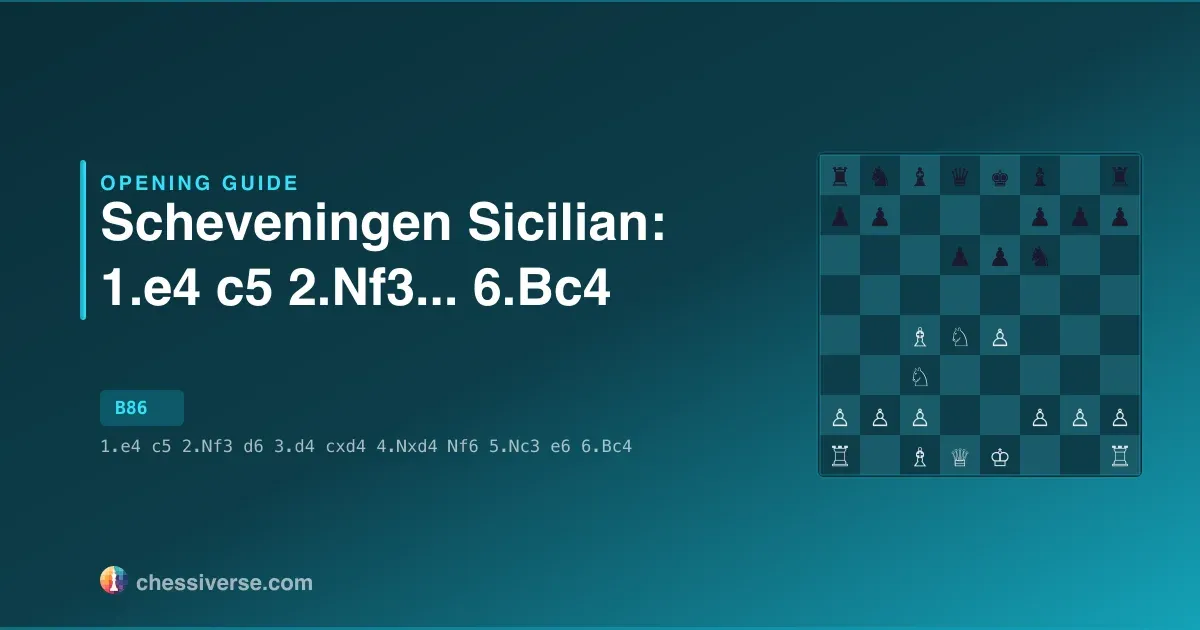
1.e4 c5 2.Nf3 d6 3.d4 cxd4 4.Nxd4 Nf6 5.Nc3 e6 6.Bc4 opens the Sicilian Defense: Sozin Attack, ECO B86. White points the bishop at f7 and prepares a Sozin-style assault. Black's e6 pawn weakens the kingside light squares, and the bishop on c4 is positioned to make him pay.
Strategic Overview
The Sozin Attack puts the bishop on c4 with one clear goal: target the soft f7-square and prepare a fast kingside attack. The Scheveningen's e6 pawn, while flexible, leaves the a2-g8 diagonal and the light squares around the king tender, and the c4-bishop is the most direct way to exploit it. White's plan from here is straightforward: Qe2, Bb3 (to preserve the bishop after Black plays ...Na5 or ...d5 ideas), 0-0, and then f4-f5 to crack the kingside open. The whole setup is concrete and attacking, and it's been a favorite of players who want sharp games with the initiative — Fischer in particular used the Sozin to crushing effect. Black has to play accurately: ...Be7 and ...0-0 quickly, then look for the right moment to either contest the center with ...d5 or counter-punch on the queenside. Slow play loses — the attack arrives quickly and the kingside falls apart if Black hasn't built defensive resources by move twelve or so. The Sozin trades the slower positional advantages of more traditional setups for raw initiative, and the games tend to be decisive and unbalanced.
Key Ideas
A few ideas come up again and again in this opening:
- Bc4 aims at f7 — The bishop is placed for one job: to put long-term pressure on the weak f7-square that Black's e6 pawn doesn't defend. The whole opening is built on exploiting this single positional concession.
- Qe2 and Bb3 are standard prep — White retreats the bishop to b3 to keep it on the active diagonal even if Black plays ...d5 or ...Na5. The queen on e2 supports the bishop and prepares 0-0 and the f-pawn push.
- f4-f5 is the attacking lever — After castling, White looks for the f4-f5 break to rip open the kingside and bring rooks and queen into the attack. Speed is everything — this isn't a slow positional plan.
- Black has to develop fast — Without ...Be7 and ...0-0 played promptly, Black walks into devastating tactics on the kingside. Even one slow move can lose, which is why the Sozin punishes unprepared opponents so often.
- Fischer's favorite anti-Sicilian — Bobby Fischer used the Sozin as one of his main weapons against the Sicilian. The combination of clear attacking plans and rich tactical possibilities suited his concrete style perfectly.
History and Notable Players
It arises from the Sicilian Defense: Scheveningen Variation. Among the most prolific White practitioners are Dragoljub Velimirovic (12 games), Darja Kaps (11 games), Jana Krivec (10 games). Black-side regulars include Mihai Suba (13 games), Lutz Espig (11 games), Dominik Pedzich (9 games).
Performance Across Rating Levels
How well the Sicilian Defense: Sozin Attack works depends on what level you're playing at. Among 1200-rated players, it appears in 0.01% of games — 40,157 of them on record — with White winning 45.3% and Black 51.2%. By 1800, popularity is 0.03% and White's score is 43.9% to Black's 51.7%. Among 2500-rated players the line appears in 0.01% of games and draws spike to 8.1%, indicating tight preparation. White's score improves by 5.6pp from the 1200 bracket to the 2500 bracket — the line rewards preparation.
Time Control Patterns
Look at the same opening across time controls and blitz stands out. In bullet, it appears in 0.01% of games (267,082); White wins 44.7%. Blitz shows 0.02% adoption across 590,738 games, White scoring 44.7%. In rapid, the share rises to 0.01% — 146,843 games, White 43.9%.
Move Diversity and Theory Depth
Looking at move selection shows how forcing — or not — the position really is. At 1200 Elo (40,157 games), the top reply is a6, played 37.3% of the time. Four other moves each take at least 5% of games, and the top three moves account for 78% of games. Entropy: 2.52. By 2500 (1,472 games), Be7 takes over as the top reply at 45.2%; only two other moves still reach 5% and the top three moves account for 95.4% of games. Entropy drops to 1.68. The narrowing is significant — strong players consolidate around a small set of best moves, while amateurs scatter across many plausible-looking options.
Historical Trends
Tracking the Sicilian Defense: Sozin Attack year over year shows a clear story. Adoption peaked in 2016 at 0.02% (13,100 games). By 2025 it sits at 0.01%, 47% below the peak and 27% under its 2013 level, leaving the line in decline.
Main Lines and Variations
After 1.e4 c5 2.Nf3 d6 3.d4 cxd4 4.Nxd4 Nf6 5.Nc3 e6 6.Bc4, the established follow-ups are:
Each branch leads to a different middlegame character — the resulting pawn structure decides what kind of game you get.
Common Mistakes
- Drifting away from main theory — At 400 Elo, the three most-played moves cover 57.3% of games, against 95.4% at 2000. The most popular deviation is Nc6 (played 16.2% of the time at 400, much less so up top). It looks fine but quietly hands the better-prepared side an edge.
- Neglecting development — It can feel productive to make extra pawn moves early, but falling behind in piece development is what loses most amateur games — especially in open positions where active pieces find squares fast.
- Ignoring the kingside attack — In sharp Sicilian lines, White typically castles long and pushes the h-pawn. Without your own counterplay on the queenside or in the centre, White's attack lands first.
Practice on Chessiverse
Ready to try the Sicilian Defense: Sozin Attack against a bot? Pick an opponent at your level and play a game.