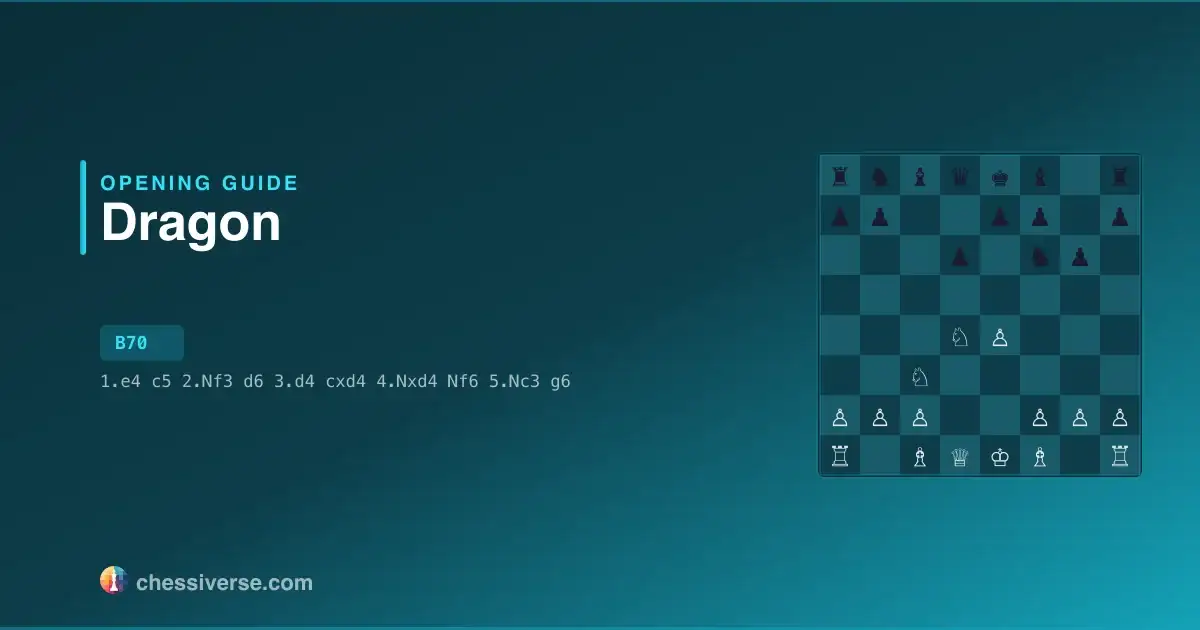




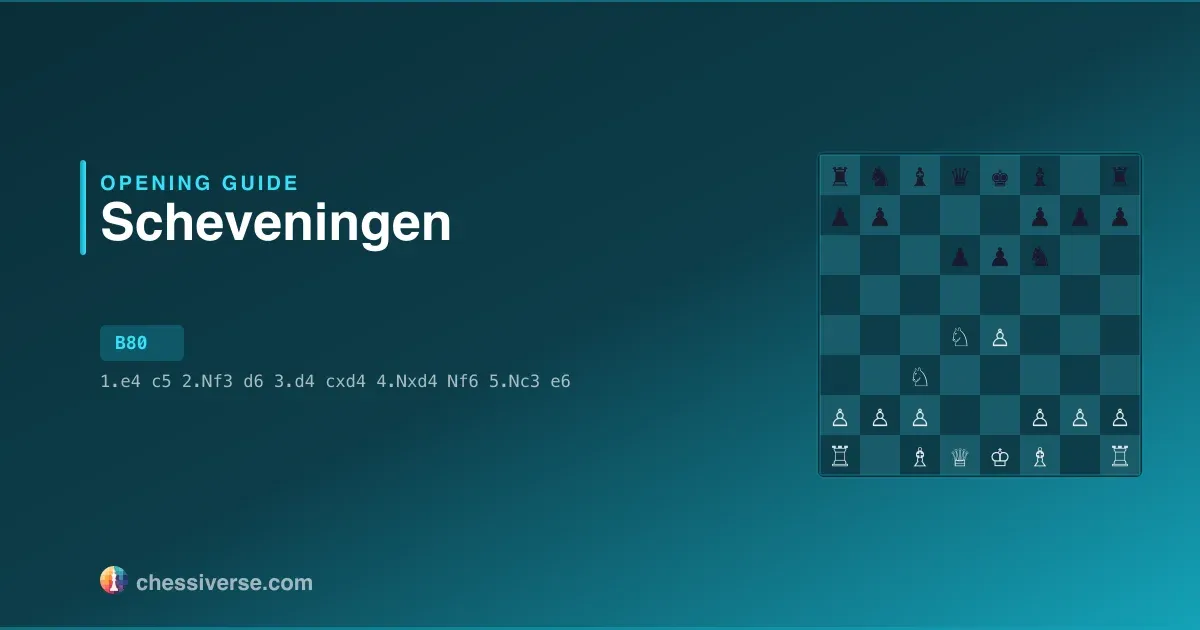
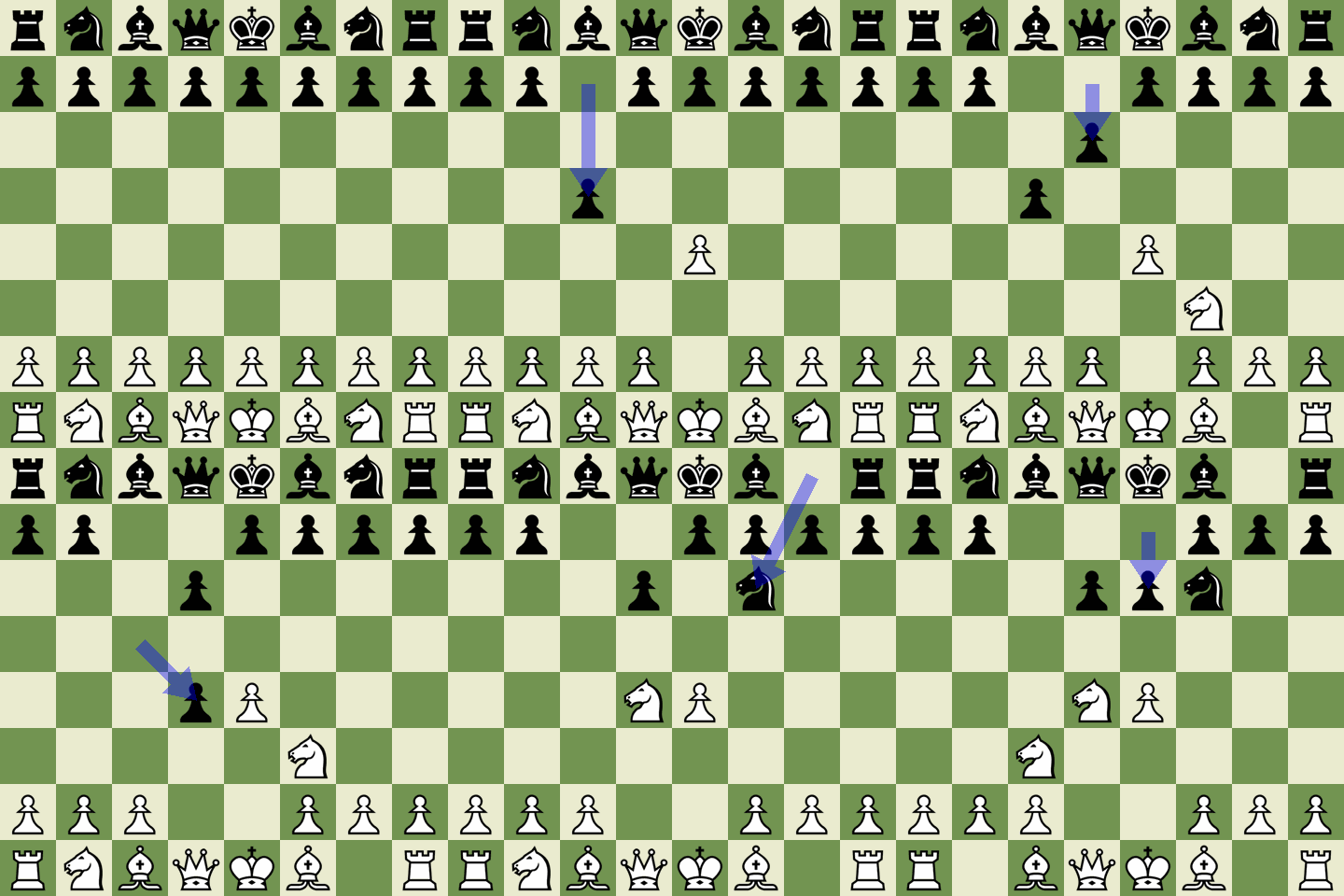
The Sicilian Defense: Scheveningen Variation arises after 1.e4 c5 2.Nf3 d6 3.d4 cxd4 4.Nxd4 Nf6 5.Nc3 e6 and falls under ECO code B80. The hallmark of the Scheveningen is 5...e6, establishing a compact "small center" that reinforces Black's grip on the critical d5 square and clears e7 for the dark-squared bishop's development. If Black can eventually achieve a safe ...d5 advance, the resulting position is very comfortable. Compared to the Najdorf (5...a6), the Scheveningen commits Black to a specific central pawn formation sooner and postpones queenside activity, but in return it accelerates piece development and castling. Both systems are regarded as highly reliable for Black, though even dedicated Scheveningen practitioners — Garry Kasparov among them — have sometimes preferred 5...a6 to sidestep the dangerous Keres Attack (5...e6 6. g4!), which, while not outright winning for White, produces statistics that heavily favor the first player. With 1.9 million Lichess games across all rating levels, it is a well-established opening choice.
- Pawns on e6 and d6 give Black a modest small centre: a solid defensive barrier that holds the critical d5 and e5 squares while staying flexible.
- Black keeps the pawn breaks ...e5 and ...d5 in reserve and in the main lines looks for counterplay on the queenside.
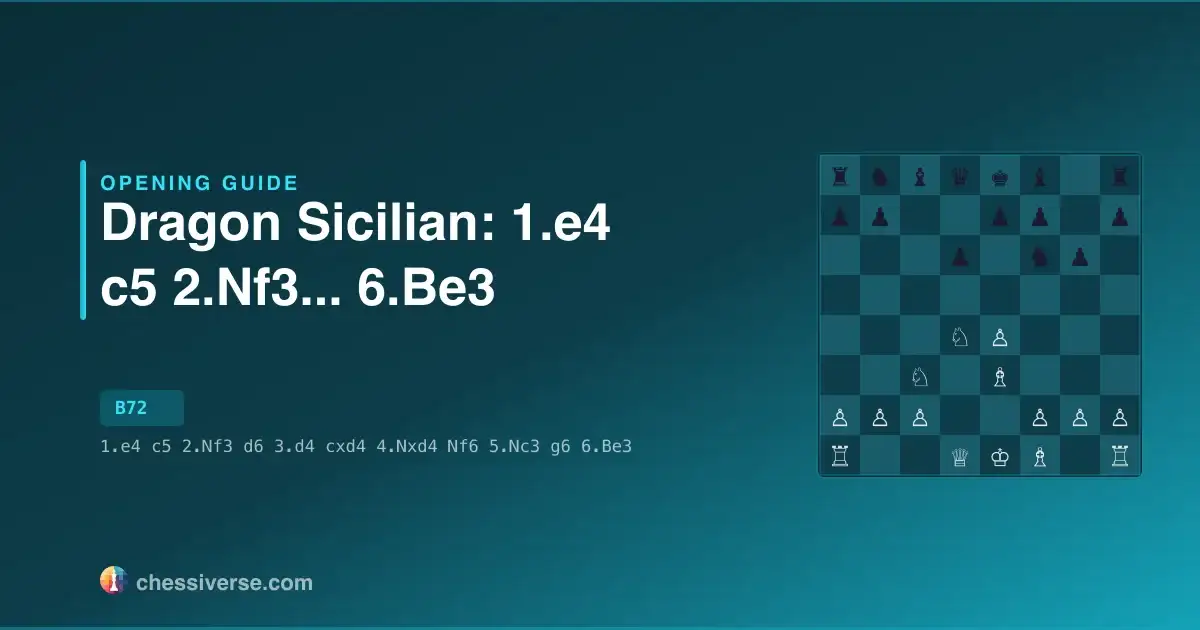
- White often attacks on the kingside with pawn storms, most dangerously via the Keres Attack 6.g4, or the heavily analysed English Attack with 6.Be3.
History and Notable Players
It arises from the Sicilian Defense (2.Nf3). Among the most prolific practitioners on the White side are Robert Zelcic (44 games), Efim Geller (36 games), Aleksandar Matanovic (35 games). On the Black side, notable exponents include Mihai Suba (209 games), Gyula Sax (156 games), Andrei Sokolov (137 games).
The setup drew international notice at the 1923 tournament in Scheveningen, where several players including Max Euwe adopted it, and it grew popular through the 1920s. Many distinguished grandmasters have advocated it since, Garry Kasparov among them. The opening offers Black sound chances and plenty of scope for creativity.
Named after: The Dutch seaside village of Scheveningen near The Hague, where the variation drew international notice at a 1923 tournament.
Notable players: Max Euwe, Garry Kasparov
The variation is named for a place rather than a player: a seaside village on the North Sea coast near The Hague, host of the 1923 tournament where the system first drew international notice.
Statistics
Based on 1.9 million Lichess games across all rating levels:
- White wins: 47.3%
- Black wins: 48%
- Draws: 4.7%
The statistics show a roughly balanced opening where both sides have equal chances.
Main Lines and Variations
After 1.e4 c5 2.Nf3 d6 3.d4 cxd4 4.Nxd4 Nf6 5.Nc3 e6, the main continuations include:
- Sicilian Defense: Scheveningen Variation, Keres Attack
- Sicilian Defense: Scheveningen Variation, Matanovic Attack
- Sicilian Defense: Scheveningen Variation, Classical Variation
- Sicilian Defense: Sozin Attack
Each of these lines leads to distinct types of positions and requires its own understanding of the resulting pawn structures and piece placements.
Practice on Chessiverse
The best way to learn the Sicilian Defense: Scheveningen Variation is through practice. On Chessiverse, you can play chess against computer opponents that specialize in this opening. Our AI bots range from beginner to grandmaster level, each with unique playing styles — from aggressive attackers to solid defenders. Choose a bot that matches your rating and work your way up as you master the opening's key ideas.
Performance Across Rating Levels
How well the Sicilian Defense: Scheveningen Variation works depends on what level you're playing at. The 1200 bracket has 56,844 games (0.01% of all games at that level); White wins 47%, Black 49.4%, 3.6% are drawn. Move up to 1800 Elo and the share shifts to 0.07%, with White winning 47.1% versus Black's 48.3%. At the top end (2500+ Elo), popularity is 0.11% with 8.2% draws — a clear sign of how much theory rules the line at master level.
Time Control Patterns
Time control matters here: blitz players reach for this opening more than others. In bullet, it appears in 0.04% of games (1,079,006); White wins 47.3%. Blitz shows 0.05% adoption across 1,643,025 games, White scoring 47.4%. In rapid, the share rises to 0.03% — 277,044 games, White 46.7%.
Move Diversity and Theory Depth
Move choice is far from uniform in the Sicilian Defense: Scheveningen Variation. At 1200 Elo (56,844 games), the top reply is Bg5, played 34.2% of the time. Four other moves each take at least 5% of games, and the top three moves account for 64% of games. Entropy: 2.85. By 2500 (15,664 games), g4 takes over as the top reply at 45.7%; four other moves reach 5% and the top three moves account for 71.1% of games. Entropy drops to 2.56.
Historical Trends
Tracking the Sicilian Defense: Scheveningen Variation year over year shows a clear story. Adoption peaked in 2016 at 0.06% (34,886 games). By 2025 it sits at 0.03%, 47% below the peak and 40% under its 2013 level, leaving the line in decline.