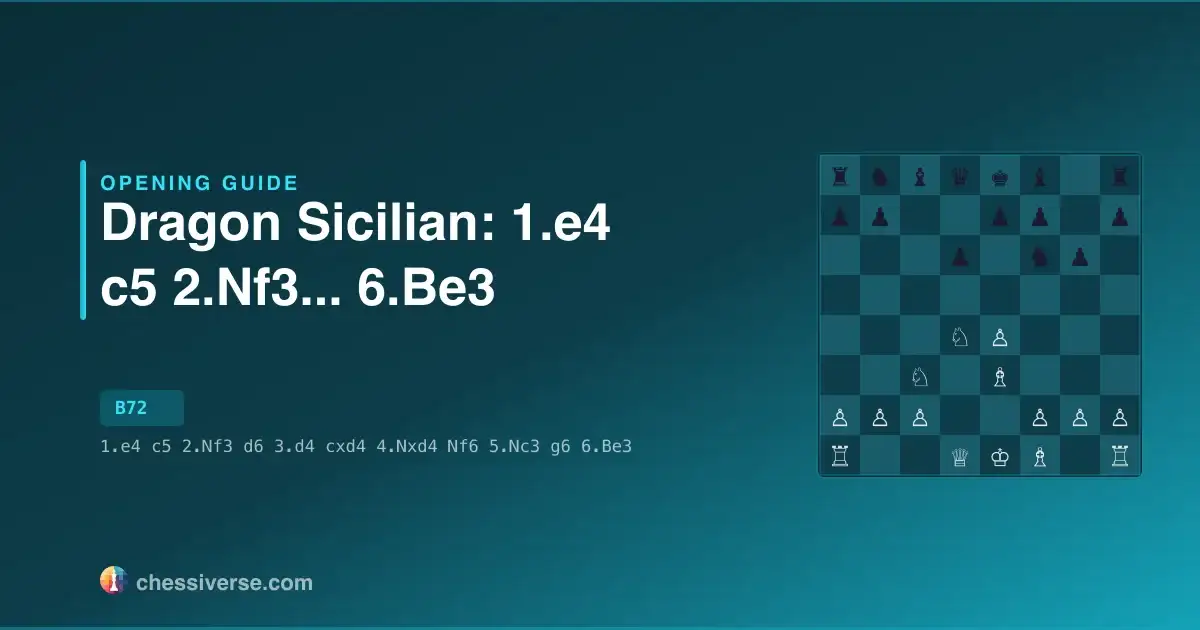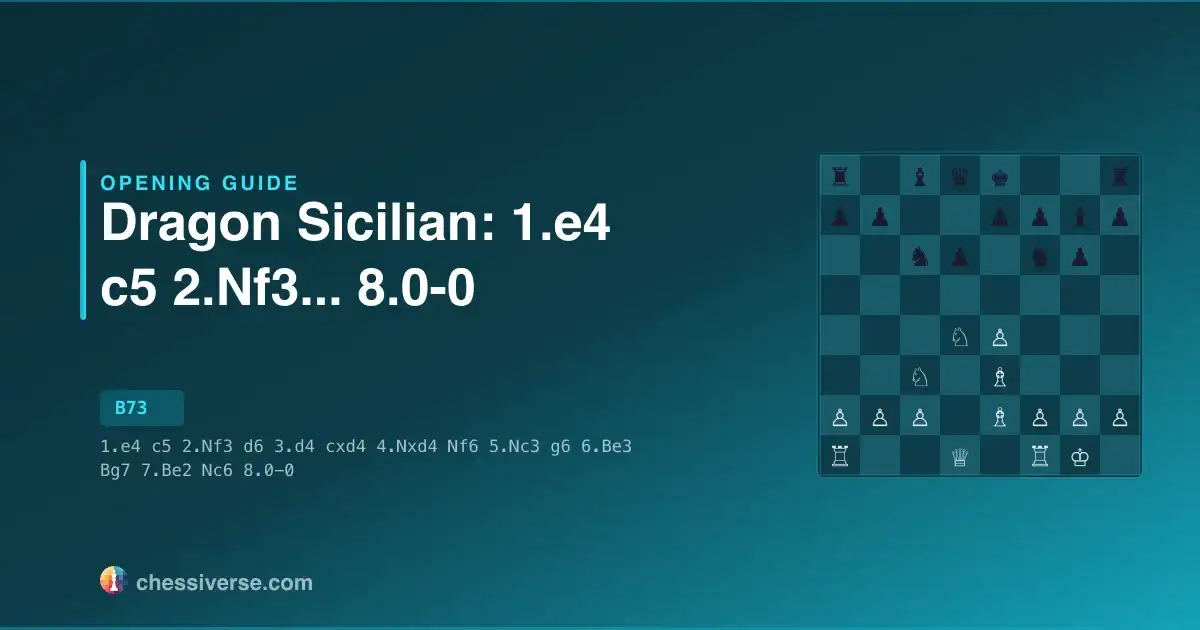




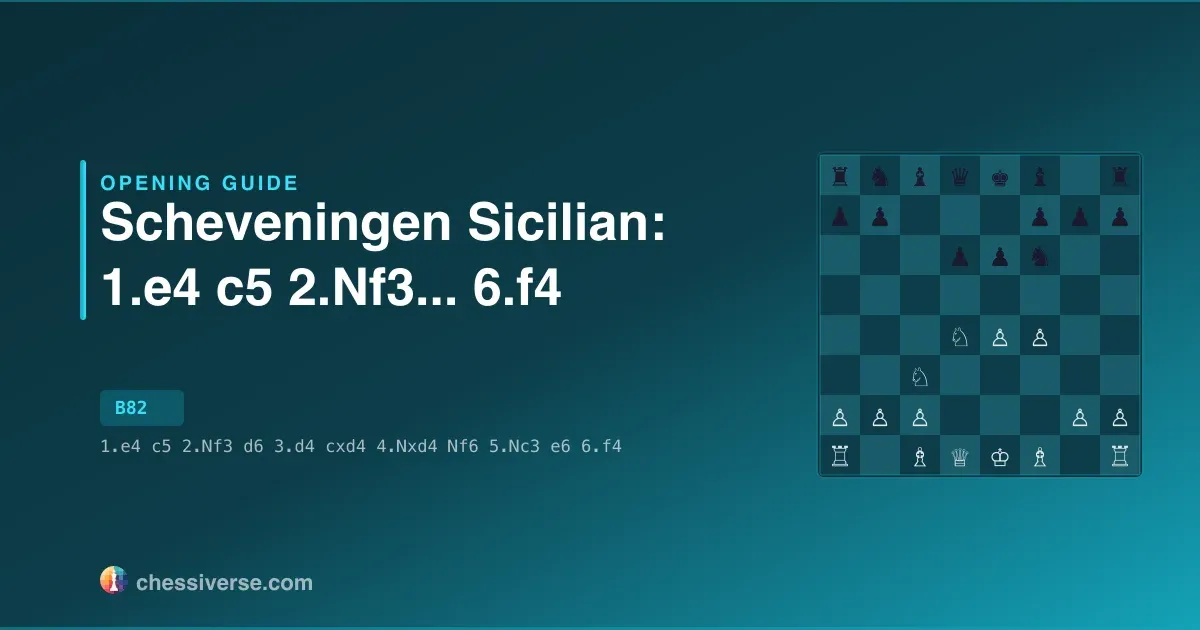
The Sicilian Defense: Scheveningen Variation, Matanovic Attack begins with 1.e4 c5 2.Nf3 d6 3.d4 cxd4 4.Nxd4 Nf6 5.Nc3 e6 6.f4 (ECO B82). Lichess records 86,692 games in this line, which gives us a reliable view of how it actually performs in practice.
History and Notable Players
It arises from the Sicilian Defense: Scheveningen Variation. On the White side, Alexey S Suetin (16 games), John TH Van der Wiel (15 games), Ralf Lau (14 games) top the database. Notable Black exponents: Mihai Suba (23 games), Vlastimil Jansa (17 games), Uwe Boensch (15 games).
Move Diversity and Theory Depth
Looking at move selection shows how forcing — or not — the position really is. At 1200 Elo (2,959 games), the top reply is Be7, played 35.5% of the time. Three other moves each take at least 5% of games, and the top three moves account for 74.3% of games. Entropy: 2.60. By 2500 (589 games), a6 takes over as the top reply at 34.3%; only two other moves still reach 5% and the top three moves account for 95.6% of games. Entropy drops to 1.84. The narrowing is significant — strong players consolidate around a small set of best moves, while amateurs scatter across many plausible-looking options.
Common Mistakes
- Drifting away from main theory — At 400 Elo, the three most-played moves cover 65.1% of games, against 94.1% at 2000. The most popular deviation is e5 (played 15.8% of the time at 400, much less so up top). It looks fine but quietly hands the better-prepared side an edge.
- Neglecting development — Extra pawn moves in the opening are tempting, especially when you "know the moves". Developing a piece each turn is the simple correction.
- Ignoring the kingside attack — In sharp Sicilian lines, White typically castles long and pushes the h-pawn. Without your own counterplay on the queenside or in the centre, White's attack lands first.
Practice on Chessiverse
Ready to try the Sicilian Defense: Scheveningen Variation, Matanovic Attack against a bot? Pick an opponent at your level and play a game.